


Premier Liu Chao-shiuan (劉兆玄) on March 24 announced a plan to draft an ethnic equality act amid uproar caused by former Toronto-based Government Information Office staffer Kuo Kuan-ying’s (郭冠英) articles defaming Taiwan and Taiwanese.
However, analysts disagree on whether such legislation would be necessary.
Shih Cheng-feng (施正峰), dean of the College of Indigenous Studies at National Dong Hwa University, said such an act would be significant even though it would be impossible for the act to root out discrimination in the country.
“At least such an act would be able to curb provocative remarks,” Shih said, adding that countries in the West had enacted similar laws in the 1970s and 1980s.
Shih said the proposed legislation should clearly list behavior considered discriminatory, although he said it would be difficult to detail every potential discriminatory act. He also supported introducing severe criminal punishment in the act, saying it would be the most effective way to sanction those who discriminate against people from different ethnic backgrounds.
Chiou Chang-tay (丘昌泰), a professor at the Department of Public Administration and Policy at National Taipei University, disagreed, saying that legislation should be “the last resort” in attempts to curb discrimination.
“We are too confident that enacting a law would be the solution to everything,” said Chiou, former chairman of the Graduate Institute of Hakka Politics and Economics at National Central University. “Many countries rely on moral education instead [when pursuing ethnic harmony] ... Respecting each other should be a very basic everyday attitude.”
Chiou said that including more ethnic education in the elementary school curriculum would be a more suitable approach.
Legislative records show that the idea of an ethnic equality act was first proposed by then-Taiwan Solidarity Union legislator Lo Chih-ming (羅志明) and eight other lawmakers across party lines on April 2, 2003, in a bid to reinforce the Constitution’s anti-discrimination spirit and promote ethnic harmony.
However, the bill did not clear the legislative floor because lawmakers failed to reach a consensus on the proposal.
Different versions of an ethnic equality act were proposed by caucuses during the next few sessions, but none of them were approved by the legislature.
On Sept. 22, 2004, then-People First Party legislators Lin Cheng-yi (林政義) and Shen Chih-hwei (沈智慧) proposed an anti-ethnic discrimination act that sought to punish anyone who discriminated against a specific ethnic group with hostile, humiliating, offensive or threatening language, pictures or behavior to a maximum of five years in prison and/or a maximum fine of NT$500,000 (US$15,000). However, the legislature also failed to pass this bill before the end of the fall legislative session in 2004.
An ethnic equality act proposed by Chinese Nationalist Party (KMT) Legislator Lu Shiow-yen (盧秀燕) and six other KMT legislators on Oct. 22 last year is currently awaiting preliminary review by the Internal Administration Committee.
The proposal defines an ethnic community as a group or community that is aware that they have a different history, origin, culture and living environment from other groups.
It defines discrimination as any act of exclusion, harassment, restriction or preferential treatment based on ethnic differences that is intended to or that results in hurting or eliminating political, economic, social, cultural or civil rights.
The bill proposes that different government branches establish their own ethnic equality committees composed of academics and experts from different ethnic groups and authorize the committees to investigate allegations of racial discrimination.
The bill stipulates that anyone has the right to request an end to and compensation for discriminatory language, news reports, advertisements, political talk show content or any other form of intentional discrimination.
Unlike previous proposals, the bill introduces a two-year jail term or a NT$1,000 fine for those who “fuel discrimination.”
Although Liu had indicated his determination to push through the bill, Chiou said he was concerned whether the government would be able to actually carry out the proposed regulations.
“First of all, it would be difficult for people investigating a racial discrimination case to reach a consensus because of their different ethnic backgrounds,” Chiou said.
Without thorough planning, the proposal could end up being almost impossible to carry out, like the Political Donation Act (政治獻金法) or the Lobby Act (遊說法), Chiou said.
Association of Mainlander Taiwanese chief executive Huang Luo-fei (黃洛斐) voiced similar views.
“There are many historical and cultural factors behind the problem of ethnic inequality [in Taiwan]. It would be difficult to resolve ethnic issues by enacting a law,” Huang said.
She said that it would be tough to draw boundaries between different ethnic groups and that she favored an anti-discrimination act aimed at tackling discrimination based on factors such as gender.
She was also concerned about the KMT’s proposed punishment for those who “fuel discrimination” as it remained unclear in the bill what constituted the provocation of discrimination.
“For example, the language [used by politicians] to mobilize supporters of a certain ethnic community to vote for them ... Should it be considered discrimination?” she said.
“There could be controversy regarding what remarks or behavior should be considered discriminatory because it involves the second party’s feelings,” she said.
Huang was also against the KMT’s proposal that would allow different government branches to set up their own ethnic equality committees.
The government should integrate the functions and power of the committees and establish a national human rights commission, she said.
“The government should not hastily enact the law in response to Kuo’s case ... [without proper legislation], as we might see a lot of ethnic lawsuits and this would not help ensure peace between different ethnic communities [in Taiwan],” she said.

An increase in Taiwanese boats using China-made automatic identification systems (AIS) could confuse coast guards patrolling waters off Taiwan’s southwest coast and become a loophole in the national security system, sources familiar with the matter said yesterday. Taiwan ADIZ, a Facebook page created by enthusiasts who monitor Chinese military activities in airspace and waters off Taiwan’s southwest coast, on Saturday identified what seemed to be a Chinese cargo container ship near Penghu County. The Coast Guard Administration went to the location after receiving the tip and found that it was a Taiwanese yacht, which had a Chinese AIS installed. Similar instances had also

GOOD DIPLOMACY: The KMT has maintained close contact with representative offices in Taiwan and had extended an invitation to Russia as well, the KMT said The Chinese Nationalist Party (KMT) would “appropriately handle” the fallout from an invitation it had extended to Russia’s representative to Taipei to attend its international banquet last month, KMT Chairman Eric Chu (朱立倫) said yesterday. US and EU representatives in Taiwan boycotted the event, and only later agreed to attend after the KMT rescinded its invitation to the Russian representative. The KMT has maintained long-term close contact with all representative offices and embassies in Taiwan, and had extended the invitation as a practice of good diplomacy, Chu said. “Some EU countries have expressed their opinions of Russia, and the KMT respects that,” he

AMENDMENT: Contact with certain individuals in China, Hong Kong and Macau must be reported, and failure to comply could result in a prison sentence, the proposal stated The Chinese Nationalist Party (KMT) and the Taiwan People’s Party (TPP) yesterday voted against a proposed bill by Democratic Progressive Party (DPP) lawmakers that would require elected officials to seek approval before visiting China. DPP Legislator Puma Shen’s (沈伯洋) proposed amendments to the Act Governing Relations Between the People of the Taiwan Area and the Mainland Area (臺灣地區與大陸地區人民關係條例), stipulate that contact with certain individuals in China, Hong Kong and Macau should be reported, while failure to comply would be punishable by prison sentences of up to three years, alongside a fine of NT$10 million (US$309,041). Fifty-six voted with the TPP in opposition
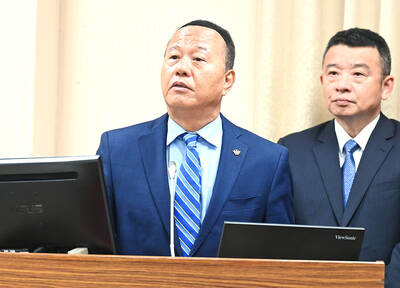
VIGILANCE: The military is paying close attention to actions that might damage peace and stability in the region, the deputy minister of national defense said The People’s Republic of China (PRC) might consider initiating a hack on Taiwanese networks on May 20, the day of the inauguration ceremony of president-elect William Lai (賴清德), sources familiar with cross-strait issues said. While US Secretary of State Anthony Blinken’s statement of the US expectation “that all sides will conduct themselves with restraint and prudence in the period ahead” would prevent military actions by China, Beijing could still try to sabotage Taiwan’s inauguration ceremony, the source said. China might gain access to the video screens outside of the Presidential Office Building and display embarrassing messages from Beijing, such as congratulating Lai


 RSS
RSS