


US President Barack Obama and Chinese President Hu Jintao (胡錦濤) ended their first face-to-face meeting — at the G20 summit in London this week — with barely a mention of the “elephant in the room”: Taiwan.
Analysts said later it demonstrated, more than anything else, that both sides were determined to make progress on other issues and put their biggest “sticking point” on the back burner.
One US insider told the Taipei Times that when Taiwan came up as an item on the agenda, Hu simply recited the “one China” policy and Obama made almost no comment as the conversation moved on to the next issue.
Both sides agreed to hold a two to three-day annual meeting — called the Strategic and Economic Dialogue — this summer, which would include a detailed discussion on Taiwan.
US Secretary of State Hillary Clinton and Secretary of the Treasury Timothy Geithner will head the US team at this meeting, while Vice Premier Wang Qishan (王岐山) and State Councilor Dai Bingguo (戴秉國) will represent China.
A well-placed US source said that both sides agreed in advance of the London meeting that because they were unlikely to make any progress on the Taiwan question, it was best to put it aside rather than allow it to dominate discussions and become an obstacle to progress on other issues.
The source said this may indicate that Taiwan has slipped as a subject of great interest and importance to the White House and that it is regarded as just one contentious issue among many in a thorny Beijing relationship that Obama is determined to improve.
In a background briefing for US reporters, a senior Obama administration official said following the London meeting that the two presidents discussed “a range of international issues — notably North Korea, Iran, Pakistan, Afghanistan and Sudan. They also discussed human rights in Tibet and Taiwan.”
Pressed for details about what was said on Tibet and Taiwan, the official answered: “The president made clear that we're going to not only talk about things on which we agree, but also things on which we disagree, that we care deeply about human rights. And he made clear our concerns about human rights in Tibet and our hopes that China will make progress.”
At the end of the briefing when it was pointed out that the official seemed to have gone out of his way to avoid any comment on Taiwan, another senior source said: “Not at all, we also hope to make progress on Taiwan.”
“President Obama's approach on China is marked by pragmatism, by a non-ideological approach, a belief that this is a critical relationship for addressing and resolving global issues, starting with the international economic and financial crisis, but also things like North Korea, Iran, Pakistan and Afghanistan and climate change,” the official said.
Asked about the Strategic and Economic Dialogue this summer at which Taiwan will be discussed, the official said: “The goal will be to build a common approach on the major issues in the relationship. It's about communication at a high level. It's not a short-term problem-solving mechanism.”
“It's more about trying to have more in-depth discussions on both the political and economic side so we understand each other's way of thinking better and build over the long-term serious solutions to problems,” the official said.
The overall approach appears to be a striking departure from that adopted by the former administration of US president George W Bush.
In meetings with the Chinese during the Bush administration, Taiwan was always discussed in depth even though there was little agreement.
Still, officials insisted that the Obama-Hu meeting was “business-like.”
“They had an hour meeting with translation and had a lot of issues to cover. They went through pretty much all of the major issues that one would expect. In these meetings there is not time to do much else,” one official said.
“I think the atmosphere of the meeting was good. Keep in mind, this is the first time these gentlemen have met. Obama agreed to visit China in the second half of this year and will almost certainly expand the trip to call on Japan, South Korea and Indonesia,” the official said.
“The two presidents agreed to fight protectionism and work to improve military ties and Admiral Gary Roughead, US Chief of Naval Operations, will visit China this month to attend events for the 60th anniversary of the PLA [People's Liberation Army],” the official said.
“The two sides agreed to maintain close communications and coordination and to work together for the settlement of conflicts and reduction of tensions,” a joint statement said.
A Washington-based analyst said that the “Obama administration wants to avoid any discussion with China on Taiwan. They are not prepared to push the established policies. The Chinese must hope that Washington will be prepared to compromise at the meeting this summer.”
“At the meeting in London the Americans didn't want to spoil the honeymoon euphoria,” another analyst said. “And so they said little or nothing about Taiwan.”
“Everyone could see the elephant in the room, but nobody wanted to mention it,” the analyst said.

The Ministry of Finance this afternoon announced the winning numbers for the March-April uniform invoice lottery. The winning number for the NT$10 million (US$318,060) special prize is 19531471, and the winning number for the NT$2 million grand prize is 85941329. Three numbers were drawn for the NT$200,000 first prize: 07225810, 20231230 and 83518781. Those with receipts matching the last seven digits of any of the first-prize numbers will win the NT$40,000 second prize, while those matching the last six digits will win the NT$10,000 third prize. Those whose receipts match the last five digits of the first-prize numbers can claim the NT$4,000 fourth prize,
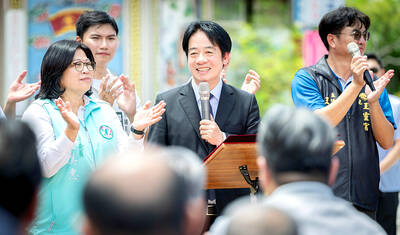
SIX SUBSIDIES: The monthly allowance for older farmers is to increase to NT$10,000, and NT$5,000 is to be given to homemakers under the national pension system, Lai said The government is to implement major welfare policies for disadvantaged groups, including raising the monthly allowance for older farmers to NT$10,000 and providing homemakers with NT$5,000 per month, President William Lai (賴清德) said yesterday. Lai made the remarks during a visit to Wangling Temple in Chiayi County, saying that the planned increases were being introduced amid economic growth and an increase in tax revenue. Touting a policy, in which the government plans to provide a monthly allowance of NT$5,000 for every child under the age of 18 in a bid to address Taiwan’s low birthrate, Lai said that if received for the
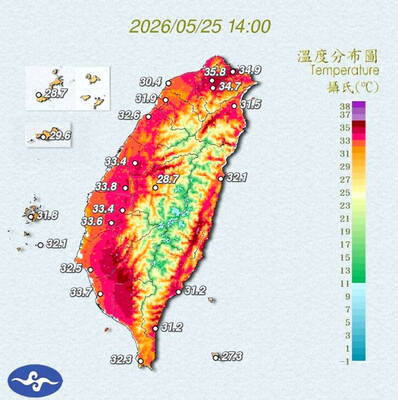
STAY COOL: The HPA recommended that people stay hydrated, use air-conditioning or fans while indoors, wear loose-fitting clothes and walk in the shade while outdoors Employers must implement measures such as installing cooling equipment, and providing drinking water and rest breaks for outdoor workers starting from Monday next week, the Taipei Department of Labor said on Sunday. Employers who fail to comply could face fines of NT$30,000 to NT$300,000 under the Occupational Safety and Health Act (職業安全衛生法), the department said. Businesses in Taipei employing fewer than 100 workers, as well as registered self-employed workers with labor insurance coverage, could receive on-site assessments and guidance from occupational safety consultants to help them apply for central government subsidies to implement or improve heat-protection measures, it said. Under the Ministry of

NATIONAL SECURITY: Authorities are working to confirm the identities of the military personnel involved and investigating possible illegal conduct and regulatory violations Authorities are probing possible national security implications after Kinmen police and immigration officers on Sunday found a Chinese woman allegedly posing as a tourist while engaging in prostitution involving more than 10 military personnel. The woman, surnamed Chen (陳), has since been deported, authorities said, adding that investigators are still working to confirm the identities of those implicated, as the records only listed code names and aliases. The case stemmed from a report received by the Kinmen District Prosecutors’ Office on Friday last week from the Jinhu Precinct of the Kinmen County Police Bureau. On Sunday, police, along with the National Immigration


 RSS
RSS