


Visitors to Taipei’s Confucius Temple in Datong District (大同) have recently had the opportunity to watch traditional rituals that are rarely performed except on Confucius Day and other major ceremonies.
Since last month a simplified version of the Yayue dance (雅樂), an ancient sacrificial rite to honor Confucius, has been performed every Saturday as part of the temple’s latest effort to promote Confucianism and traditional culture.
The full ceremony, which follows ancient rules with 33 steps in sequence and lasts for about 60 minutes, is only performed on Sept. 28 each year in celebration of Confucius’ birthday with a limited number of residents and tourists allowed to participate.
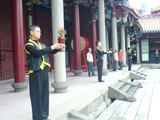
PHOTO: MO YAN-CHIH, TAIPEI TIMES
Seeking to vitalize the ceremony and make the ritual more accessible, the temple has invited more than 40 volunteers to practice the rites and perform the dance at the Da Cheng Palace (大成殿) from 9am to 9:30am every Saturday morning.
“Taipei Confucius Temple seeks to promote Confucianism in modern times, and performing the dance, which represents an ancient form of education in nurturing the body and mind, makes Confucius’ teachings more accessible to people,” said Shih Shu-li (施淑梨), the temple’s executive secretary.
The shortened version of the rites begins with performers standing at the corners of the palace holding food, wine and flowers. Then, in time with a solemn bell and drumbeat, the performers walk a straight line to the center of the palace and present the sacrifices to the great philosopher using small, slow steps.
The volunteers, ranging from college students and housewives to retired teachers, did not have previous experience performing the rites. In order to give a perfect performance, they spend two nights a week practicing.
“The dance stresses the balance of all body parts, and is also great practice for the mind, helping you stay calm and focused,” said Kuo Han (郭瀚), the volunteers’ teacher.
Shih said the temple hopes to present a longer version of the ceremony with a multi-lingual guide for visitors in the near future.
Starting with the regular performances, the temple has also presented a series of events to promote Confucianism and traditional culture following the Spring Ceremony earlier this month and will also hold a blessing ceremony in May for candidates getting ready for their school entrance exams, she said.
The temple also designed dolls of Confucius and other Chinese deities two years ago to modernize the temple’s image and solicit support from younger generations. The cute deities have become popular items in the gift shop, Shih said.
Another attempt to promote traditional culture in a modern way is the free weekend Chinese classics program for elementary school students that began several years ago.
The program has attracted hundreds of children to study Chinese literary classics ranging from the teachings of Confucius to poetry from the Tang Dynasty.
The teaching and promotion of Confucian philosophy in Taiwan has sparked some controversy in recent years as the former Democratic Progressive Party government reduced the number of school lessons in Chinese classics and put more effort into promoting Taiwanese literature and culture.
Winnie Wang (王素珠), a mother of two, brushed off the controversy over Confucianism as she waited for her two sons outside the Tang poetry chanting class last Saturday.
“I want my children to learn Chinese literature and moral values through the program, but it doesn’t mean that we are against localization. The two things coexist,” she said.
Shih said Confucius encouraged diversity in education and stood for a harmonious society and would not oppose the development of any language or culture.
In response to the growing emphasis on localization, the Taipei City Government initiated an effort to establish regulations in 2005 to honor those who made great contributions to education and culture in Taipei City.
Chen Wei-ying (陳維英), a local teacher in Datung who dedicated his life to building schools and promoting education in the area in the 18th century, became the first person honored at an ancestral shrine in the temple in 2006.
Similar efforts to give formal recognition to the contributions of local educators are also planned for Confucius temples in Hsinchu and Changhua, Shih said.
He added that Taipei Confucius Temple will continue its efforts to strike a balance between Chinese culture and localization.
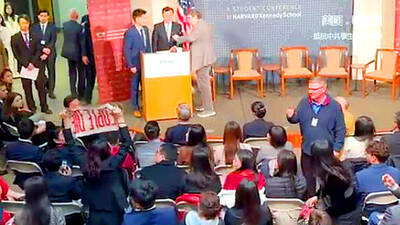
A group of Taiwanese-American and Tibetan-American students at Harvard University on Saturday disrupted Chinese Ambassador to the US Xie Feng’s (謝鋒) speech at the school, accusing him of being responsible for numerous human rights violations. Four students — two Taiwanese Americans and two from Tibet — held up banners inside a conference hall where Xie was delivering a speech at the opening ceremony of the Harvard Kennedy School China Conference 2024. In a video clip provided by the Coalition of Students Resisting the CCP (Chinese Communist Party), Taiwanese-American Cosette Wu (吳亭樺) and Tibetan-American Tsering Yangchen are seen holding banners that together read:

UNAWARE: Many people sit for long hours every day and eat unhealthy foods, putting them at greater risk of developing one of the ‘three highs,’ an expert said More than 30 percent of adults aged 40 or older who underwent a government-funded health exam were unaware they had at least one of the “three highs” — high blood pressure, high blood lipids or high blood sugar, the Health Promotion Administration (HPA) said yesterday. Among adults aged 40 or older who said they did not have any of the “three highs” before taking the health exam, more than 30 percent were found to have at least one of them, Adult Preventive Health Examination Service data from 2022 showed. People with long-term medical conditions such as hypertension or diabetes usually do not
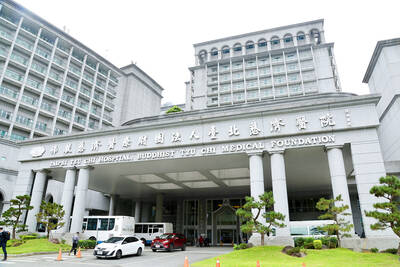
POLICE INVESTIGATING: A man said he quit his job as a nurse at Taipei Tzu Chi Hospital as he had been ‘disgusted’ by the behavior of his colleagues A man yesterday morning wrote online that he had witnessed nurses taking photographs and touching anesthetized patients inappropriately in Taipei Tzu Chi Hospital’s operating theaters. The man surnamed Huang (黃) wrote on the Professional Technology Temple bulletin board that during his six-month stint as a nurse at the hospital, he had seen nurses taking pictures of patients, including of their private parts, after they were anesthetized. Some nurses had also touched patients inappropriately and children were among those photographed, he said. Huang said this “disgusted” him “so much” that “he felt the need to reveal these unethical acts in the operating theater
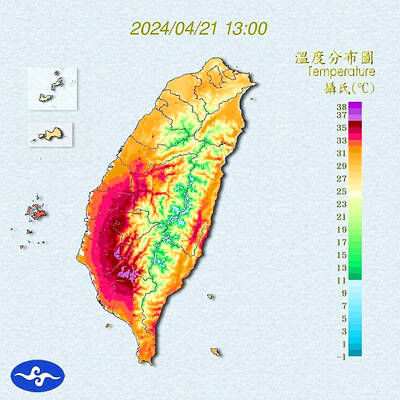
Heat advisories were in effect for nine administrative regions yesterday afternoon as warm southwesterly winds pushed temperatures above 38°C in parts of southern Taiwan, the Central Weather Administration (CWA) said. As of 3:30pm yesterday, Tainan’s Yujing District (玉井) had recorded the day’s highest temperature of 39.7°C, though the measurement will not be included in Taiwan’s official heat records since Yujing is an automatic rather than manually operated weather station, the CWA said. Highs recorded in other areas were 38.7°C in Kaohsiung’s Neimen District (內門), 38.2°C in Chiayi City and 38.1°C in Pingtung’s Sandimen Township (三地門), CWA data showed. The spell of scorching


 RSS
RSS