


President Ma Ying-jeou (馬英九) yesterday pledged to improve diplomatic ties with the nation’s allies as it was reported that El Salvador was moving to establish ties with China.
He said that the government would not recognize diplomatic ties between Taiwan’s allies and China.
“Dual recognition is not what we are pursuing. The government will focus its efforts on strengthening ties with its allies,” Ma told reporters at the Presidential Office.
Salvadoran president-elect Mauricio Funes has repeatedly promised to switch ties to Beijing upon taking office in June.
Ma said more and more countries in Latin America were electing leftist national leaders, but his administration would seek to maintain ties with existing allies, regardless of their political ideology.
“Our diplomatic truce with the mainland does not mean that we are having a diplomatic vacation and it certainly doesn’t mean a diplomatic coma. We will continue strengthening ties with our allies and promoting relations with non-allies,” he said.
In discussing the nation’s bid for an observership at the World Health Assembly (WHA) in May, the president promised to defend Taiwan’s sovereignty while seeking the observer status.
Ma said the government would apply for observer status under the name “Republic of China,” “Taiwan” or “Chinese Taipei,” and insisted that the nation would not join international organizations as part of China.
“Of course we will not return to international society as part of mainland China because it would be belittling our sovereignty ... We will not sacrifice our sovereignty and national dignity in return for participation in international organizations,” Ma said.
When asked to comment on his previous remarks that the government would conduct negotiations with China at an undisclosed location outside of Taiwan next month about the WHA bid, Ma declined to elaborate on the issue, but said the government would make public the negotiation results at a proper time.
The president defended his “diplomatic truce” with China and his flexible diplomacy policy, saying he was confident that these policies were having a positive impact on cross-strait relations.
Ma said the issue regarding Taiwan’s participation in the WHA should be handled under the “1992 consensus,” which pan-blue figures say means “one China, with each side having its own interpretation.”
China’s Taiwan Affairs Office Director Wang Yi (王毅) told CCTV earlier this month that he was “cautiously optimistic” on Taiwan’s bid to join the WHA as an observer.
The WHA, the decision-making body of the WHO, is scheduled to meet from May 18 to May 27 in Geneva, Switzerland.
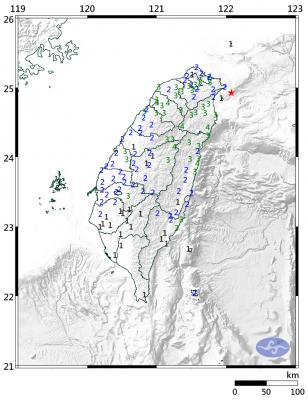
A magnitude 6.1 earthquake struck off the coast of Yilan County at 8:39pm tonight, the Central Weather Administration (CWA) said, with no immediate reports of damage or injuries. The epicenter was 38.7km east-northeast of Yilan County Hall at a focal depth of 98.3km, the CWA’s Seismological Center said. The quake’s maximum intensity, which gauges the actual physical effect of a seismic event, was a level 4 on Taiwan’s 7-tier intensity scale, the center said. That intensity level was recorded in Yilan County’s Nanao Township (南澳), Hsinchu County’s Guansi Township (關西), Nantou County’s Hehuanshan (合歡山) and Hualien County’s Yanliao (鹽寮). An intensity of 3 was
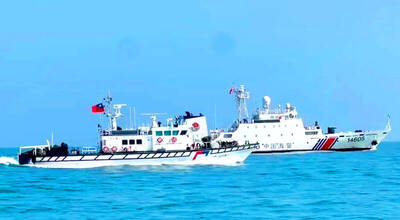
Instead of focusing solely on the threat of a full-scale military invasion, the US and its allies must prepare for a potential Chinese “quarantine” of Taiwan enforced through customs inspections, Stanford University Hoover fellow Eyck Freymann said in a Foreign Affairs article published on Wednesday. China could use various “gray zone” tactics in “reconfiguring the regional and ultimately the global economic order without a war,” said Freymann, who is also a nonresident research fellow at the US Naval War College. China might seize control of Taiwan’s links to the outside world by requiring all flights and ships entering or leaving Taiwan
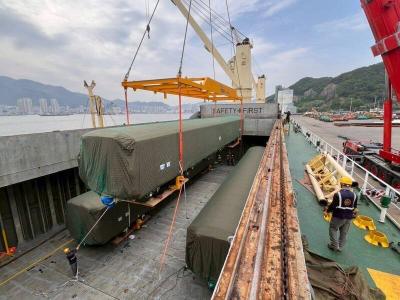
The first of 10 new high-capacity trains purchased from South Korea’s Hyundai Rotem arrived at the Port of Taipei yesterday to meet the demands of an expanding metro network, Taipei Rapid Transit Corp (TRTC) said yesterday. The train completed a three-day, 1,200km voyage from the Port of Masan in South Korea, the company said. Costing NT$590 million (US$18.79 million) each, the new six-carriage trains feature a redesigned interior based on "human-centric" transportation concepts, TRTC said. The design utilizes continuous longitudinal seating to widen the aisles and optimize passenger flow, while also upgrading passenger information displays and driving control systems for a more comfortable
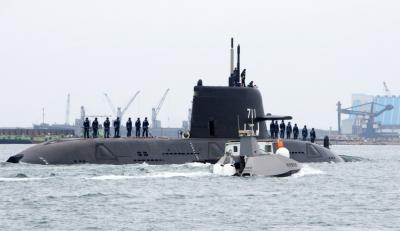
Taiwan's first indigenous defense submarine, the SS-711 Hai Kun (海鯤, or Narwhal), departed for its 13th sea trial at 7am today, marking its seventh submerged test, with delivery to the navy scheduled for July. The outing also marked its first sea deployment since President William Lai (賴清德) boarded the submarine for an inspection on March 19, drawing a crowd of military enthusiasts who gathered to show support. The submarine this morning departed port accompanied by CSBC Corp’s Endeavor Manta (奮進魔鬼魚號) uncrewed surface vessel and a navy M109 assault boat. Amid public interest in key milestones such as torpedo-launching operations and overnight submerged trials,


 RSS
RSS