


The National Geographic Channel received a warning from the National Communications Commission (NCC) last year for broadcasting a documentary involving violence and bloodshed at too early a time, potentially the first governmental penalty the channel has ever received in the 166 nations where the channel is available.
NCC Communications Content Department Director Jason Ho (何吉森) said yesterday that the commission had received quite a few complaints from parents when the channel first broadcast Ou Dede and His Daughters in 2007, a documentary on the Nu Tribe who reside in southwestern China.
Ho said parents complained that their children were terrified after watching the goat-beheading scene in the film, where blood was splattered everywhere. The documentary was broadcast at 1:30pm, Ho said.
“It [beheading the goat] was not a religious ritual and the goat was killed because of a feud between two families,” Ho said. “The scene lasted about two minutes and was not blocked by any mosaics. Neither did the channel warn the audience about the gory scene to come.”
Following the complaints, the NCC turned the case over to an independent media content consulting panel, mainly consisting of media researchers and representatives from non-governmental organizations.
Ho said a majority of the members on the panel ruled that, while the film was a documentary, the channel should still have followed the ratings system and broadcast it at a later hour. The channel then received a warning for violating the regulations on ratings in the Satellite Radio and Television Act (衛星廣播電視法).
Meanwhile, the channel also received a note from the NCC about The Riddles of Dead Diva Mummy, another documentary on the anatomy of a female mummy from the Han Dynasty.
“The documentary explicitly showed the internal organs of the mummy,” Ho said, “The channel did warn the audience about the scene, but members on the panel thought it was more appropriate that the documentary was aired at a later hour.”
Mindy Lee (李敏), marketing director at the channel’s Taiwan office, said National Geographic has been following a strict content review procedure. The decision caught it off guard, she said.
“We try to comply with government regulation as much as possible, especially if the authority in charge is concerned about issues such as this one,” Lee said, adding that they would report the case to the channel’s head office.
Yang Li-chou (楊力州), who won a Golden Horse Award for My Football Summer, a documentary on a junior high school soccer team in Hualien, said that media outlets have to fulfill their responsibility to society. To avoid tampering with creative content, television channels should warn the audience beforehand about the possibility that the content could offend.
Yang, however, objected the use of the mosaics, particularly when the program is dealing with cultural issues.
“Sometimes, mosaics are not just mosaics. They make it look as though you despise and disrespect the value system of a certain culture,” Yang said.
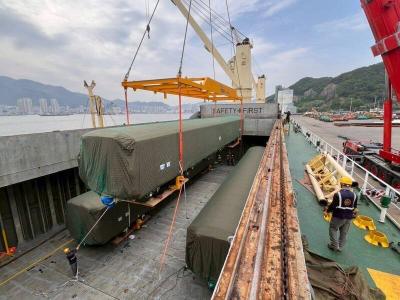
The first of 10 new high-capacity trains purchased from South Korea’s Hyundai Rotem arrived at the Port of Taipei yesterday to meet the demands of an expanding metro network, Taipei Rapid Transit Corp (TRTC) said yesterday. The train completed a three-day, 1,200km voyage from the Port of Masan in South Korea, the company said. Costing NT$590 million (US$18.79 million) each, the new six-carriage trains feature a redesigned interior based on "human-centric" transportation concepts, TRTC said. The design utilizes continuous longitudinal seating to widen the aisles and optimize passenger flow, while also upgrading passenger information displays and driving control systems for a more comfortable

Instead of focusing solely on the threat of a full-scale military invasion, the US and its allies must prepare for a potential Chinese “quarantine” of Taiwan enforced through customs inspections, Stanford University Hoover fellow Eyck Freymann said in a Foreign Affairs article published on Wednesday. China could use various “gray zone” tactics in “reconfiguring the regional and ultimately the global economic order without a war,” said Freymann, who is also a nonresident research fellow at the US Naval War College. China might seize control of Taiwan’s links to the outside world by requiring all flights and ships entering or leaving Taiwan
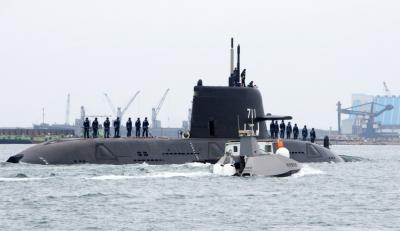
Taiwan's first indigenous defense submarine, the SS-711 Hai Kun (海鯤, or Narwhal), departed for its 13th sea trial at 7am today, marking its seventh submerged test, with delivery to the navy scheduled for July. The outing also marked its first sea deployment since President William Lai (賴清德) boarded the submarine for an inspection on March 19, drawing a crowd of military enthusiasts who gathered to show support. The submarine this morning departed port accompanied by CSBC Corp’s Endeavor Manta (奮進魔鬼魚號) uncrewed surface vessel and a navy M109 assault boat. Amid public interest in key milestones such as torpedo-launching operations and overnight submerged trials,

Quarantine awareness posters at Taiwan Taoyuan International Airport have gone viral for their use of wordplay. Issued by the airport branch of the Animal and Plant Health Inspection Agency, the posters feature sniffer dogs making a range of facial expressions, paired with advisory messages built around homophones. “We update the messages for holidays and campaign needs, periodically refreshing materials to attract people’s attention,” quarantine officials said. “The aim is to use the dogs’ appeal to draw focus to quarantine regulations.” A Japanese traveler visiting Taiwan has posted a photo on X of a poster showing a quarantine dog with a


 RSS
RSS