

The Ministry of Foreign Affairs was unaware that the US had recently said the US-Japan security treaty includes the much-disputed Diaoyutai archipelago in the East China Sea, Department of North American Affairs Director-General Harry Tseng (曾厚仁) said yesterday during a weekly briefing.
The island chain has been a source of contention between Taiwan, Japan and China, which all claim sovereignty over the islands. Last month during his US visit, Japanese Prime Minister Taro Aso said that the Daioyutais, or Senkaku in Japanese, came under the protection of the Treaty of Mutual Cooperation and Security signed by the US and Japan in 1960.
The American Institute in Taiwan (AIT) last week told the Taipei Times that the US Department of State does not take a position on the ultimate sovereignty of the islands, but has clearly stated that the “treaty does apply” to the archipelago.
Tseng, however, said news of the US’ view that the treaty includes the island chain “was not reported back.”
Tseng said it was his understanding that the US continues to abide by its long-standing hands-off position.
He said the reason that MOFA was unaware of the state department’s position was there had been no public announcement and it only existed as a guidance note for dealing with direct questions from reporters.
“I didn’t ask the US for more information on this particular issue,” Tseng said. “For a more thorough explanation of the statement, I would suggest you go and speak to the AIT. The government’s stance is very clear: That we have rightful claim over the Diaoyutais.”
Tseng said one of the main priorities for his department this year was commemorating the 30th anniversary of the signing of the Taiwan Relations Act, a landmark piece of US legislation that serves as the backbone of Taiwan-US ties in the absence of formal diplomatic relations.
Tseng said a series of forums would be held in Washington this month and next month by several US think tanks and two forums would also be held in Taiwan.
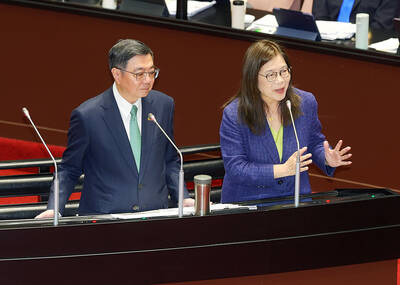
The donation of offshore patrol vessel Kinmen to the Philippines includes provisions that protect Taiwanese fishers and facilitate security cooperation across the First Island Chain, officials said yesterday. The comment was made during the Cabinet’s comprehensive administrative report at the legislature after Chinese Nationalist Party (KMT) Legislator Hsu Yu-chen (許宇甄) expressed concerns about the decision to give a ship to a country whose coast guard had in 2013 fired on a Taiwanese trawler and killed its captain without provocation. The Cabinet should lay out the safeguards that have been established to prevent the Philippine government from using the Kinmen to harass, expel
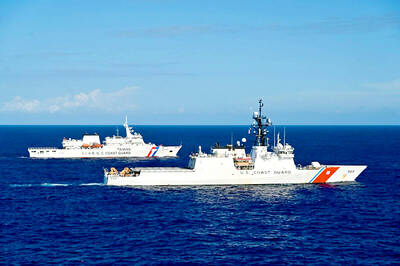
GROWING TIES: The CGA is planning a goodwill mission to the Philippines, in what would be the first time since 1975 a Taiwanese paramilitary vessel has visited the country The Coast Guard Administration (CGA) plans to significantly expand its participation in international security cooperative frameworks and its operational capabilities, a budget proposal for next year showed. The budget indicates a transformation of the CGA from a maritime law enforcement arm into a national defense and intelligence gathering entity capable of tackling larger regional security matters. The proposal showed that personnel from the coast guard’s Intelligence Division and Special Action Support Center are to participate in high-level national security talks with the US. As the CGA has dealt with China’s rising “gray zone” threats around Taiwan, it has become a valuable asset to
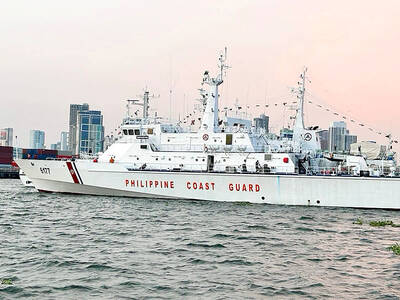
A patrol vessel donated by the Coast Guard Administration (CGA) to the Philippines was commissioned into the Philippine Coast Guard (PCG) on Friday, a Philippine non-governmental organization said. The CGA on Sept. 16 confirmed media reports that Taiwan had donated a retired 500-tonne patrol vessel to the Philippines. The Manila-based We Protect Our Seas (WPS) foundation, which served as an intermediary in the transfer, said that the vessel was formerly the CGA’s 500-tonne petrol vessel Kinmen (CG123). The WPS, in a statement issued on Friday, said the vessel, renamed as the BRP Sarangani, had been commissioned into the PCG the
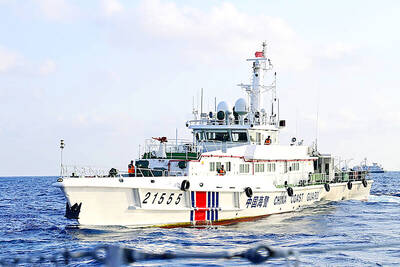
‘GRAY ZONE’ TACTICS: Beijing sent two China Coast Guard vessels to escort a ‘supposedly private research ship,’ a Philippine Coast Guard spokesman said The Coast Guard Administration (CGA) yesterday confirmed that it had recently deployed three patrol vessels to waters in Taiwan’s overlapping exclusive economic zone with the Philippines to monitor three Chinese vessels. CGA Deputy Director-General Hsieh Ching-chin (謝慶欽) said the agency regularly monitors Chinese vessels around Taiwan, and that the deployment south of Oluanpi (鵝鑾鼻), Taiwan proper’s southernmost point, was carried out in accordance with standard procedures. He added that the waters fall within the overlapping exclusive economic zones of Taiwan and the Philippines, which extend 200 nautical miles (370km) from their coastlines. Hsieh made the comments when asked about a


 RSS
RSS