


The Chinese Nationalist Party (KMT) once again dominated the elections for legislative committee heads yesterday after the caucus resolved not to yield any convener seats to the Democratic Progressive Party (DPP).
The KMT took 15 of the 16 seats for committee heads, while the DPP won just one seat.
The DPP, which did not compete for any of the convener seats in the previous session, had expressed an interest in seeking four seats in this session.
DPP caucus whip Ker Chien-ming (柯建銘) said two weeks ago that the legislature should consider assigning the committee head seats to caucuses in accordance with the number of legislative seats each caucus holds.
In cross-party negotiation sessions led by Legislative Speaker Wang Jin-pyng (王金平) to resolve the matter last week, the KMT was only willing to yield a maximum of three seats to the DPP.
KMT caucus secretary-general Yang Chiung-ying (楊瓊瓔) told a press conference that the KMT had done its best to extend goodwill to the DPP.
She urged the DPP caucus to react rationally when reviewing the government’s special budget request to increase infrastructure investment after the committee head elections were over.
DPP Legislator Lee Chun-yee (李俊毅) said in response that since the DPP occupies one-quarter of the seats in the legislature, it should be allocated the same ratio of convener positions.
The DPP caucus regretted the KMT caucus’ unwillingness to yield committee head positions to the DPP, which spoiled the harmony between the two parties in the legislature and meant that the KMT should shoulder the responsibility for any legislative conflicts between the two parties, Lee said.
Following yesterday’s elections, KMT Legislator Wu Yu-sheng (吳育昇), who had served as head of the Internal Administration Committee over the past two legislative sessions, will continue to lead the committee along with KMT Legislator Chang Ching-chung (張慶忠).
The Foreign and National Defense Committee will be led by KMT legislators Shuai Hua-ming (帥化民) and Justin Chou (周守訓).
KMT legislators Ting Shou-chung (丁守中) and Lin Tsang-min (林滄敏) will convene meetings of the Economics Committee, while KMT legislators Chen Chieh (陳杰) and Lai Shyh-bao (賴士葆) will head the Finance Committee.
KMT Legislator Huang Chih-hsiung (黃志雄) will lead the Education and Culture Committee with KMT Legislator Cheng Chin-ling (鄭金玲). KMT legislators Lin Chien-jung (林建榮) and Tsao Erh-chang (曹爾忠) will be responsible for arranging the agenda of the Transportation Committee, while the KMT’s Pan Wei-kang (潘維剛) and Wu Ching-chih (吳清池) will take charge of the Judiciary and Organic Laws and Statutes Committee.
KMT Legislator Liao Kuo-tung (廖國棟) will head the Social Welfare and Environmental Hygiene Committee with DPP Legislator Huang Sue-ying (黃淑英).
ADDITIONAL REPORTING BY RICH CHANG

FUKUOKA SITUATION: Japanese media reported that the pathogen is expected to be identified by the summer, while the CDC downplayed the idea that it was hMPV A “mysterious cold-like illness” reported in Japan’s Fukuoka Prefecture does not seem to be a new disease, but Japanese authorities have been asked about the situation, the Centers for Disease Control (CDC) said yesterday. The Fukuoka Prefectural Medical Association on Wednesday told a news conference that a “mystery cold” that has become a hot topic on social media is “highly likely to be caused by some kind of viral infection,” Japan’s KBC News reported. “Many people are experiencing symptoms starting with a sore throat, followed by a runny nose, phlegm and a severe cough,” KBC News reported, citing association officials. Health authorities are

Nvidia Corp CEO Jensen Huang (黃仁勳) arrived in Taiwan yesterday ahead of upcoming AI and technology events, saying he plans to meet with clients and Taiwan Semiconductor Manufacturing Co Chairman C.C. Wei (魏哲家) during his visit. After landing at Taipei Songshan Airport, Huang posed for photos with fans and handed out Yakult drinks to reporters and supporters waiting at the scene, saying he has “a lot to do” during the trip. Asked about reports that Nvidia’s planned headquarters site in Taipei’s Beitou Shilin Technology Park could break ground on May 27, Huang said that if the company holds an event, he would

The Ministry of Finance this afternoon announced the winning numbers for the March-April uniform invoice lottery. The winning number for the NT$10 million (US$318,060) special prize is 19531471, and the winning number for the NT$2 million grand prize is 85941329. Three numbers were drawn for the NT$200,000 first prize: 07225810, 20231230 and 83518781. Those with receipts matching the last seven digits of any of the first-prize numbers will win the NT$40,000 second prize, while those matching the last six digits will win the NT$10,000 third prize. Those whose receipts match the last five digits of the first-prize numbers can claim the NT$4,000 fourth prize,
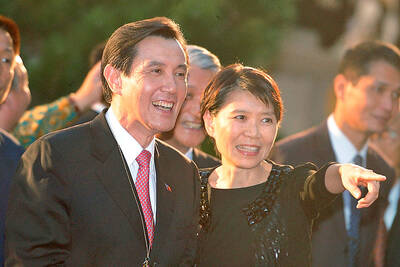
Former president Ma Ying-jeou (馬英九) yesterday expressed “shock and regret” over a statement issued by his wife without his consent, and rejected her assertion that his eldest sister, Ma Yi-nan (馬以南), would manage his medical care or act as his spokesperson amid an ongoing embezzlement probe into his foundation. Ma Ying-jeou in a statement said he was shocked by a statement by his wife, Chou Mei-ching (周美青), regarding his affairs. Ma Yi-nan “must not” be in charge of his healthcare and other personal affairs, nor can she be allowed to represent the Ma family, the former president said. He said he was also


 RSS
RSS