


The Ministry of Foreign Affairs (MOFA) yesterday reiterated Taiwan’s claim of sovereignty over the Diaoyutai island chain.
The MOFA statement came two days after Japanese Prime Minister Taro Aso said during a trip to the US that the island chain was included in a Japan-US security treaty.
The US concurred with Japan, saying that because the archipelago was part of the territories administered by the Japanese government, “the treaty does apply” to the Diaoyutais.
Known as Senkaku in Japanese, the archipelago in the East China Sea has been a bone of contention between China, Japan and Taiwan, who all assert territorial claim over the islands.
On Wednesday, Aso said the Diaoyutai islands were part of Japan’s territory and fell under the protection of the Treaty of Mutual Cooperation and Security signed by Japan and the US in 1960.
“The government will not waiver from the stance that the Diaotyutais are part of Republic of China [ROC] territory. The ROC has rightful claim over the [the island chain],” MOFA Deputy Minister Andrew Hsia (夏立言) said when asked by the press about the issue.
Taiwan’s response came one day after the Chinese Foreign Ministry lodged a vehement protest against Aso’s assertion.
Claims over the island chain have been a constant source of friction between Taiwan and Japan. Last June, a Taiwanese fishing boat was sunk by a Japanese coast guard patrol ship while operating within the disputed region.
The Japanese later apologized for the incident and agreed to pay compensation.
Meanwhile, Hsia said that the 16th round of fisheries talks between Japan and Taiwan currently being held in Taipei would not be affected by the controversy.
“We fully understand both sides hold different views on the Diaoyutai issue. But we also hope that both sides can shelve those differences for now and strive to resolve the fishing rights issue,” he said.
In a telephone interview with the Taipei Times, American Institute in Taiwan press officer Lawrence Walker said: “The US’ position on the issue is longstanding and has not changed.
“The US does not take a position on the ultimate sovereignty of these islands. We expect the claimants to resolve the issue through peaceful means among themselves,” he said.
Walker said that the islands have been under Japanese administrative control since the reversion of Okinawa in 1972. Therefore, Article 5 of the 1960 treaty, which states that it applies to the territories under the administration of Japan, “does apply” to the islands.
Meanwhile, MOFA last night said Japan and Taiwan agreed to resolve the dispute through peaceful means at the conclusion of the 16th round of fishery talks held in Taipei yesterday.
Both sides also agreed to set up a reporting mechanism to respond to emergency disputes and boost communication between the fishery industries in both countries.
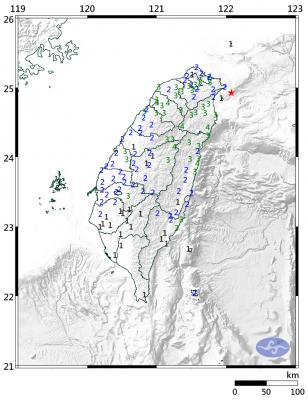
A magnitude 6.1 earthquake struck off the coast of Yilan County at 8:39pm tonight, the Central Weather Administration (CWA) said, with no immediate reports of damage or injuries. The epicenter was 38.7km east-northeast of Yilan County Hall at a focal depth of 98.3km, the CWA’s Seismological Center said. The quake’s maximum intensity, which gauges the actual physical effect of a seismic event, was a level 4 on Taiwan’s 7-tier intensity scale, the center said. That intensity level was recorded in Yilan County’s Nanao Township (南澳), Hsinchu County’s Guansi Township (關西), Nantou County’s Hehuanshan (合歡山) and Hualien County’s Yanliao (鹽寮). An intensity of 3 was
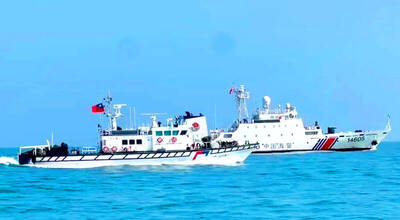
Instead of focusing solely on the threat of a full-scale military invasion, the US and its allies must prepare for a potential Chinese “quarantine” of Taiwan enforced through customs inspections, Stanford University Hoover fellow Eyck Freymann said in a Foreign Affairs article published on Wednesday. China could use various “gray zone” tactics in “reconfiguring the regional and ultimately the global economic order without a war,” said Freymann, who is also a nonresident research fellow at the US Naval War College. China might seize control of Taiwan’s links to the outside world by requiring all flights and ships entering or leaving Taiwan
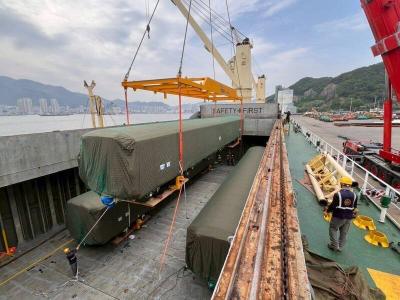
The first of 10 new high-capacity trains purchased from South Korea’s Hyundai Rotem arrived at the Port of Taipei yesterday to meet the demands of an expanding metro network, Taipei Rapid Transit Corp (TRTC) said yesterday. The train completed a three-day, 1,200km voyage from the Port of Masan in South Korea, the company said. Costing NT$590 million (US$18.79 million) each, the new six-carriage trains feature a redesigned interior based on "human-centric" transportation concepts, TRTC said. The design utilizes continuous longitudinal seating to widen the aisles and optimize passenger flow, while also upgrading passenger information displays and driving control systems for a more comfortable
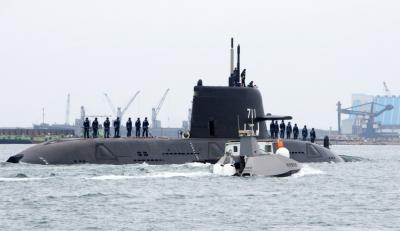
Taiwan's first indigenous defense submarine, the SS-711 Hai Kun (海鯤, or Narwhal), departed for its 13th sea trial at 7am today, marking its seventh submerged test, with delivery to the navy scheduled for July. The outing also marked its first sea deployment since President William Lai (賴清德) boarded the submarine for an inspection on March 19, drawing a crowd of military enthusiasts who gathered to show support. The submarine this morning departed port accompanied by CSBC Corp’s Endeavor Manta (奮進魔鬼魚號) uncrewed surface vessel and a navy M109 assault boat. Amid public interest in key milestones such as torpedo-launching operations and overnight submerged trials,


 RSS
RSS