

Amis Aborigines from the Kanjin (崁津) and Saowac communities in Taoyuan County that are facing demolition rallied outside the Executive Yuan yesterday, calling on the central government to intervene.
The two communities are located on the banks of the Dahan River (大漢溪) in Dasi Township (大溪), Taoyuan County. The Kanjin Community got its name from the nearby Kanjin Bridge (崁津大橋), while Saowac is the Amis word for “riverside,” said Chang Chin-tsai (張進財), a preacher at the Saowac Church.
“Saowac has been there for 28 years,” Chang said. “The residents are Amis from Hualien and Taitung counties who migrated to Taipei and Taoyuan to find work, but could not afford housing.”

PHOTO: GEORGE TSORNG, TAIPEI TIMES
He said that the community has about 40 residents.
The 80 residents at the Kanjin Community share a similar background.
“I came here more than 20 years ago from Chengkung Township [成?Taitung County, because I could not find a job in my hometown,” said Azun Balis, a Kanjin resident. “After I got here, I found a construction job.”
In her sixties now, Azun still works part-time jobs on construction sites.
“With this recession, jobs are hard to find and if they tear down my house, I really don’t know how I can carry on living,” she said.
The demolition notices, issued by the Taoyuan County Government, came in May for Kanjin and December for Saowac, to make way for a riverside park and bike path. The county government said in the notice that the plan would also protect the Aborigines from the threat of flooding.
But Kanjin and Saowac residents resisted the eviction order, saying that in the decades they have lived there the areas have never flooded.
“No to forced eviction! We want to stay where we are!” nearly 100 residents from the two Taoyuan communities and their supporters shouted as they demonstrated.
Fifty of the demonstrators shaved their heads.
“They shaved their heads to show their determination to save their homes because they don’t want to see bloodshed, but if the government doesn’t respond to them, we Aborigines will certainly take more extreme action,” said Panay Luni, an Amis who came from Taitung to support her people.
“Most of these people are in their fifties and sixties. They have nowhere else to go. Why can’t they just be left alone?” Panay said.
Council of Indigenous Peoples Vice Minister Wang Chin-fa (王進發), who came out to meet the demonstrators, only promised he would help negotiate with the Taoyuan County Government.
“It would be a little hard to allow you to stay where you are since it’s illegal to live in a flood zone and all public servants must abide by the law. I’ll talk with the county government to see if we can come up with a better resolution,” Wang said, before being booed and interrupted by upset demonstrators, after which he hurriedly left.
“Our muddle-headed government only cares about achievements that people can see, they don’t care about people’s lives,” said Lin Chih-chiang (林志強), a Dasi Township councilor of Amis origin. “Politicians always say that they care about Aborigines and stand with us, but when they’re elected and we’re in trouble, they are nowhere to be found.”
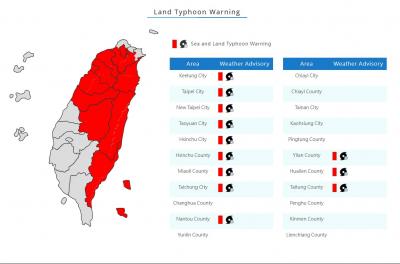
The Central Weather Administration at 5:30am today issued a land warning for Typhoon Bavi, which is expected to have its greatest impact on Taiwan from this evening through tomorrow. As of 8am, the eye of Bavi was about 700km east of Oluanpi (鵝鑾鼻), Taiwan's southernmost point, and was moving northwest at 25kph, the CWA said. The storm was packing maximum sustained winds of 162kph, with gusts of up to 198kph, the weather agency said, adding that Bavi had a storm radius of about 380km. Rainfall is expected to increase in mountainous areas of northern, central and southern Taiwan later today, with the heaviest

Taiwan tied for first with five golds at the 56th International Physics Olympiad (IPhO) held in Colombia this year, showcasing high school physics prowess. The team, led by National Taiwan Normal University physics professor Chen Chuan-Ren (陳傳仁), was represented by five students, who were chosen from 2,361 students nationwide via multiple selections to receive pre-competition training. Competing with 381 participants from 91 countries, all five students won a gold medal for Taiwan. Other countries earning five golds included China, India, Kazakhstan, South Korea and Russia. One of the five Taiwanese, Chien Kuo High School (CKHS) student Wu Ssu-chien (吳思謙) said he has enjoyed studying

WIDESPREAD CANCELATIONS: Airline and ferry operators have canceled a number of journeys following the issue of a sea warning, with a land warning also expected today Airlines and ferry operators yesterday announced widespread service changes as Typhoon Bavi approaches Taiwan, with authorities urging travelers to monitor updates and avoid nonessential trips to outlying islands. The Central Weather Administration issued a sea warning for Bavi at 2:30pm yesterday and is expected to issue a land warning early today if the typhoon maintains its projected path and speed. AIR TRAVEL Starlux Airlines said flights scheduled from yesterday through Sunday could be rescheduled or canceled, and urged passengers to check the latest flight information before heading to the airport. Tigerair Taiwan said due to safety concerns, yesterday’s IT232 Taoyuan-Naha and IT289 Naha-Kaohsiung flights

Beijing has been offering subsidized trips to China’s Xinjiang region for Taiwanese teachers as part of efforts to influence teachers and, indirectly, students, a government official said yesterday. With China subsidizing the trips, the teachers only need to pay a NT$4,000 registration fee for an eight-day, seven-night tour that includes accommodation and meals, the official said, speaking on condition of anonymity. Participants risk having their personal information collected and their social networks monitored by Chinese authorities, the official said. Chinese authorities are offering separate summer exchange programs targeting Taiwanese teachers and students, with the student program including study-related activities, they


 RSS
RSS