


Over-development and long-term neglect have brought Taiwan’s only indigenous bears to near extinction, researchers said, adding that while the newly arrived Chinese pandas were being pampered in world-class shelters, the black bears’ natural habitat was being destroyed for roads and other projects.
The Formosan black bear was once voted the best animal to represent Taiwan’s wildlife. It was also the Taipei City Zoo’s most popular animal, but its popularity has beens waning amid the recent panda fever.
The Council of Agriculture (COA) said that years of poaching and insufficient conservation funding have left only about 200 to 300 black bears in the wild — far less than the world’s panda population, which is estimated at 1,600. It has been reported that only NT$18 million (US$540,000) for 10 years has been allocated for funding to protect Taiwanese black bears, while the two pandas, Tuan Tuan (團團) and Yuan Yuan (圓圓), will each receive at least NT$2 million (US$60,000) in funding a year.
In addition to the lack of funding, researchers said much of the bears’ habitat was being destroyed.
At the country’s leading wildlife research center, National Pingtung University of Science and Technology, assistant professor Huang Mei-hsiu (黃美琇) has helped record and chart the bears’ whereabouts for 15 years.
Her maps show that the bears inhabit a large area that extends to the Chatian Natural Reserve in the north, Pingtung County’s Nandawu Mountains in the south, Ilan County in the east and Taiwu Township (泰武) in the west. Huang said traces of the bears have also been found along the coastal mountain range.
However, her study shows that the bear population has declined rapidly as their living environment is flattened to build roads for tourists.
Center director Yang Ji-chung (楊吉宗) listed human activities and over-development as the biggest threats to the bears.
Yang said the lack of funding presented a big challenge to the center. For example, researchers had successfully bred two cubs and intended to release them into the wild, he said, but the plan had to be dropped because some experts said the cubs’ genes did not fully match up with that of indigenous Formosan black bears, which meant the parents could have been from a different family.
He said that although there was not enough data to confirm the cubs were not Formosan black bears, the center did not have the funding to use DNA sequencing to prove whether or not the parents were pure Formosans.
Unlike other tropical bears, Formosan black bears do not hibernate during the winter. Huang’s research shows that even in the winter months, the bears spend 54 percent to 57 percent of their days hunting for food. In the summer and fall, that increases to 60 percent, while during the spring it drops to 47 percent.
Many people mistakenly think that bears are strictly carnivores, Yang said, but the fact is most bears are omnivores. More than 80 percent of their diet is plant-based, he said.
Fossil data shows that bears have been roaming the island for more than 500,000 years. The Formosan black bear is considered an endangered species by the Convention on International Trade in Endangered Species.

LOUD AND PROUD Taiwan might have taken a drubbing against Australia and Japan, but you might not know it from the enthusiasm and numbers of the fans Taiwan might not be expected to win the World Baseball Classic (WBC) but their fans are making their presence felt in Tokyo, with tens of thousands decked out in the team’s blue, blowing horns and singing songs. Taiwanese fans have packed out the Tokyo Dome for all three of their games so far and even threatened to drown out home team supporters when their team played Japan on Friday. They blew trumpets, chanted for their favorite players and had their own cheerleading squad who dance on a stage during the game. The team struggled to match that exuberance on the field, with
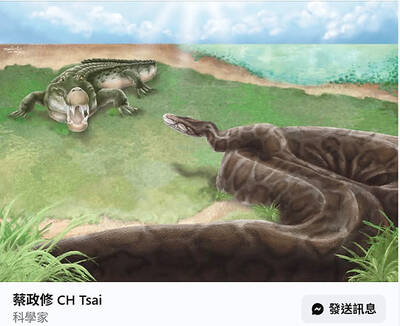
Taiwanese paleontologists have discovered fossil evidence that pythons up to 4m long inhabited Taiwan during the Pleistocene epoch, reporting their findings in the international scientific journal Historical Biology. National Taiwan University (NTU) Institute of Ecology and Evolutionary Biology associate professor Tsai Cheng-hsiu (蔡政修) led the team that discovered the largest snake fossil ever found in Taiwan. The single trunk vertebra was discovered in Tainan at the Chiting Formation, dated to between 400,000 and 800,000 years ago in the Middle Pleistocene, the paper said. The area also produced Taiwan’s first avian fossil, as well as crocodile, mammoth, saber-toothed cat and rhinoceros fossils, it said. Discoveries

Taiwanese paleontologists have discovered fossil evidence that pythons up to 4m long inhabited Taiwan during the Pleistocene epoch, reporting their findings in the international scientific journal Historical Biology. National Taiwan University (NTU) Institute of Ecology and Evolutionary Biology associate professor Tsai Cheng-hsiu (蔡政修) led the team that discovered the largest snake fossil ever found in Taiwan. A single trunk vertebra was discovered in Tainan at the Chiting Formation, dated to between 800,000 to 400,000 years ago in the Middle Pleistocene, the paper said. The area also produced Taiwan’s first avian fossil, as well as crocodile, mammoth, sabre-toothed cat and rhinoceros fossils, it said. Discoveries

Whether Japan would help defend Taiwan in case of a cross-strait conflict would depend on the US and the extent to which Japan would be allowed to act under the US-Japan Security Treaty, former Japanese minister of defense Satoshi Morimoto said. As China has not given up on the idea of invading Taiwan by force, to what extent Japan could support US military action would hinge on Washington’s intention and its negotiation with Tokyo, Morimoto said in an interview with the Liberty Times (sister paper of the Taipei Times) yesterday. There has to be sufficient mutual recognition of how Japan could provide


 RSS
RSS