

Hsieh Kuo-liang (謝國樑), head of the legislature’s Judiciary and Organic Laws and Statutes Committee, said yesterday he would pursue a legal amendment to lower the caps on credit and cash card interest rates by 5 percent.
At a press conference at the Chinese Nationalist Party (KMT) caucus, Hsieh applauded Financial Supervisory Commission (FSC) Chairman Sean Chen (陳沖) for trying to persuade banks to lower credit and cash card interest rates.
However, Hsieh said that such tactics had proved ineffective, as many banks were only willing to make marginal cuts.
Hsieh was referring to Chen’s appeal to credit card issuers after the central bank cut its benchmark interest rate for the sixth time since September, for a total of 2.125 percentage points.
The highest revolving interest rates from banks on credit and cash cards have remained unchanged at 19 percent and 20 percent respectively.
FSC officials said on Tuesday that 10 major credit card issuers were scheduled to finalize their rate cuts by tomorrow at the earliest.
Despite the FSC’s announcement, Hsieh said he believed the best way to give credit and cash card debtors a break was to amend Article 205 of the Civil Code, which sets the ceiling for rates at 20 percent.
Hsieh said many banks justified their high credit and cash card interest rates — which range between 15 percent and 20 percent — by citing the article, a practice Hsieh described as “legal, but unethical.”
Hsieh said the article had not been amended since it took effect in 1929.
The proposed amendment to lower the ceiling to 15 percent was in line with recent global interest rate cuts, he said.
“It’s time to make a thorough adjustment,” he said. “Banks can still make a lot of profit with the cap at 15 percent ... Lowering the ceiling would not affect the operations of banks.”
Hsieh said that he hoped the proposal would be included as a caucus priority for the spring legislative session.
If members of the legislature do not have a problem with the new ceiling, the bill could clear the legislative floor as early as the end of March, he said.
But he did not rule out the possibility of calling for a vote on the proposal.
KMT Legislator Wu Ching-chih (吳清池), another head of the committee, also voiced support for Hsieh’s proposal.
“The government should abandon its persuasion strategy and take the initiative to intervene [in unreasonably high credit and cash card interest rates],” he said.

The donation of offshore patrol vessel Kinmen to the Philippines includes provisions that protect Taiwanese fishers and facilitate security cooperation across the First Island Chain, officials said yesterday. The comment was made during the Cabinet’s comprehensive administrative report at the legislature after Chinese Nationalist Party (KMT) Legislator Hsu Yu-chen (許宇甄) expressed concerns about the decision to give a ship to a country whose coast guard had in 2013 fired on a Taiwanese trawler and killed its captain without provocation. The Cabinet should lay out the safeguards that have been established to prevent the Philippine government from using the Kinmen to harass, expel
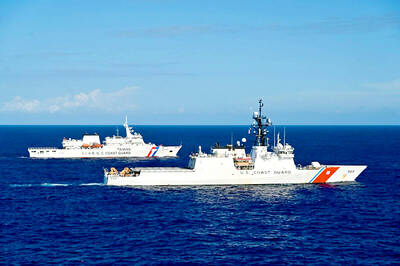
GROWING TIES: The CGA is planning a goodwill mission to the Philippines, in what would be the first time since 1975 a Taiwanese paramilitary vessel has visited the country The Coast Guard Administration (CGA) plans to significantly expand its participation in international security cooperative frameworks and its operational capabilities, a budget proposal for next year showed. The budget indicates a transformation of the CGA from a maritime law enforcement arm into a national defense and intelligence gathering entity capable of tackling larger regional security matters. The proposal showed that personnel from the coast guard’s Intelligence Division and Special Action Support Center are to participate in high-level national security talks with the US. As the CGA has dealt with China’s rising “gray zone” threats around Taiwan, it has become a valuable asset to
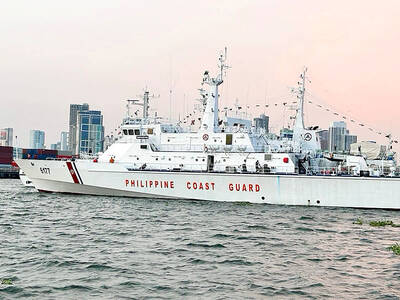
A patrol vessel donated by the Coast Guard Administration (CGA) to the Philippines was commissioned into the Philippine Coast Guard (PCG) on Friday, a Philippine non-governmental organization said. The CGA on Sept. 16 confirmed media reports that Taiwan had donated a retired 500-tonne patrol vessel to the Philippines. The Manila-based We Protect Our Seas (WPS) foundation, which served as an intermediary in the transfer, said that the vessel was formerly the CGA’s 500-tonne petrol vessel Kinmen (CG123). The WPS, in a statement issued on Friday, said the vessel, renamed as the BRP Sarangani, had been commissioned into the PCG the
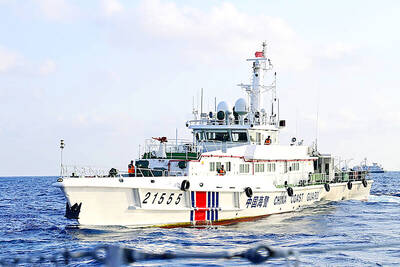
‘GRAY ZONE’ TACTICS: Beijing sent two China Coast Guard vessels to escort a ‘supposedly private research ship,’ a Philippine Coast Guard spokesman said The Coast Guard Administration (CGA) yesterday confirmed that it had recently deployed three patrol vessels to waters in Taiwan’s overlapping exclusive economic zone with the Philippines to monitor three Chinese vessels. CGA Deputy Director-General Hsieh Ching-chin (謝慶欽) said the agency regularly monitors Chinese vessels around Taiwan, and that the deployment south of Oluanpi (鵝鑾鼻), Taiwan proper’s southernmost point, was carried out in accordance with standard procedures. He added that the waters fall within the overlapping exclusive economic zones of Taiwan and the Philippines, which extend 200 nautical miles (370km) from their coastlines. Hsieh made the comments when asked about a


 RSS
RSS