


Erin Gruwell did not expect to be a household name in Taiwan when she arrived earlier this month, but when she entered the auditorium for a speech the next day, she was met by more than 1,000 people.
“It’s amazing for a book that we only expected 150 of us to read, never thought people outside our classroom would pick it up, let alone to be across the world in Taiwan,” she said during an interview with the Taipei Times on Dec. 10.
But Freedom Writers Diary — a collection of journals by Gruwell’s 150 high school students — wasn’t the only reason many Taiwanese were enchanted by Gruwell and her story.
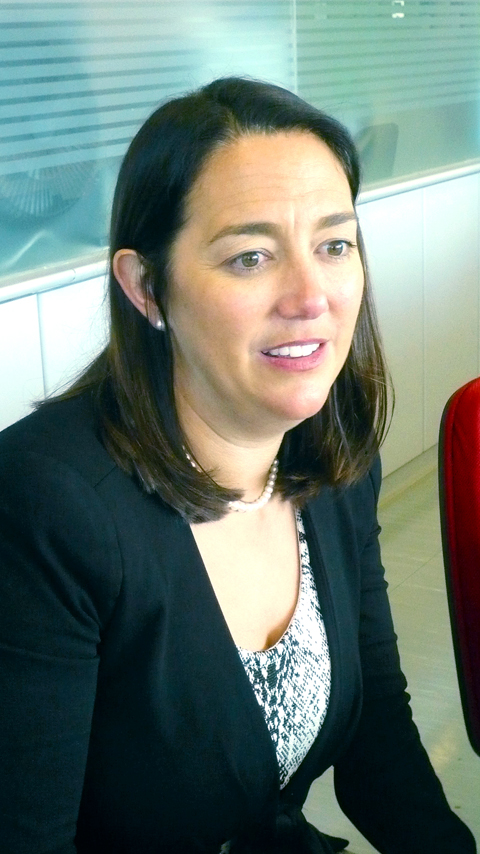
PHOTO: FLORA WANG, TAIPEI TIMES
Her appeal also had a lot to do with the movie Freedom Writers starring Hilary Swank, released in Taiwan last year.
Although Swank gave an impressive performance in the movie, expertly portraying how persistent and caring the real Gruwell was with her students, she was still unable to completely capture the essence of Gruwell’s personal charm and her passion for education.
“I’ve always thought that education is the greatest way to be equal in a society that oftentimes values equality,” a beaming Gruwell said in a Taipei County Hall conference room.
DEDICATION
Gruwell, now in her late 30s, is best known for her dedication to 150 underprivileged students at Wilson High School in Long Beach, California, between 1994 and 1998, as portrayed in the movie.
“Almost every event and character [in the movie] was accurate” as Gruwell and her students formed a partnership with the filmmakers and helped with casting, costume choice and the set of the film.
But a two-hour film is not enough to accommodate every detail of her five years of work with the students, whom the school administration previously considered unteachable.
Gruwell, then 26, went into a community where many parents were not educated and children were in need of a good education to help them out of poverty.
Though a novice teacher who had just graduated from college, she soon formulated a plan.
“I thought the best way to get my kids out of that situation was to teach them critical thinking, to question what they knew,” she said.
And the main methods she used were reading and writing, which may seem ordinary at first, but collaborations between the students could be life-altering.
“I think reading and writing have something to do with expression and having a voice,” she said.
With their family and neighborhood backgrounds, many of Gruwell’s students felt they were “invisible” and “didn’t matter,” but she was determined to help them feel important and find their own voice.
“The more you read, the better writer you become and the better communicator. They all went hand-in-hand,” she said.
Describing reading and writing as “empowering tools,” Gruwell said she began by choosing books about and for children who came from backgrounds similar to those of her students.
One of the books the movie highlighted was The Diary of a Young Girl by Anne Frank, a Jewish girl who hid from the Nazis during World War II.
Also on the list was Zlata’s Diary by Zlata Filipovic, a young girl who survived the Bosnian War in Sarajevo between 1991 and 1993.
In addition to encouraging her students to read, Gruwell also pushed them to put their own stories into words by keeping journals regularly.
“I wanted my students to know that you had a story to tell just like Anne Frank ... If you write them down, you too could be mortal and could have a voice in society,” she said.
And indeed, their stories have enjoyed widespread popularity across the globe since the book was published about a decade ago.
The book even became a bestseller in the US.
“What’s great about reading and writing is they are not only liberating and converting but also very subjective,” she said.
“I love the idea that reading and writing are all based on interpretation, inferences [and] creating your own reality. By doing that with inferences and subjectivity, it makes you a critical thinker and a critical thinker can handle any situation,” she said.
OPPOSITION
However, unconventional teaching approaches are often met with hesitance, and Gruwell’s methodology was no exception.
While the film also depicted the conflict between Gruwell and the school authorities, she said the clash was more dramatic in real life.
“It’s easier to just dismiss the kids if you feel they are not smart, they are not working hard enough or [you just] get rid of them, but my philosophy is, ‘I’m not going to get rid of anybody,’” she said.
That philosophy helped Gruwell turn her students into critical thinkers, but it also made students challenge other authority figures, creating a school environment she referred to as “hostile.”
The power struggle during those years was painful, she said, but Gruwell’s efforts yielded fruitful results when all of the 150 students graduated from high school and many of them went on to attend college.
She also won 150 “torchbearers” who continued to work with her at the Freedom Writers Foundation she later established, passing on their experiences to other children facing similar problems.
Gruwell expressed strong confidence when asked whether she could replicate the teaching and learning experiences that took place in her Classroom 203 between 1994 and 1998.
FAILURE NO OPTION
Over the past decade, she and the students have been working with numerous teachers and trying to reproduce the model of “truly believing that every kid has the ability to be successful and failure is not an option,” she said.
The foundation created a teacher’s guide to help instructors replicate some of Gruwell’s original teaching activities in their own classrooms.
Although Gruwell humbly said it was difficult to quantify how many people she had influenced, it was certain that her teaching philosophy reached beyond her classroom.
When asked to give advice to parents, teachers and policymakers in Taiwan about how to deal with many children’s preference to read non-traditional texts such as comic books, Gruwell suggested that they try to find books that speak to children about real issues.
Books written in teenage language, even if they contain profanity, would be good choices, she said.
“Because so many kids used profanities, that element of profanity was in the text [of our book], as the stories were written the way people spoke. A lot of kids are able to seek refuge in our book because they feel that ‘someone cares to write in the way I understand and the way I talk,’” she said.

Yangmingshan National Park authorities yesterday urged visitors to respect public spaces and obey the law after a couple was caught on a camera livestream having sex at the park’s Qingtiangang (擎天崗) earlier in the day. The Shilin Police Precinct in Taipei said it has identified a suspect and his vehicle registration number, and would summon him for questioning. The case would be handled in accordance with public indecency charges, it added. The couple entered the park at about 11pm on Thursday and began fooling around by 1am yesterday, the police said, adding that the two were unaware of the park’s all-day live

Fast food chain McDonald's is to raise prices by up to NT$5 on some products at its restaurants across Taiwan, starting on Wednesday next week, the company announced today. The prices of all extra value meals and sharing boxes are to increase by NT$5, while breakfast combos and creamy corn soup would go up by NT$3, the company said in a statement. The price of the main items of those meals, if ordered individually, would remain the same. Meanwhile, the price of a medium-sized lemon iced tea and hot cappuccino would rise by NT$3, extra dipping sauces for chicken nuggets would go up
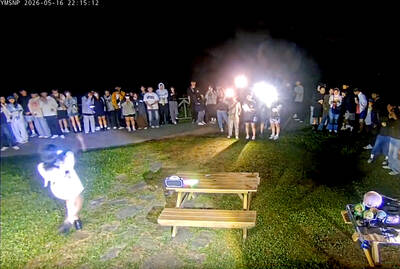
Yangmingshan National Park’s Qingtiangang (擎天崗) nature area has gone viral after a park livestream camera observed a couple in the throes of intimate congress, which was broadcast live on YouTube, drawing large late-night crowds and sparking a backlash over noise, bright lights and disruption to wildlife habitat. The area’s livestream footage appeared to show a couple engaging in sexual activity on a picnic table in the park on Friday last week, with the uncensored footage streamed publicly online. The footage quickly spread across social media, prompting a tide of visitors to travel to the site to “check in” and recreate the

Minister of Digital Affairs Lin Yi-ching (林宜敬) yesterday cited regulatory issues and national security concerns as an expert said that Taiwan is among the few Asian regions without Starlink. Lin made the remarks on Facebook after funP Innovation Group chief executive officer Nathan Chiu (邱繼弘) on Friday said Taiwan and four other countries in Asia — China, North Korea, Afghanistan and Syria — have no access to Starlink. Starlink has become available in 166 countries worldwide, including Ukraine, Malaysia, the Philippines and Vietnam, in the six years since it became commercial, he said. While China and North Korea block Starlink, Syria is not


 RSS
RSS