


A highly educated US couple was seeking reconsideration from Taiwanese judges on their adoption of a developmentally delayed baby girl after a Kaohsiung District Court last week rejected their case, fearing the couple would be unsatisfied with the child once she grows up, local media reported.
The Apple Daily reported that the Marks, who both have Harvard doctoral degrees, came to Taiwan to plead with the judges for another chance when the court rejected their adoption of eight-month-old Ju-yi (如意).
The court based their decision on fear the couple, who agreed to adopt the baby without ever spending time with her, could end up being disappointed because of their high educational background.
The judges, however, said the couple were welcome to appeal after spending time with the child.
At a press conference in Kaohsiung on Wednesday in the company of Democratic Progressive Party Councilor Huang Shu-mei (黃淑美), the couple said they decided to adopt when they could not have their own children. The couple saw a picture of the child in July through a Kaohsiung-based charity organization.
Without seeing the baby and after consulting with doctors, the couple agreed to the adoption with full knowledge of her developmental problems.
The couple said their hearts were shattered when the court ruled against them. They were quoted in the report as saying that after spending time with Ju-yi in the last few days, they felt she was an “angel” and desperately wanted to take her home.
Kuo Liang-ling (郭亮伶), the head of the charity organization, said the Marks were the best candidates they had seen and hoped the judges would give them a chance.
Kaohsiung City Bureau of Social Welfare chief Hsu Chuan-sheng (許傳盛) said if not adopted, Ju-yi might end up in an orphanage, adding that adoption by the Marks would be the best arrangement because most Taiwanese do not like adopting developmentally challenged children.
Each year, approximately 3,000 Taiwanese children are adopted, 10 percent of them by foreign families, most from the US.

LOUD AND PROUD Taiwan might have taken a drubbing against Australia and Japan, but you might not know it from the enthusiasm and numbers of the fans Taiwan might not be expected to win the World Baseball Classic (WBC) but their fans are making their presence felt in Tokyo, with tens of thousands decked out in the team’s blue, blowing horns and singing songs. Taiwanese fans have packed out the Tokyo Dome for all three of their games so far and even threatened to drown out home team supporters when their team played Japan on Friday. They blew trumpets, chanted for their favorite players and had their own cheerleading squad who dance on a stage during the game. The team struggled to match that exuberance on the field, with
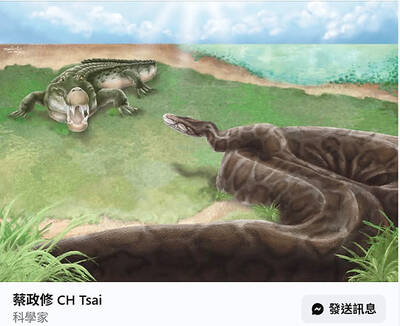
Taiwanese paleontologists have discovered fossil evidence that pythons up to 4m long inhabited Taiwan during the Pleistocene epoch, reporting their findings in the international scientific journal Historical Biology. National Taiwan University (NTU) Institute of Ecology and Evolutionary Biology associate professor Tsai Cheng-hsiu (蔡政修) led the team that discovered the largest snake fossil ever found in Taiwan. The single trunk vertebra was discovered in Tainan at the Chiting Formation, dated to between 400,000 and 800,000 years ago in the Middle Pleistocene, the paper said. The area also produced Taiwan’s first avian fossil, as well as crocodile, mammoth, saber-toothed cat and rhinoceros fossils, it said. Discoveries

Taiwanese paleontologists have discovered fossil evidence that pythons up to 4m long inhabited Taiwan during the Pleistocene epoch, reporting their findings in the international scientific journal Historical Biology. National Taiwan University (NTU) Institute of Ecology and Evolutionary Biology associate professor Tsai Cheng-hsiu (蔡政修) led the team that discovered the largest snake fossil ever found in Taiwan. A single trunk vertebra was discovered in Tainan at the Chiting Formation, dated to between 800,000 to 400,000 years ago in the Middle Pleistocene, the paper said. The area also produced Taiwan’s first avian fossil, as well as crocodile, mammoth, sabre-toothed cat and rhinoceros fossils, it said. Discoveries
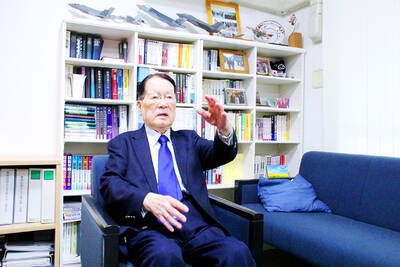
Whether Japan would help defend Taiwan in case of a cross-strait conflict would depend on the US and the extent to which Japan would be allowed to act under the US-Japan Security Treaty, former Japanese minister of defense Satoshi Morimoto said. As China has not given up on the idea of invading Taiwan by force, to what extent Japan could support US military action would hinge on Washington’s intention and its negotiation with Tokyo, Morimoto said in an interview with the Liberty Times (sister paper of the Taipei Times) yesterday. There has to be sufficient mutual recognition of how Japan could provide


 RSS
RSS