


The detention of former president Chen Shui-bian (陳水扁), Yunlin County Commissioner Su Chih-fen (蘇治芬), Chiayi County Commissioner Chen Ming-wen (陳明文) and other pan-green figures have sparked a debate about potential amendments to the Code of Criminal Procedure (刑事訴訟法).
Chen Shui-bian, Chen Ming-wen and Su all started hunger strikes in protest of their “unfair” detention without charge. Su and Chen Ming-wen continued to turn away food until they were indicted and released, while Chen Shui-bian gave up his hunger strike after being hospitalized.
The former president was detained on Nov. 12 after questioning by the Special Investigation Panel (SIP) of the Supreme Prosecutor’s Office in relation to money laundering allegations.
After his lawyer Cheng Wen-lung (鄭文龍) continued to speak on the former president’s behalf in public, the Ministry of Justice requested that Cheng not pass on any messages and said it would seek punishment for Cheng with the Taipei Bar Association. The association said Cheng was merely carrying out his duties as a lawyer.
Cheng criticized prosecutors for Chen Shui-bian’s continued detention without charge.
The former president was indicted on Friday and released on bail yesterday.
Su is suspected of accepting bribes in a landfill construction project in Yunlin County back in 2006.
Yunlin prosecutors showed up at her residence early in the morning on Nov. 4, escorted her to the prosecutors’ office and immediately put her behind bars with the permission of judges.
Su began her hunger strike immediately in protest of being detained without charge and before having been questioned by prosecutors.
Yunlin Chief Prosecutor Liu Chia-fang (劉家芳), upset by complaints from Su and her supporters, defended the decision to detain Yu. Prosecutors would not detain someone without due cause, Liu said.
Su was indicted and released on Nov. 14.
Chen Ming-wen was detained on Oct. 28 on suspicion of bribery. Prosecutors did not speak to him until Nov. 21, when they questioned him and released him on NT$3 million (US$90,000) bail.
RISK OF ABUSE
The detention of suspects without charge for extended periods of time has been criticized by their supporters and lawyers who argue that prosecutors use detention without charge to pressure a suspect into providing information on the case. Prosecutors, however, say the detentions have not violated any laws.
National Taiwan University law professor Wang Jaw-perng (王兆鵬) suggested amending the Code of Criminal Procedure. Judges should only grant a request to detain a suspect in special circumstances, he said.
“Detention should be the last option for prosecutors to consider if the person fails to cooperate and help them in their investigation,” Wang said.
“But our law allows law enforcement officers to detain a suspect first and then continue to collect sufficient evidence [to charge them],” Wang said.
Wang said the Code of Criminal Procedure stipulates that a detention request may be granted in cases where the suspect is believed to have committed a crime punishable by death or a sentence longer than five years.
But “once they detain a person, the prosecutors have the advantage and the game isn’t fair at all.”
IMPLEMENTATION
The state public prosecutor-general, Chen Tsung-ming (陳聰明), said that there was no problem with the code, but that there was room for improvement in its implementation.
“To detain a suspect prior to the trial is quite normal around the world. The only difference is for how long,” Chen Tsung-ming said.
“Law enforcement officers should be more careful when they decide to detain somebody. We should be more precise, when we are deciding whether a person needs to be temporarily put behind bars,” he said.
Although defending his fellow prosecutors in the Su case, Liu echoed Chen Tsung-ming’s remarks.
“Perhaps we could be more patient and gentle through the process,” Liu said. “Detention should always be the last option.”
At a press conference on Friday, SIP Prosecutor Yueh Fang-ju (越方如) said she seldom chose to detain a suspect.
“When you detain a person, you do not only detain this person, you actually [penalize] the entire family because this person’s family members will begin to suffer the pain as well,” Yueh said.
“Sometimes, as a prosecutor, you need to consider whether it is really necessary to do so when it comes to detention. You cannot be careful enough,” Yueh said.

UPGRADE: The Kang Ding-class frigate is replacing its Chaparall missiles with Tien Chien II and Hua Yang VLS, which would provide it with long-range, 360° air defense Taiwan plans to produce 1,200 to 1,376 Hai Chien II missiles (海劍二, Sea Sword II) — also known as TC-2N — to serve as the standard air defense system of the navy’s surface combatant fleet, a source said yesterday. Last week, the Hai Chien II, the naval version of the Tien Kung II missile (天劍二, Sky Sword II), completed a live-fire test in waters off the National Chungshan Institute of Science and Technology’s Jiupeng facility (九鵬) in Pingtung County’s Manjhou Township (滿州). The MIM72 Chaparral and other dated air defense missiles that currently arm Taiwanese ships have inadequate range to combat Chinese

REASONS FOR TRAVEL: An assistant professor said that proposed amendments to penalize drivers if they used drugs overseas would not deter people from traveling People who operate a motor vehicle under the influence of marijuana would have their driver’s license revoked, even if they used the substance while overseas, the Ministry of Transportation and Communications said yesterday, citing proposed amendments to the Road Traffic Management and Penalty Act (道路交通管理處罰條例). The amendments would also authorize the government to revoke the licenses of people determined to have used Category 1 or Category 2 narcotics, even if they were not operating a vehicle while under the influence of drugs, as well as ban them from taking the license test for three years, the ministry said. People aged 18 or

HEAVY WEATHER: Typhoon Jangmi is due to crash straight into the Ryukyus as airlines look to shift flights to larger aircraft or cancel flights to Okinawa entirely Taiwan’s international air carriers announced flight adjustments over the weekend as Typhoon Jangmi is forecast to hit the Ryukyu Islands today and tomorrow. The Central Weather Administration (CWA) upgraded Jangmi from a tropical storm to a typhoon at 8am yesterday, with the eye located 580km south of Naha city. It was moving north at 19kph. Today, China Airlines’ CI-120, CI-121, CI-122 and CI-123 flights between Taoyuan and Naha, Okinawa, have been canceled as well as CI-132 and CI-133 between Kaohsiung and Naha. EVA Air’s BR-112, BR-113, BR-186 and BR-185 flights between Taoyuan and Naha are also canceled. Low-cost carrier Tigerair Taiwan canceled IT-230,
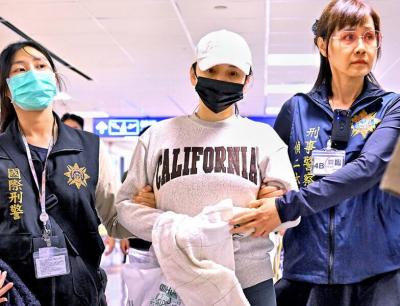
Johanne Liou (劉喬安), a Taiwanese woman who shot to unwanted fame during the Sunflower movement protests in 2014, returned to Taiwan last night after being deported from the US. She is to stand trial in Taiwan for charges involving embezzlement, fraud and drug crimes. The Criminal Investigation Bureau (CIB) said it took her into custody at Taiwan Taoyuan International Airport and would first question her before transferring her to the New Taipei District Prosecutors’ Office. She was arrested upon disembarking a flight from San Francisco that landed shortly before 7pm. Liou absconded to the US in 2019 after jumping bail


 RSS
RSS