


The Mongolian and Tibetan Affairs Commission (MTAC) promised to help Tibetan refugees yesterday, saying those who entered the country illegally may be granted legal resident status.
More than 100 Tibetans have been staging a sit-in at Liberty Square in Taipei since Tuesday, demanding that the government grant them legal resident status or at least a work permit.
They were forcibly removed from the demonstration site and dropped off in the outskirts of the city, including Guandu (關渡), Nangang (南港) and in the mountains in Neihu (內湖) at around 3am yesterday.
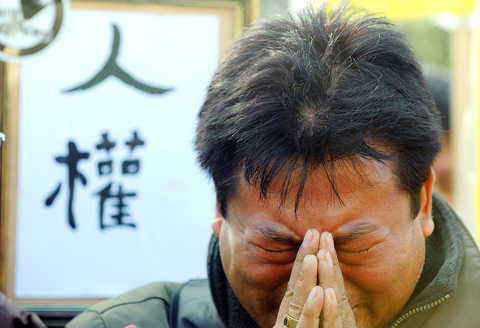
PHOTO: WANG YI-SUNG, TAIPEI TIMES
While a majority of the group — who speak little Mandarin — struggled to find their way back, 10 members who have been living in Taiwan for decades and are naturalized Taiwanese turned to the commission to plead for help for their Tibetan comrades.
“There are hundreds of Tibetans out there who entered Taiwan on forged [Indian and Nepalese] passports — they don't have stable jobs because they cannot legally work here,” Taiwan Tibetan Welfare Association chairman Jangka (蔣卡) told reporters.
“They live in extreme poverty and often wake up in the morning not knowing where their lunch and dinner will come from. They cannot return to India, they have nowhere to go now,” he said.
“Please help them. Give them at least work permits so they can live,” he said.
A Tibetan who has no legal resident status in Taiwan told the Taipei Times that he makes about NT$10,000 (US$299) a month doing part-time jobs and lives with 13 other Tibetans in an 85m² apartment with one living room and two bedrooms.
Commission Secretary-General Chien Shih-yin (錢世英), who received the Tibetan representatives, said that help from the commission was on the way.
“We understand that it's difficult to find jobs without legal status, but it's not an issue that can be resolved by the MTAC alone,” Chien told the Tibetans.
“That's why we're in the process of coordinating efforts with the Ministry of Foreign Affairs, the National Immigration Agency and the Ministry of the Interior to revise the Immigration Act [出入國及移民法]” Chien said. “We're doing something — but please understand that this cannot be done within one day.”
Chien's words failed to pacify the Tibetans.
“You always want us to wait, wait, wait — how long do we have to wait? Ten years?” one of them shouted.
Chien then threatened to discontinue the talk if the Tibetan representatives continued shouting.
Taiwan Friends of Tibet vice chairman Yang Chang-chen (楊長鎮) and Democratic Progressive Party Legislator Tien Chiu-chin (田秋堇), who accompanied the Tibetan, said the government should treat Tibetans without legal status in Taiwan in the same way it treated refugees from Thailand and Myanmar earlier this year.
Around 400 stateless Thai and Myanmar refugees who entered the country illegally were granted temporary residency so that they could work before the Immigration Act is amended.
Chien agreed and promised the commission would try to forward the proposal during Cabinet meetings.
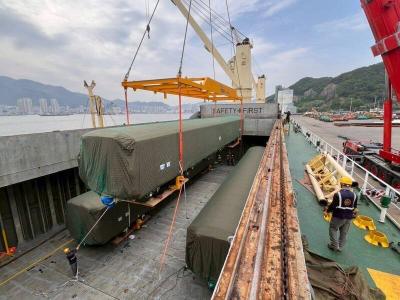
The first of 10 new high-capacity trains purchased from South Korea’s Hyundai Rotem arrived at the Port of Taipei yesterday to meet the demands of an expanding metro network, Taipei Rapid Transit Corp (TRTC) said yesterday. The train completed a three-day, 1,200km voyage from the Port of Masan in South Korea, the company said. Costing NT$590 million (US$18.79 million) each, the new six-carriage trains feature a redesigned interior based on "human-centric" transportation concepts, TRTC said. The design utilizes continuous longitudinal seating to widen the aisles and optimize passenger flow, while also upgrading passenger information displays and driving control systems for a more comfortable
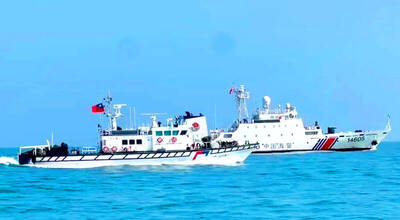
Instead of focusing solely on the threat of a full-scale military invasion, the US and its allies must prepare for a potential Chinese “quarantine” of Taiwan enforced through customs inspections, Stanford University Hoover fellow Eyck Freymann said in a Foreign Affairs article published on Wednesday. China could use various “gray zone” tactics in “reconfiguring the regional and ultimately the global economic order without a war,” said Freymann, who is also a nonresident research fellow at the US Naval War College. China might seize control of Taiwan’s links to the outside world by requiring all flights and ships entering or leaving Taiwan
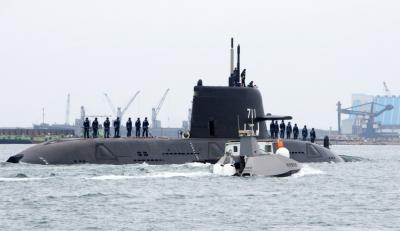
Taiwan's first indigenous defense submarine, the SS-711 Hai Kun (海鯤, or Narwhal), departed for its 13th sea trial at 7am today, marking its seventh submerged test, with delivery to the navy scheduled for July. The outing also marked its first sea deployment since President William Lai (賴清德) boarded the submarine for an inspection on March 19, drawing a crowd of military enthusiasts who gathered to show support. The submarine this morning departed port accompanied by CSBC Corp’s Endeavor Manta (奮進魔鬼魚號) uncrewed surface vessel and a navy M109 assault boat. Amid public interest in key milestones such as torpedo-launching operations and overnight submerged trials,
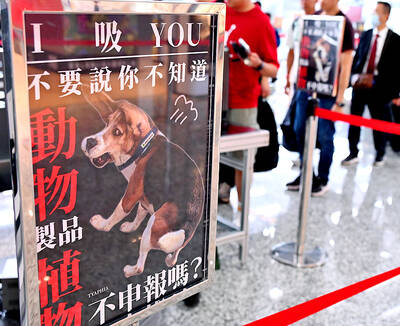
Quarantine awareness posters at Taiwan Taoyuan International Airport have gone viral for their use of wordplay. Issued by the airport branch of the Animal and Plant Health Inspection Agency, the posters feature sniffer dogs making a range of facial expressions, paired with advisory messages built around homophones. “We update the messages for holidays and campaign needs, periodically refreshing materials to attract people’s attention,” quarantine officials said. “The aim is to use the dogs’ appeal to draw focus to quarantine regulations.” A Japanese traveler visiting Taiwan has posted a photo on X of a poster showing a quarantine dog with a


 RSS
RSS