


Facing financial problems because of the global economic recession, civic groups yesterday urged President Ma Ying-jeou (馬英九) to keep his promise to donate his consumer vouchers to welfare groups, in the hope that more people would follow suit.
When Premier Liu Chao-shiuan (劉兆玄) announced last week that NT$3,660 in consumer vouchers would be distributed to the public before the Lunar New Year holiday starts on Jan. 24, Ma immediately said he would donate his vouchers to charity groups.
However, when some academics questioned how the distribution of vouchers would stimulate the economy by boosting consumption if many people decided to donate them, Ma changed his mind and said on Wednesday that he would use the vouchers to buy produce and donate a cash equivalent to charity groups.
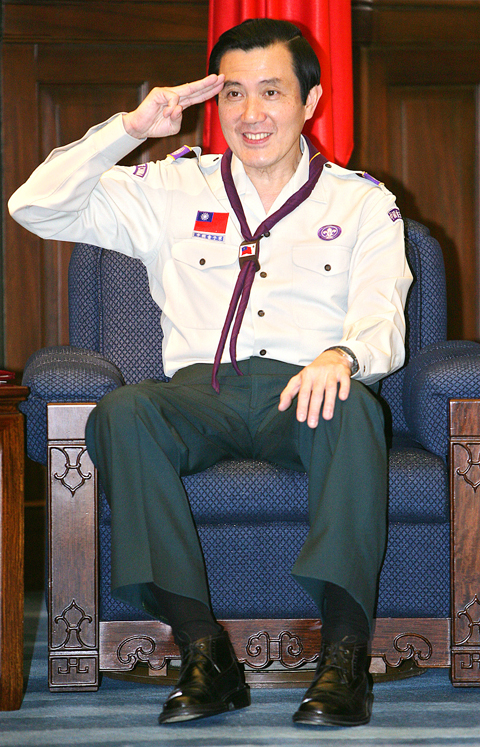
PHOTO: CNA
Wang Yu-ling (王幼玲), secretary-general of the Alliance for Handicapped People, said that consumer vouchers donated to welfare groups would still stimulate consumption.
“When we receive those vouchers as a donation, we can’t just lock them up in a safe, we’ll still have to spend them,” Wang said.
Wu Yu-chin (吳玉琴), secretary-general of the Alliance for Old People’s Welfare Promotion, agreed.
“Some people don’t need the extra NT$3,600, while others are in desperate need. Welfare groups can act as the platform by which people are able to help those in need,” Wu said.
Taiwan Fund for Children and Family executive director Miguel Wang (王明仁) said that donations to the group had fallen by almost 20 percent this year.
“The number of people sponsoring a child has also fallen — many people have called us and said that they can no longer sponsor children at our shelters because they’ve been laid off,” he said.
Presidential Office Spokesman Wang Yu-chi (王郁琦) said yesterday that Ma would spend his vouchers, but would also donate cash to civic groups.
When asked how much Ma intended to donate, Wang said the amount would be at least 10 times the value of the vouchers. He said Ma had not yet decided whether the donation would come from his own pocket or from the president’s discretionary fund. Ma would decide on that by Jan. 18, when the vouchers are scheduled to be issued, Wang said.
Wang said Ma has used the president’s discretionary fund to buy items that he would give away as gifts and his own money on items that were for his personal use.
ADDITIONAL REPORTING BY KO SHU-LING
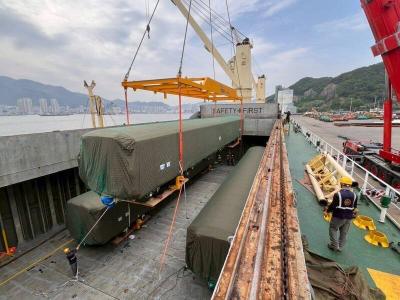
The first of 10 new high-capacity trains purchased from South Korea’s Hyundai Rotem arrived at the Port of Taipei yesterday to meet the demands of an expanding metro network, Taipei Rapid Transit Corp (TRTC) said yesterday. The train completed a three-day, 1,200km voyage from the Port of Masan in South Korea, the company said. Costing NT$590 million (US$18.79 million) each, the new six-carriage trains feature a redesigned interior based on "human-centric" transportation concepts, TRTC said. The design utilizes continuous longitudinal seating to widen the aisles and optimize passenger flow, while also upgrading passenger information displays and driving control systems for a more comfortable
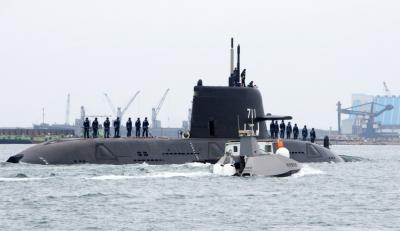
Taiwan's first indigenous defense submarine, the SS-711 Hai Kun (海鯤, or Narwhal), departed for its 13th sea trial at 7am today, marking its seventh submerged test, with delivery to the navy scheduled for July. The outing also marked its first sea deployment since President William Lai (賴清德) boarded the submarine for an inspection on March 19, drawing a crowd of military enthusiasts who gathered to show support. The submarine this morning departed port accompanied by CSBC Corp’s Endeavor Manta (奮進魔鬼魚號) uncrewed surface vessel and a navy M109 assault boat. Amid public interest in key milestones such as torpedo-launching operations and overnight submerged trials,
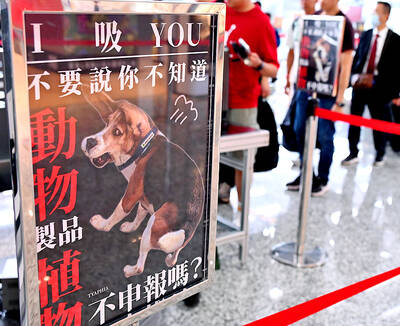
Quarantine awareness posters at Taiwan Taoyuan International Airport have gone viral for their use of wordplay. Issued by the airport branch of the Animal and Plant Health Inspection Agency, the posters feature sniffer dogs making a range of facial expressions, paired with advisory messages built around homophones. “We update the messages for holidays and campaign needs, periodically refreshing materials to attract people’s attention,” quarantine officials said. “The aim is to use the dogs’ appeal to draw focus to quarantine regulations.” A Japanese traveler visiting Taiwan has posted a photo on X of a poster showing a quarantine dog with a

Taiwan’s coffee community has launched a “one-person-one-e-mail” campaign, calling for people to send a protest-e-mail to the World Coffee Championships (WCC) urging it to redesignate Taiwanese competitors as from “Taiwan,” rather than “Chinese Taipei.” The call followed sudden action last week after the WCC changed all references to Taiwanese competitors from “Taiwan” to “Chinese Taipei,” including recent World Latte Art champion Bala (林紹興), who won the World Latte Art Championship in San Diego earlier this month. When Bala received the trophy, he was referred to as representing Taiwan, as well as in the announcement on the WCC’s Web site, until it


 RSS
RSS