


The office of former president Chen Shui-bian (陳水扁) said yesterday that his lawyer would ask the Special Investigation Panel (SIP) to lift a ban on visitors after Chen agreed to drink some mi shui (米水, liquid drawn from boiled rice). Chen had refused to eat since being detained without charge on Nov. 12.
Chen had asked his lawyer to request that his wife, Wu Shu-jen (吳淑珍), or former vice president Annette Lu (呂秀蓮) be allowed to see him, but the SIP rejected both requests.
Chen's office issued a statement asking the SIP — through his lawyer — to immediately lift the ban on visitors, adding that it was unnecessary for the panel to detain Chen because all the defendants in the case had already been questioned and released and that Chen would not collude with them.
“Please don't use detention as a tool to intimidate the defendant and force a confession,” the statement said.
Chen is suspected of money-laundering, accepting bribes, forgery and embezzling NT$15 million (US$450,000) during his presidency.
He has been held incommunicado since Nov. 12 and has refused to eat to protest what he called “political persecution.” The former president has accused the Chinese Nationalist Party (KMT) administration of “political persecution” and of waging a “political vendetta” against him to curry favor with China.
Chen's office said yesterday that his health had deteriorated and remained unstable because he had refused food. Prosecutors should allow Chen to meet his family for humanitarian reasons and respect Chen's fundamental right to life, the statement said.
Lee Da-chu (李大竹), deputy head at the Taipei Detention Center in Tucheng (土城), Taipei County, said Chen yesterday agreed to drink a sports drink and 60ml of mi shui to settle his stomach, but declined to have his blood sugar tested.
Chen's office said many people had expressed concern over his detention and refusal to eat. They expressed concern that Chen's incarceration would become a case of “judicial killing” committed by the KMT government.
Reverend Kao Chun-ming (高俊明) and Reverend Lo Rong-kuang (羅榮光) yesterday wrote a joint letter to Chen asking him to resume eating.
They said they had been praying for Chen since his imprisonment and felt “surprised and sad” when they learned from a TV report on Tuesday night that Chen had written a poem to his wife, hinting that he was willing to die for his pro-independence beliefs.
“This ambition to establish an independent country hangs in mid-air,” Chen wrote in the poem, titled For My Wife. “If I cannot walk out of the jail standing straight, I will die on the cross of Taiwanese history.”
Kao and Lo urged Chen to cherish life and join them “to make Taiwan a more normal country and contribute to righteousness, peace and safety for humankind.”
In the poem, Chen apologized to his wife for entering the “ruthless” world of politics and described the difficult conditions of his imprisonment. But much of the poem's fire is directed at the KMT government.
“I am now a prisoner of the new master, and I lament the changeable, cruel, ruthless and dark nature of politics,” the poem read.
At a separate setting on Tuesday, Graham Watson, leader of the Alliance of Liberals and Democrats for Europe in the European Parliament, told the Taiwanese media that Chen should not have been handcuffed when he was taken to court two weeks ago for a detention hearing.
Although the principle of rule of law should be respected, “there should also be a rule of civility,” he said, adding that as Chen was unlikely to escape, handcuffing the former president had been unnecessary.
ADDITIONAL REPORTING BY AP AND CNA
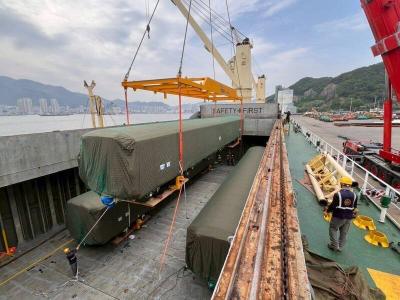
The first of 10 new high-capacity trains purchased from South Korea’s Hyundai Rotem arrived at the Port of Taipei yesterday to meet the demands of an expanding metro network, Taipei Rapid Transit Corp (TRTC) said yesterday. The train completed a three-day, 1,200km voyage from the Port of Masan in South Korea, the company said. Costing NT$590 million (US$18.79 million) each, the new six-carriage trains feature a redesigned interior based on "human-centric" transportation concepts, TRTC said. The design utilizes continuous longitudinal seating to widen the aisles and optimize passenger flow, while also upgrading passenger information displays and driving control systems for a more comfortable

Instead of focusing solely on the threat of a full-scale military invasion, the US and its allies must prepare for a potential Chinese “quarantine” of Taiwan enforced through customs inspections, Stanford University Hoover fellow Eyck Freymann said in a Foreign Affairs article published on Wednesday. China could use various “gray zone” tactics in “reconfiguring the regional and ultimately the global economic order without a war,” said Freymann, who is also a nonresident research fellow at the US Naval War College. China might seize control of Taiwan’s links to the outside world by requiring all flights and ships entering or leaving Taiwan
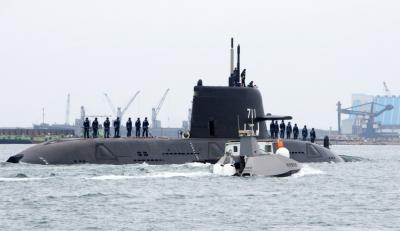
Taiwan's first indigenous defense submarine, the SS-711 Hai Kun (海鯤, or Narwhal), departed for its 13th sea trial at 7am today, marking its seventh submerged test, with delivery to the navy scheduled for July. The outing also marked its first sea deployment since President William Lai (賴清德) boarded the submarine for an inspection on March 19, drawing a crowd of military enthusiasts who gathered to show support. The submarine this morning departed port accompanied by CSBC Corp’s Endeavor Manta (奮進魔鬼魚號) uncrewed surface vessel and a navy M109 assault boat. Amid public interest in key milestones such as torpedo-launching operations and overnight submerged trials,
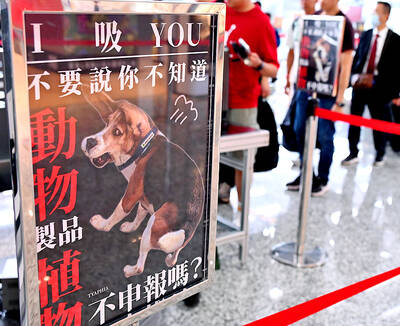
Quarantine awareness posters at Taiwan Taoyuan International Airport have gone viral for their use of wordplay. Issued by the airport branch of the Animal and Plant Health Inspection Agency, the posters feature sniffer dogs making a range of facial expressions, paired with advisory messages built around homophones. “We update the messages for holidays and campaign needs, periodically refreshing materials to attract people’s attention,” quarantine officials said. “The aim is to use the dogs’ appeal to draw focus to quarantine regulations.” A Japanese traveler visiting Taiwan has posted a photo on X of a poster showing a quarantine dog with a


 RSS
RSS