


Chiao Chung-hsing (焦中興) is a rare breed in Taiwan, a former baritone and now a classically-trained violin maker. But far from keeping his trade secrets to himself, this artistic master is keen to pass on his knowledge to anyone who is interested.
Chiao, who has a studio next to National Taiwan Normal University (NTNU), also teaches at the National Taiwan University of Arts in Banciao, Taipei County.
From his studio he runs classes every Saturday where he hands down his skills to pupils from a wide variety of backgrounds; physicians, businesspeople, computer engineers.
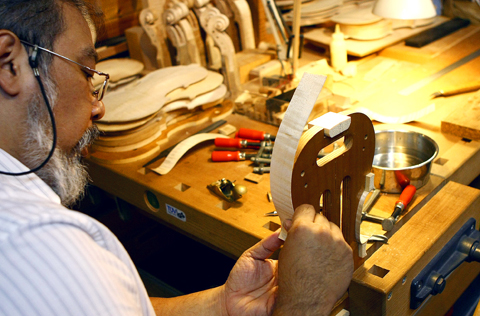
PHOTO: JIMMY CHUANG, TAIPEI TIMES
“I don’t know why so few people are interested in this kind of career,” Chiao said. “I have cornered the market.”
It takes around 200 hours and costs NT$280,000 to learn from Chiao how to make a violin and at the end of the course each pupil ends up with a handmade instrument. Chiao says it takes between one and two years to come up with a top quality handmade violin.
“You do not make a violin in one go,” he said. “It takes several segments or breaks during the process so the maple wood can cure and become more stable and solid. This improves the quality of each instrument.”
After 16 years of making and teaching how to make violins in Taiwan, Chiao has established a reputation and is now recognized as a master, especially after helping violinist Su Shien-ta (蘇顯達) maintain and tune his handmade Stradivarius violin, worth more than US$1 million, before his concert last December.
Su was very impressed by Chiao’s professionalism and the quality of his work.
Another international violinist, Lin Cho-liang (林昭亮), was also impressed after trying one of Chiao’s instruments.
A story in the Chinese-language Ming Sheng Bao on April 2, 2001, reported that after playing spiccato — bowing the strings in such a way that it bounces lightly off the strings — on one of Chiao’s violins, Lin said he believed such a high-quality violin would retain its sound quality for more than 200 years.
Born in 1959, Chiao is a Keelung native and still lives there today. Prior to his violin-making career, Chiao wanted to become a baritone.
“I was not a good child in high school. It took me five years to graduate,” Chiao said. “But, this was also the time when I was inspired to pursue a career in music.”
Chiao said that he spent lots of time playing soccer during his five years at National Keelung Senior High School and neglected the academic side of things, which disappointed his parents. Sometime during his third year, he became entranced by the voice of then trainee music teacher Chien Shan-hua (錢善華), now a professor and a former director of NTNU’s music department.
“I never heard such a beautiful voice,” Chiao said.
Chien encouraged Chiao to take up music and he began practicing piano. But shortly after Chien finished his one-year internship at the high school, he joined the army.
With his inspiration gone, Chiao, who is Christian, vowed to continue practicing the piano at church.
After eventually graduating from high school, Chiao joined the military police’s Harley-Davidson Co where he developed his other passion in life, motorcycles.
To this day he remains very proud of his involvement in the 1980 National Day military parade, in which he rode his Harley.
“Riding big bikes like Harley-Davidsons remains a hobby of mine even today, although I currently do not have one,” he said.
After completing his military service, Chiao got his first job as a sales representative at an air cargo company. But he could not let go of his musical dream.
“I told my boss that I wanted to quit to take college exams. He asked me to take a sabbatical and offered me the chance to come back to the office if I was successful, which I was,” Chiao said.
Graduating from the National College of Arts with an associate degree in vocal music in 1986, Chiao left for Italy with his wife.
After landing cash-strapped in Milan, Chiao earned a living by planting bean spouts for local Chinese restaurants. But in a strange twist of fate this ended up finishing his dream of becoming a baritone, causing him to turn to violin making.
“Bean sprouts are planted in big tanks, which are full of water. I had to move them around and all the lifting injured my spine. After an examination, a doctor said that I could not sing anymore,” Chiao said.
After two years in Milan, Chiao and his wife relocated to Cremona, where he met his most important mentor — Francesco Bissdotti.
Chiao describes his relationship with Bissdotti as like that between “father and son.”
“In all the time I was there, he never hid anything from me. He even treated me better than his real sons,” Chiao said.
Before Chiao decided to return to Taiwan, Bissdotti gave Chiao all his materials for mixing violin varnish.
“There is so much of it that it will be impossible for me to use it all before my next life time,” he said.
Chiao graduated from the Instituto Professionale del Art Liutaio Antonio Stradivari di Cremona in 1992. In the same year he won a silver medal for violin tone during the 10th International Competition and Exhibition by the Violin Society of America in Carlisle, Pennsylvania.
These two facts made Chiao special because the institute only accepts between 10 and 13 applications from foreign students. No Taiwanese has been admitted to the institute since 1998. In addition, Chiao is the only Taiwanese to ever win the medal.
Then, at the age of 33, Chiao decided to come home.
“I wanted to spend more time with my mother,” he said. “I also wanted to share my talents with my fellow Taiwanese.”
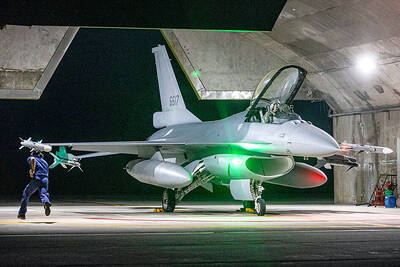
Taiwan has received more than US$70 million in royalties as of the end of last year from developing the F-16V jet as countries worldwide purchase or upgrade to this popular model, government and military officials said on Saturday. Taiwan funded the development of the F-16V jet and ended up the sole investor as other countries withdrew from the program. Now the F-16V is increasingly popular and countries must pay Taiwan a percentage in royalties when they purchase new F-16V aircraft or upgrade older F-16 models. The next five years are expected to be the peak for these royalties, with Taiwan potentially earning
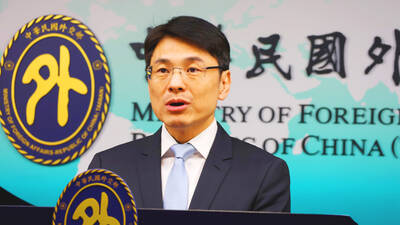
STAY IN YOUR LANE: As the US and Israel attack Iran, the ministry has warned China not to overstep by including Taiwanese citizens in its evacuation orders The Ministry of Foreign Affairs (MOFA) yesterday rebuked a statement by China’s embassy in Israel that it would evacuate Taiwanese holders of Chinese travel documents from Israel amid the latter’s escalating conflict with Iran. Tensions have risen across the Middle East in the wake of US and Israeli airstrikes on Iran beginning Saturday. China subsequently issued an evacuation notice for its citizens. In a news release, the Chinese embassy in Israel said holders of “Taiwan compatriot permits (台胞證)” issued to Taiwanese nationals by Chinese authorities for travel to China — could register for evacuation to Egypt. In Taipei, the ministry yesterday said Taiwan
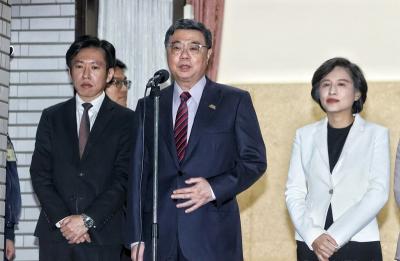
Taiwan is awaiting official notification from the US regarding the status of the Agreement on Reciprocal Trade (ART) after the US Supreme Court ruled US President Donald Trump's global tariffs unconstitutional. Speaking to reporters before a legislative hearing today, Premier Cho Jung-tai (卓榮泰) said that Taiwan's negotiation team remains focused on ensuring that the bilateral trade deal remains intact despite the legal challenge to Trump's tariff policy. "The US has pledged to notify its trade partners once the subsequent administrative and legal processes are finalized, and that certainly includes Taiwan," Cho said when asked about opposition parties’ doubts that the ART was
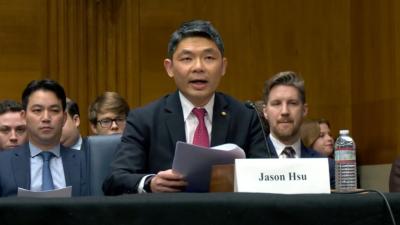
If China chose to invade Taiwan tomorrow, it would only have to sever three undersea fiber-optic cable clusters to cause a data blackout, Jason Hsu (許毓仁), a senior fellow at the Hudson Institute and former Chinese Nationalist Party (KMT) legislator, told a US security panel yesterday. In a Taiwan contingency, cable disruption would be one of the earliest preinvasion actions and the signal that escalation had begun, he said, adding that Taiwan’s current cable repair capabilities are insufficient. The US-China Economic and Security Review Commission (USCC) yesterday held a hearing on US-China Competition Under the Sea, with Hsu speaking on


 RSS
RSS