


The Cabinet yesterday approved the creation of a Taiwan Food and Drug Administration (TFDA), an effort by the government to integrate the Department of Health’s food and medicine screening mechanisms.
During a briefing to reporters after the Cabinet’s weekly meeting yesterday, Minister of Health Yeh Chin-chuan (葉金川) said such an agency, if established, would be responsible for the management and examination of food and drugs and the prevention of the abuse of controlled drugs.
Personnel would be dispatched to each sea port and airport for food and drug examinations, Yeh said. The administration would also be in charge of developing the nation’s biotechnology industry and new medical technologies, such as blood products and stem cell research, Yeh said.
“We will be able to directly mobilize personnel [in response to food scares],” Yeh said. “The establishment of such an administration will be another important landmark in Taiwan’s food and drug safety [history].”
Yeh said the government hoped the legislature would prioritize the draft bill in the current legislative session so that the TFDA could be created early next year. It is expected to include some 600 staffers, experts and researchers, he said.
The Department of Health first began discussing the idea of establishing a food and drug administration about a decade ago, but the draft was not finalized until yesterday.
Yeh dismissed speculation that the planned establishment of the TFDA was entirely in response to recent food scares emanating from China, adding that many food stuffs were also imported from South and Southeast Asia.
Yeh said personnel from the administration would have the authority to inspect the sources of food stuffs in China in line with the cross-strait food safety agreement recently signed by the Straits Exchange Foundation and the Association for Relations Across the Taiwan Strait.
Examination of food stuffs from China would also be conducted in Taiwan, he said.
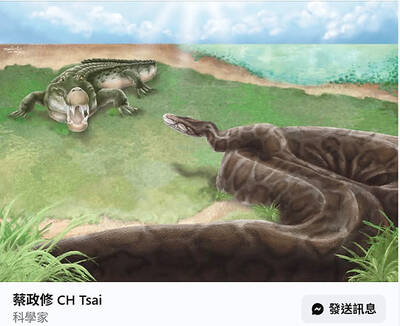
Taiwanese paleontologists have discovered fossil evidence that pythons up to 4m long inhabited Taiwan during the Pleistocene epoch, reporting their findings in the international scientific journal Historical Biology. National Taiwan University (NTU) Institute of Ecology and Evolutionary Biology associate professor Tsai Cheng-hsiu (蔡政修) led the team that discovered the largest snake fossil ever found in Taiwan. The single trunk vertebra was discovered in Tainan at the Chiting Formation, dated to between 400,000 and 800,000 years ago in the Middle Pleistocene, the paper said. The area also produced Taiwan’s first avian fossil, as well as crocodile, mammoth, saber-toothed cat and rhinoceros fossils, it said. Discoveries

Taiwanese paleontologists have discovered fossil evidence that pythons up to 4m long inhabited Taiwan during the Pleistocene epoch, reporting their findings in the international scientific journal Historical Biology. National Taiwan University (NTU) Institute of Ecology and Evolutionary Biology associate professor Tsai Cheng-hsiu (蔡政修) led the team that discovered the largest snake fossil ever found in Taiwan. A single trunk vertebra was discovered in Tainan at the Chiting Formation, dated to between 800,000 to 400,000 years ago in the Middle Pleistocene, the paper said. The area also produced Taiwan’s first avian fossil, as well as crocodile, mammoth, sabre-toothed cat and rhinoceros fossils, it said. Discoveries
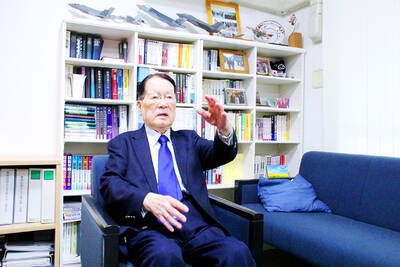
Whether Japan would help defend Taiwan in case of a cross-strait conflict would depend on the US and the extent to which Japan would be allowed to act under the US-Japan Security Treaty, former Japanese minister of defense Satoshi Morimoto said. As China has not given up on the idea of invading Taiwan by force, to what extent Japan could support US military action would hinge on Washington’s intention and its negotiation with Tokyo, Morimoto said in an interview with the Liberty Times (sister paper of the Taipei Times) yesterday. There has to be sufficient mutual recognition of how Japan could provide
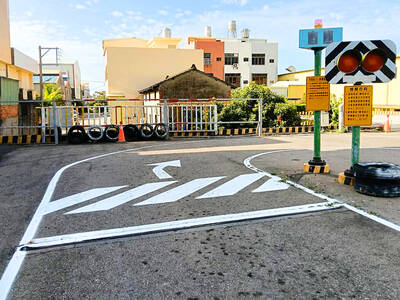
UPDATED TEST: The new rules aim to assess drivers’ awareness of risky behaviors and how they respond under certain circumstances, the Highway Bureau said Driver’s license applicants who fail to yield to pedestrians at intersections or to check blind spots, or omit pointing-and-calling procedures would fail the driving test, the Highway Bureau said yesterday. The change is set to be implemented at the end of the month, and is part of the bureau’s reform of the driving portion of the test, which has been criticized for failing to assess whether drivers can operate vehicles safely. Sedan drivers would be tested regarding yielding to pedestrians and turning their heads to check blind spots, while drivers of large vehicles would be tested on their familiarity with pointing-and-calling


 RSS
RSS