

American Institute in Taiwan (AIT) Director Stephen Young told a press conference yesterday that Taiwan should fully open its market to US beef, but acknowledged that the possibility of the US government and Taiwan signing a free-trade agreement (FTA) was remote.
Young said the US was asking the Taiwanese government to make a “science-based decision” consistent with the tenets laid out by the World Organization for Animal Health (OIE), to allow the comprehensive no-strings attached import of US beef to Taiwan.
Since 2005, Taiwan has twice imposed a partial ban on the meat after two confirmed cases of bovine spongiform encephalopathy (BSE), or mad cow disease, were confirmed in the US. Currently, only bone-free beef from cattle under 30 months of age is allowed for sale in Taiwan.
Some medical research suggests consumption of BSE-tainted beef can lead to fatal brain disease in humans.
The government has been reluctant to lift restrictions, citing a lack of public support on the issue.
Consumers Foundation chairman Hsieh Tien-jen (謝天仁) has repeatedly urged the government not to give in on the issue for the sake of public health.
“The US currently already supplies 32 percent of Taiwan’s beef. It is time for the [Taiwanese public] to enjoy access to the same range of US beef and beef products that US consumers eat and enjoy every day,” Young said, urging the Taiwanese government to also increase imports of US pork, rice, fruit and wheat.
Young did not sound optimistic about a Taiwan-US FTA, saying that the subject remained a bone of contention in the US Congress.
This year’s annual bilateral Trade and Investment Framework Agreement talk had yet to be scheduled, Young said, even though in July he mentioned the talks would be held in Taipei later this year.
The Ministry of Foreign Affairs said the US side has suspended talks on Taiwan-US trade issues until the beef dilemma is resolved.
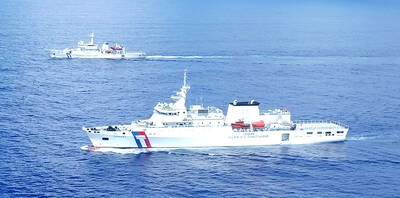
‘FRIENDSHIP FLEET’: A CGA official is scheduled to meet with the president of the Pacific nation, while one of the ships is to host a banquet and National Day event Two Coast Guard Administration (CGA) patrol vessels have docked at Malakal Harbor in Palau as part of an expedition exercise and diplomatic visit, during which a senior official is expected to meet with Palauan President Surangel Whipps Jr, the agency said yesterday. The two vessels, the 4,000-tonne-class Chiayi and the 1,000-tonne-class Penghu, set sail for Palau from Taiwan last week and arrived on Tuesday at Malakal Harbor, the CGA’s Fleet Branch said in a statement. The journey marks the second time the CGA has dispatched a “friendship fleet” to another country, after it sent its first-ever goodwill fleet, comprising the Hualien and
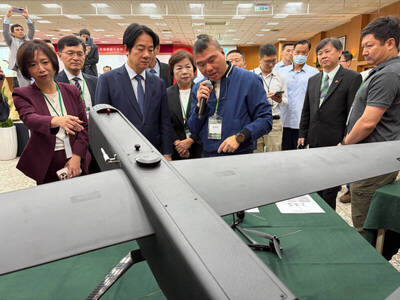
Two executives of drone supplier Jiin Ming Industry Co (錦明實業) have been detained and held incommunicado over the company's alleged use of prohibited China-made chips and camera lenses in drones supplied under recent military contracts, the Taoyuan District Prosecutors' Office said today. In a statement, prosecutors said they raided the offices of Jiin Ming — headquartered in Taoyuan — as well as those of its subsidiaries and its suppliers on Thursday last week. The raids followed a report that the company had breached its procurement contracts by putting the prohibited components into drones delivered to the military. During the raids, prosecutors summoned

South Korean boy band BigBang drew 120,000 fans to three concerts at Taipei Dome from Friday through yesterday, as the band thanked them for their support over their 20-year career. The Taipei Dome concerts were part of BigBang's "2026-2027 World Tour XX: Cosmos." Friday's concert was BigBang's first performance in Taiwan in 11 years. During the encore, group leader G-Dragon (GD) shouted "I love you" in Chinese and said he was especially happy to perform in Taiwan with bandmates Taeyang and Daesung. "Taipei, I'm very grateful to you all," GD said in Chinese, asking fans to wait for the band's return. Daesung thanked
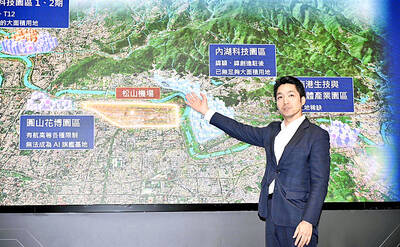
DETAILED PLAN NEEDED: Relocating the airport would affect not just travelers, but also undermine national defense and emergency medical services, a legislator said Taipei Mayor Chiang Wan-an (蔣萬安) yesterday proposed relocating Taipei International Airport (Songshan airport) and turning the site into an artificial intelligence (AI) park, drawing opposition from politicians across party lines. Chiang’s plan would turn the 300 hectares into an AI park featuring tech clusters, residential communities and green space. The industrial cluster would host 200 domestic enterprises, generate NT$12 trillion (US$376.47 billion) in output, and accommodate 65,000 jobs and 35,000 residents, he said. Cabinet spokeswoman Michelle Lee (李慧芝) said the Executive Yuan was surprised by the announcement, as the Taipei City Government did not discuss the proposal with the central government before making


 RSS
RSS