


Former president Chen Shui-bian’s (陳水扁) son Chen Chih-chung (陳致中) and daughter Chen Hsing-yu (陳幸妤) irritated judges yesterday when they appeared as witnesses in the case against former Bureau of Investigation director-general Yeh Sheng-mao (葉盛茂) at the Taipei District Court.
Yeh stands accused of withholding official documents and leaking classified information.
Yeh, who was director-general for six years under Chen Shui-bian, has been detained since last month on charges of leaking national secrets.
Yeh has been accused of covering up for Chen Shui-bian and warning the former president that an international organization was investigating his family for suspected money laundering.
If convicted, Yeh faces at least five years in jail.
“Are you trying to tell me that the evidence I have here is nonsense?” Judge Tseng Cheng-lung (曾正龍) shouted at Chen Chih-chung.
Tseng became visibly angry at Chen Chih-chung’s responses during the hearing.
Tseng asked Chen Chih-chung why it was necessary for his family members to transfer their money between accounts.
Chen Chih-chung answered that it was for “security reasons.”
Tseng then went on to ask him why security was such a concern when all the accounts were in the names of his family members and the money in those accounts belonged to them.
“Of course they need to remain confidential. Are you telling me that I should make public the details of these accounts?” Chen Chih-chung said.
Chen Hsing-yu further annoyed the judges when she said, “My family is being oppressed by the judiciary.”
“May I remind you that those kinds of comments are inappropriate for a courtroom. We would not be questioning you unless we had reliable evidence showing wrongdoing by either you or your family members,” Tseng said.
The hearing began at 9:30am.
Judges Lee Ying-hao (李英豪), Tseng Cheng-lung (曾正龍) and Yang Tai-ching (楊台清) summoned former presidential adviser Wu Li-pei (吳澧培), Chen Chih-chung, his wife Huang Jui-ching (黃睿靚) and Chen Hsing-yu.
All of them reported to the court on time, with Wu arriving early.
Judges began the hearing with Wu’s testimony. The former presidential adviser and senior Taiwan independence figure explained in detail how Chen Shui-bian had wired a total of US$1.91 million to four of his foreign bank accounts in Hong Kong on Feb. 22 this year.
Chen Shui-bian had claimed during an earlier hearing that the money was for “secret diplomatic work” with the US.
Tseng asked Wu why he did not question Chen Shui-bian about the money given that he had previously told judges that a president had never done anything like this before.
Wu said that “he was moved and touched” when he learned that a man who was getting ready to stand down as president would donate such a large amount of money for the country’s benefit.
He told judges that he learned about the entire alleged money laundering case by reading newspapers.
“As you know, 80 percent of local news coverage is not trustworthy. Plus, I was so touched by what he was willing to do that I did not question him or ask where the money came from,” Wu said.
Chen Hsing-yu’s questioning lasted only about 15 minutes, as she continued to deny any knowledge of the money transfers concerned.
Following Chen Hsing-yu, Chen Chih-chung explained in detail the purposes of his seven foreign trips between 2006 and last year. Except for one family trip to Bangkok on Dec. 14, last year, he flew to New York four times, Los Angeles once and once to Charlottesville, Virginia, to “terminate his apartment lease” and “meet with professors and school authorities about his ongoing degree applications.”
He told judges that he and his wife were just following his “mother’s orders” when they opened bank accounts and made the money transfers in question.
Huang was questioned last during yesterday’s hearing. With her voice quivering, she also told judges that she was “following her mother-in-law’s orders.”
Judges decided to convene another hearing on Thursday.

LOUD AND PROUD Taiwan might have taken a drubbing against Australia and Japan, but you might not know it from the enthusiasm and numbers of the fans Taiwan might not be expected to win the World Baseball Classic (WBC) but their fans are making their presence felt in Tokyo, with tens of thousands decked out in the team’s blue, blowing horns and singing songs. Taiwanese fans have packed out the Tokyo Dome for all three of their games so far and even threatened to drown out home team supporters when their team played Japan on Friday. They blew trumpets, chanted for their favorite players and had their own cheerleading squad who dance on a stage during the game. The team struggled to match that exuberance on the field, with
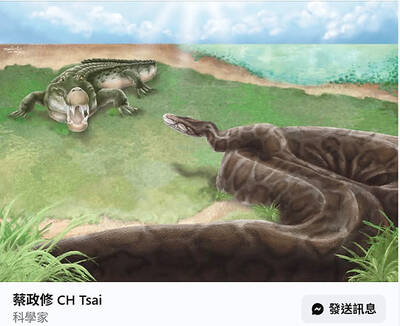
Taiwanese paleontologists have discovered fossil evidence that pythons up to 4m long inhabited Taiwan during the Pleistocene epoch, reporting their findings in the international scientific journal Historical Biology. National Taiwan University (NTU) Institute of Ecology and Evolutionary Biology associate professor Tsai Cheng-hsiu (蔡政修) led the team that discovered the largest snake fossil ever found in Taiwan. The single trunk vertebra was discovered in Tainan at the Chiting Formation, dated to between 400,000 and 800,000 years ago in the Middle Pleistocene, the paper said. The area also produced Taiwan’s first avian fossil, as well as crocodile, mammoth, saber-toothed cat and rhinoceros fossils, it said. Discoveries

Taiwanese paleontologists have discovered fossil evidence that pythons up to 4m long inhabited Taiwan during the Pleistocene epoch, reporting their findings in the international scientific journal Historical Biology. National Taiwan University (NTU) Institute of Ecology and Evolutionary Biology associate professor Tsai Cheng-hsiu (蔡政修) led the team that discovered the largest snake fossil ever found in Taiwan. A single trunk vertebra was discovered in Tainan at the Chiting Formation, dated to between 800,000 to 400,000 years ago in the Middle Pleistocene, the paper said. The area also produced Taiwan’s first avian fossil, as well as crocodile, mammoth, sabre-toothed cat and rhinoceros fossils, it said. Discoveries
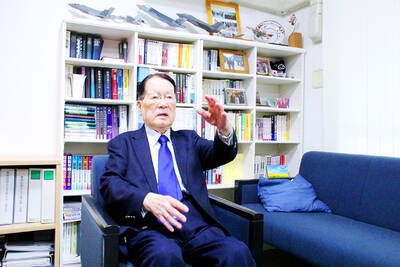
Whether Japan would help defend Taiwan in case of a cross-strait conflict would depend on the US and the extent to which Japan would be allowed to act under the US-Japan Security Treaty, former Japanese minister of defense Satoshi Morimoto said. As China has not given up on the idea of invading Taiwan by force, to what extent Japan could support US military action would hinge on Washington’s intention and its negotiation with Tokyo, Morimoto said in an interview with the Liberty Times (sister paper of the Taipei Times) yesterday. There has to be sufficient mutual recognition of how Japan could provide


 RSS
RSS