


Calling on people to join the Democratic Progressive Party’s (DPP) rally to “besiege” Association for Relations Across the Taiwan Strait Chairman Chen Yunlin (陳雲林) when he meets President Ma Ying-jeou (馬英九) today, DPP Chairwoman Tsai Ing-wen (蔡英文) said yesterday she would take full responsibility for the rally.
Tsai said the DPP would do all it can to hold a peaceful demonstration, but that it cannot guarantee that protesters would not be radicalized if police denied them their right to free expression.
The DPP-organized “Yellow Ribbon Siege” will start at 1pm, with protesters walking to the Taipei Guest House on Ketagalan Boulevard and besiege the Boai District (博愛), chanting slogans and using horns, bells, whistles and other objects to generate noise, DPP spokesman Cheng Wen-tsang (鄭文燦) said.

PHOTO: LIN CHENG-KUNG, TAIPEI TIMES
Cheng said that the party expects 100,000 to take part in the rally.
“We will let Ma and Chen hear the voice of the people,” he said.
After initially denying the DPP permission to hold the rally, the Taipei City Police Department yesterday afternoon announced it had given the DPP permission.
Saying that the DPP is not opposed to cross-Taiwan Strait exchanges or dialogue to help maintain stability and peace, Tsai said the party is simply worried that Taiwan is paying too high a price.
“Balance has been lost on this visit [by Chen]. Taiwan is paying too high a political price in terms of sovereignty, democracy, freedom of speech and all other forms of expression commonly enjoyed in a free and democratic society,” Tsai said.
“I am depressed because we are going through a dark period in Taiwan’s history,” she said. “People’s rights, personal liberties, freedom of speech and judicial rights were seriously violated in the past couple of days. Facing an authoritarian government, the party had no choice but to take to the streets, just as it fought for Taiwan’s democracy before.”
At a separate setting yesterday, National Police Agency director-general Wang Cho-chiun (王卓鈞) denied allegations that government officials had ordered the confiscation of Republic of China flags, and rebutted rumors that local police departments in central and southern Taiwan were to stop any bus heading to Taipei carrying demonstrators on their way to the rally.
“Our goal has always been to protect all legal activities, block illegal ones and sanction violent acts,” Wang said, acknowledging that there are had been problems in how police had handled demonstrators.
He said, however, that police had acted within the law.
Wang said all police officers on duty would follow three main guidelines: act according to the law, remain neutral and strictly reinforce the law.
“So far, all police action has respected the legal framework,” he said. “Although I have to say that some officers do need to improve their skills and attitude.”
Taiwan Solidarity Union (TSU) Chairman Huang Kun-huei (黃昆輝) said yesterday he would also lead TSU supporters at the rally.
The Chinese Nationalist Party (KMT) caucus urged the DPP to call off its plan to “besiege” the Taipei Guest House during Ma’s meeting with Chen.
Calling the plan “illegal,” KMT caucus deputy secretary-general Yang Chiung-ying (楊瓊瓔) yesterday urged Tsai to “stop throwing Taiwan into chaos.”
ADDITIONAL REPORTING BY FLORA WANG
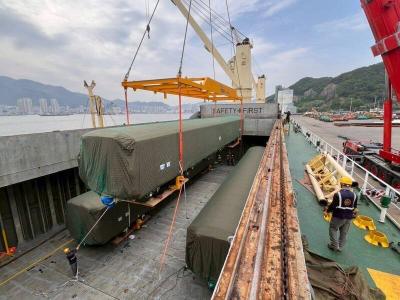
The first of 10 new high-capacity trains purchased from South Korea’s Hyundai Rotem arrived at the Port of Taipei yesterday to meet the demands of an expanding metro network, Taipei Rapid Transit Corp (TRTC) said yesterday. The train completed a three-day, 1,200km voyage from the Port of Masan in South Korea, the company said. Costing NT$590 million (US$18.79 million) each, the new six-carriage trains feature a redesigned interior based on "human-centric" transportation concepts, TRTC said. The design utilizes continuous longitudinal seating to widen the aisles and optimize passenger flow, while also upgrading passenger information displays and driving control systems for a more comfortable
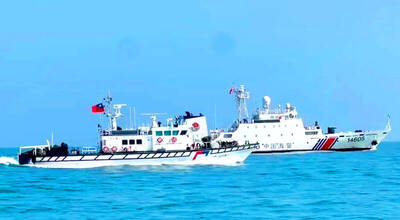
Instead of focusing solely on the threat of a full-scale military invasion, the US and its allies must prepare for a potential Chinese “quarantine” of Taiwan enforced through customs inspections, Stanford University Hoover fellow Eyck Freymann said in a Foreign Affairs article published on Wednesday. China could use various “gray zone” tactics in “reconfiguring the regional and ultimately the global economic order without a war,” said Freymann, who is also a nonresident research fellow at the US Naval War College. China might seize control of Taiwan’s links to the outside world by requiring all flights and ships entering or leaving Taiwan
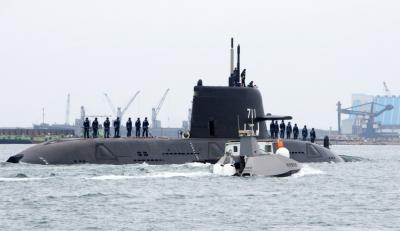
Taiwan's first indigenous defense submarine, the SS-711 Hai Kun (海鯤, or Narwhal), departed for its 13th sea trial at 7am today, marking its seventh submerged test, with delivery to the navy scheduled for July. The outing also marked its first sea deployment since President William Lai (賴清德) boarded the submarine for an inspection on March 19, drawing a crowd of military enthusiasts who gathered to show support. The submarine this morning departed port accompanied by CSBC Corp’s Endeavor Manta (奮進魔鬼魚號) uncrewed surface vessel and a navy M109 assault boat. Amid public interest in key milestones such as torpedo-launching operations and overnight submerged trials,
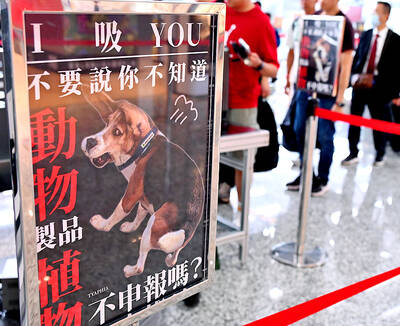
Quarantine awareness posters at Taiwan Taoyuan International Airport have gone viral for their use of wordplay. Issued by the airport branch of the Animal and Plant Health Inspection Agency, the posters feature sniffer dogs making a range of facial expressions, paired with advisory messages built around homophones. “We update the messages for holidays and campaign needs, periodically refreshing materials to attract people’s attention,” quarantine officials said. “The aim is to use the dogs’ appeal to draw focus to quarantine regulations.” A Japanese traveler visiting Taiwan has posted a photo on X of a poster showing a quarantine dog with a


 RSS
RSS