


Beijing should apologize for exporting melamine-contaminated milk powder to Taiwan before its top cross-strait negotiator arrives, a new opinion poll says.
The poll by the China Credit Information Service found that more than 52 percent of respondents said the Chinese Communist Party government should apologize to Taiwan for the milk-powder scandal, while nearly 38 percent said they disagreed.
Local consumers reacted angrily after 25 tonnes of milk powder imported from China in June was found to contain traces of the industrial chemical melamine.
The government has asked China for compensation for Taiwanese consumers from the companies responsible.
Premier Liu Chao-shiuan (劉兆玄) has also demanded Beijing apologize, but Beijing has not responded to the request.
The scare over Chinese-made food products has become a sensitive issue in bilateral relations ahead of a planned visit by Association for Relations Across the Taiwan Strait (ARATS) Chairman Chen Yunlin (陳雲林).
Chen is scheduled to arrive later this month or early next month to hold talks with his Taiwanese counterpart, Straits Exchange Foundation (SEF) Chairman Chiang Pin-kung (江丙坤).
The Democratic Progressive Party (DPP) is planning to stage a protest against Chen’s visit on Oct. 25.
While the Chinese Nationalist Party (KMT) administration has adopted many China-friendly policies since it took office, the survey found that nearly 65 percent of respondents feel Beijing is unfriendly to Taiwan’s government and nearly 46 percent said it was unfriendly to Taiwanese.
The survey also found a sharp increase in support for Taiwan independence.
Chao Chien-min (趙建民), a professor at National Chengchi University’s Graduate Institute of Development Studies, said that it remained to be seen whether the increase in support had anything to do with the milk powder controversy.
Chou Jih-shine (周繼祥), chairman of the Asia-Pacific Elite Interchange Association, said that this might have something to do with the apprehension of activists over the administration’s China-friendly policies.
Chang Wu-ueh (張五岳), pointed to the record low percentage of support for unification with China.
He urged the DPP to welcome Chen’s upcoming visit, because the more problems both sides have, the more communication is necessary.
Mainland Affairs Council Vice Chairman Liu Te-shun (劉德勳) said despite the dramatic growth in support for independence, the percentage of people supporting the status quo and those moving toward independence showed a substantial decline.
A total of 1,081 adults were questioned in the poll between Friday and Sunday.
Meanwhile, MAC Vice Chairman Fu Don-cheng (傅棟成) said the Chinese government is the main obstacle in exchanges between Chinese professionals and Taiwan.
Fu said government agencies examining measures governing exchange activities of Chinese professionals and hoped to complete a report within a month.
Fu made the remark during a question-and-answer session after he delivered a speech at an award ceremony for cross-strait professional exchanges and a forum to discuss the current situation.
Fu was asked whether Taiwan’s regulations on Chinese professionals seeking to conduct exchanges were too rigid.
He said the main obstacle for such exchanges was China’s onerous restrictions, not Taiwan.
In related news, National Police Agency Director-General Wang Cho-chun (王卓鈞) told lawmakers yesterday that his officers were up to the task of protecting Chen.
“The police are ready. But I cannot reveal any details as no plans for his trip are available at the moment,” Wang told lawmakers after he was asked about security measures for Chen.
Chinese Nationalist Party (KMT) Legislator Lee Chia-chin (李嘉進) said that it would be good for Chen to experience Taiwan’s democracy as the DPP rally would probably take place during his visit.
Lee, however, urged the police to be vigilant as any incident involving Chen could cause political friction.
DPP Legislator Chiu Yi-ying (邱議瑩) said that since Chen was not a national leader, police protection should be sufficient.
“I do not think National Security Bureau forces should be required,” she said.
Wang said that the police are experienced and that there would not be any problems.
ADDITIONAL REPORTING BY JIMMY CHUANG
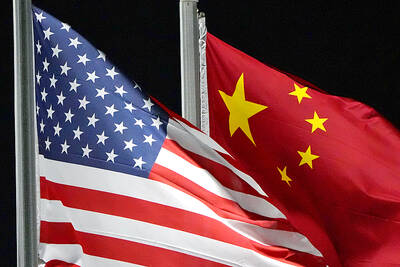
The brilliant blue waters, thick foliage and bucolic atmosphere on this seemingly idyllic archipelago deep in the Pacific Ocean belie the key role it now plays in a titanic geopolitical struggle. Palau is again on the front line as China, and the US and its allies prepare their forces in an intensifying contest for control over the Asia-Pacific region. The democratic nation of just 17,000 people hosts US-controlled airstrips and soon-to-be-completed radar installations that the US military describes as “critical” to monitoring vast swathes of water and airspace. It is also a key piece of the second island chain, a string of
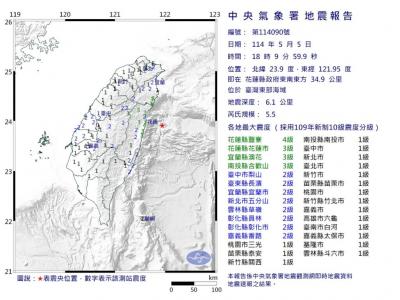
A magnitude 5.9 earthquake that struck about 33km off the coast of Hualien City was the "main shock" in a series of quakes in the area, with aftershocks expected over the next three days, the Central Weather Administration (CWA) said yesterday. Prior to the magnitude 5.9 quake shaking most of Taiwan at 6:53pm yesterday, six other earthquakes stronger than a magnitude of 4, starting with a magnitude 5.5 quake at 6:09pm, occurred in the area. CWA Seismological Center Director Wu Chien-fu (吳健富) confirmed that the quakes were all part of the same series and that the magnitude 5.5 temblor was

Taiwan will now have four additional national holidays after the Legislative Yuan passed an amendment today, which also made Labor Day a national holiday for all sectors. The Chinese Nationalist Party (KMT) and Taiwan People’s Party (TPP) used their majority in the Legislative Yuan to pass the amendment to the Act on Implementing Memorial Days and State Holidays (紀念日及節日實施辦法), which the parties jointly proposed, in its third and final reading today. The legislature passed the bill to amend the act, which is currently enforced administratively, raising it to the legal level. The new legislation recognizes Confucius’ birthday on Sept. 28, the
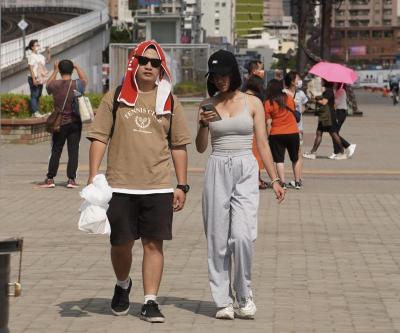
The Central Weather Administration has issued a heat alert for southeastern Taiwan, warning of temperatures as high as 36°C today, while alerting some coastal areas of strong winds later in the day. Kaohsiung’s Neimen District (內門) and Pingtung County’s Neipu Township (內埔) are under an orange heat alert, which warns of temperatures as high as 36°C for three consecutive days, the CWA said, citing southwest winds. The heat would also extend to Tainan’s Nansi (楠西) and Yujing (玉井) districts, as well as Pingtung’s Gaoshu (高樹), Yanpu (鹽埔) and Majia (瑪家) townships, it said, forecasting highs of up to 36°C in those areas


 RSS
RSS