


Hyalella azteca, a small amphipod commonly found in the aquatic system in North America, may provide the Environmental Protection Administration’s (EPA) National Institute of Environmental Analysis with a new level of sensitivity in its biotoxicity testing of rivers and sediments, the EPA said yesterday.
Amphipods are an order of animals that includes more than 7,000 described species of shrimp-like crustaceans.
The development was the result of a successful preliminary technical transfer from the US Geological Survey and the US Environmental Protection Agency to Taiwan, researcher Yang Hsi-nan (楊喜男) said.
ADVANTAGES
Before the hyalella, the institute had employed other live creatures — such as carp — as biotoxicity testers for toxins in river systems as well as treated water going into them, Yang said, adding that the hyalella offers many advantages that the other creatures do not.
“Because of its biological traits, the hyalella can provide a sensitivity to toxins that is up to 10 times that of carp,” Yang said.
This means that carp may detect toxic elements at 10 parts per million (ppm), but the hyalella can offer a positive test result for as low as 1ppm, he said.
Toxicity — usually pertaining to chemicals or metal residues — is usually measured in water and sediment in terms of “lethal concentration,” Yang said.
“For example, in acute biotoxicity tests, the lethal concentration is the concentration that kills half of the tested culture in a given amount of time [usually under 96 hours],” he said.
SENSITIVITY
The hyalella’s high sensitivity also means that test times can be shortened, Yang said, adding that the creature is cheap — the hyalella is about NT$100 per culture but carp are about NT$5,000 each.
Another advantage is that the hyalella can be used in the testing of 2,000 to 3,000 different types of toxins, Yang said.
So far, the institute had tested the crustacean in river water and sediment collected from Taipei’s Tamsui and Keelung rivers, Yang said, adding that after the initial testing is completed the creature would be applied to other river systems.
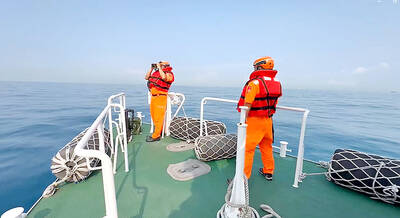
An increase in Taiwanese boats using China-made automatic identification systems (AIS) could confuse coast guards patrolling waters off Taiwan’s southwest coast and become a loophole in the national security system, sources familiar with the matter said yesterday. Taiwan ADIZ, a Facebook page created by enthusiasts who monitor Chinese military activities in airspace and waters off Taiwan’s southwest coast, on Saturday identified what seemed to be a Chinese cargo container ship near Penghu County. The Coast Guard Administration went to the location after receiving the tip and found that it was a Taiwanese yacht, which had a Chinese AIS installed. Similar instances had also

GOOD DIPLOMACY: The KMT has maintained close contact with representative offices in Taiwan and had extended an invitation to Russia as well, the KMT said The Chinese Nationalist Party (KMT) would “appropriately handle” the fallout from an invitation it had extended to Russia’s representative to Taipei to attend its international banquet last month, KMT Chairman Eric Chu (朱立倫) said yesterday. US and EU representatives in Taiwan boycotted the event, and only later agreed to attend after the KMT rescinded its invitation to the Russian representative. The KMT has maintained long-term close contact with all representative offices and embassies in Taiwan, and had extended the invitation as a practice of good diplomacy, Chu said. “Some EU countries have expressed their opinions of Russia, and the KMT respects that,” he

AMENDMENT: Contact with certain individuals in China, Hong Kong and Macau must be reported, and failure to comply could result in a prison sentence, the proposal stated The Chinese Nationalist Party (KMT) and the Taiwan People’s Party (TPP) yesterday voted against a proposed bill by Democratic Progressive Party (DPP) lawmakers that would require elected officials to seek approval before visiting China. DPP Legislator Puma Shen’s (沈伯洋) proposed amendments to the Act Governing Relations Between the People of the Taiwan Area and the Mainland Area (臺灣地區與大陸地區人民關係條例), stipulate that contact with certain individuals in China, Hong Kong and Macau should be reported, while failure to comply would be punishable by prison sentences of up to three years, alongside a fine of NT$10 million (US$309,041). Fifty-six voted with the TPP in opposition

VIGILANCE: The military is paying close attention to actions that might damage peace and stability in the region, the deputy minister of national defense said The People’s Republic of China (PRC) might consider initiating a hack on Taiwanese networks on May 20, the day of the inauguration ceremony of president-elect William Lai (賴清德), sources familiar with cross-strait issues said. While US Secretary of State Anthony Blinken’s statement of the US expectation “that all sides will conduct themselves with restraint and prudence in the period ahead” would prevent military actions by China, Beijing could still try to sabotage Taiwan’s inauguration ceremony, the source said. China might gain access to the video screens outside of the Presidential Office Building and display embarrassing messages from Beijing, such as congratulating Lai


 RSS
RSS