


Legislative Speaker Wang Jin-pyng (王金平), who also serves as chairman of the Taiwan Foundation for Democracy (TFD), yesterday denied a media report that the Ministry of Foreign Affairs (MOFA) had attempted to interfere in the non-governmental foundation’s affairs.
“How could this be possible?” Wang said. “The Minister of Foreign Affairs [Francisco Ou (歐鴻鍊)] would not dare to interfere in the speaker’s business ... he was only checking if the foundation needed to make a personnel reshuffle.”
Wang said he had turned down Ou’s enquiry about a reshuffle.
“I dismissed the need [to reshuffle personnel]. We are [an] impartial and independent [organization] and he completely respected us,” Wang said.
Wang was responding to a Liberty Times (the Taipei Times’ sister newspaper) story yesterday quoting Wang as saying that Ou mentioned a personnel reshuffle to him but that Wang had rejected the suggestion.
The story cited anonymous sources as saying that Ou hoped to replace the foundation’s chief executive officer and three deputy executive officers.
Wang yesterday said that although the foundation is funded by MOFA, it is non-partisan.
Its role is to promote Taiwan’s democracy and help the world understand the nation’s democratic system, he said, adding it had recently hired consultants including two former ministers of foreign affairs, James Huang (黃志芳) and Mark Chen (陳唐山).
The Chinese Nationalist Party (KMT) government has been accused of attempting to interfere in several organizations.
Last week, a group of board members at Radio Taiwan International resigned after accusing the Government Information Office (GIO) of trying to prevent the radio station from criticizing China — an accusation GIO Minister Vanessa Shih (史亞平) denied.
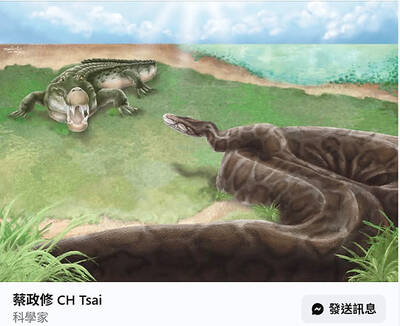
Taiwanese paleontologists have discovered fossil evidence that pythons up to 4m long inhabited Taiwan during the Pleistocene epoch, reporting their findings in the international scientific journal Historical Biology. National Taiwan University (NTU) Institute of Ecology and Evolutionary Biology associate professor Tsai Cheng-hsiu (蔡政修) led the team that discovered the largest snake fossil ever found in Taiwan. The single trunk vertebra was discovered in Tainan at the Chiting Formation, dated to between 400,000 and 800,000 years ago in the Middle Pleistocene, the paper said. The area also produced Taiwan’s first avian fossil, as well as crocodile, mammoth, saber-toothed cat and rhinoceros fossils, it said. Discoveries

Taiwanese paleontologists have discovered fossil evidence that pythons up to 4m long inhabited Taiwan during the Pleistocene epoch, reporting their findings in the international scientific journal Historical Biology. National Taiwan University (NTU) Institute of Ecology and Evolutionary Biology associate professor Tsai Cheng-hsiu (蔡政修) led the team that discovered the largest snake fossil ever found in Taiwan. A single trunk vertebra was discovered in Tainan at the Chiting Formation, dated to between 800,000 to 400,000 years ago in the Middle Pleistocene, the paper said. The area also produced Taiwan’s first avian fossil, as well as crocodile, mammoth, sabre-toothed cat and rhinoceros fossils, it said. Discoveries
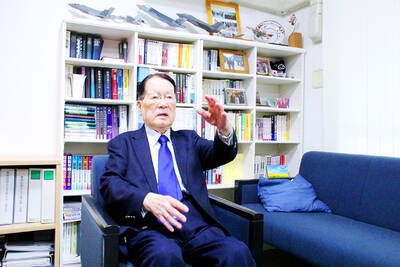
Whether Japan would help defend Taiwan in case of a cross-strait conflict would depend on the US and the extent to which Japan would be allowed to act under the US-Japan Security Treaty, former Japanese minister of defense Satoshi Morimoto said. As China has not given up on the idea of invading Taiwan by force, to what extent Japan could support US military action would hinge on Washington’s intention and its negotiation with Tokyo, Morimoto said in an interview with the Liberty Times (sister paper of the Taipei Times) yesterday. There has to be sufficient mutual recognition of how Japan could provide
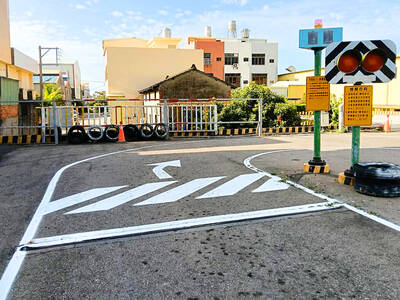
UPDATED TEST: The new rules aim to assess drivers’ awareness of risky behaviors and how they respond under certain circumstances, the Highway Bureau said Driver’s license applicants who fail to yield to pedestrians at intersections or to check blind spots, or omit pointing-and-calling procedures would fail the driving test, the Highway Bureau said yesterday. The change is set to be implemented at the end of the month, and is part of the bureau’s reform of the driving portion of the test, which has been criticized for failing to assess whether drivers can operate vehicles safely. Sedan drivers would be tested regarding yielding to pedestrians and turning their heads to check blind spots, while drivers of large vehicles would be tested on their familiarity with pointing-and-calling


 RSS
RSS