


The nation’s top cross-strait negotiator yesterday remained evasive about whether he would request compensation and ask his Chinese counterpart to apologize to the Taiwanese public for the contaminated milk powder scandal and request compensation.
Straits Exchange Foundation (SEF) Chairman Chiang Pin-kung (江丙坤) said yesterday that the foundation would definitely “communicate” with Beijing if the Mainland Affairs Council (MAC) asked the foundation to seek an apology from China over the tainted milk scandal.
When asked whether he would ask his Chinese counterpart — Association for Relations Across the Taiwan Strait (ARATS) Chairman Chen Yunlin (陳雲林) — to apologize or bring up the issue of compensation when he visits Taiwan later this month or early next month, Chiang said he would “exchange views with Chen on issues placed on the agenda.”
Chiang said the administration’s policy has always been to address trade problems through the communication channel between SEF and ARATS.
Chiang said that talks on sea and transportation links would be on the agenda, adding that once such links are established, it would save not only time but also money.
It will also boost the competitiveness of Taiwanese products and make travel more convenient for people on both sides of the Strait, Chiang said, adding that he believed Taiwanese would support the normalization of cross-strait trade.
Asked about the effectiveness of sending a delegation of food safety experts and officials to Beijing to deal with the tainted milk powder issue, Chiang said the delegation, which returned on Monday, had fulfilled its mission.
Both sides have agreed to set up a direct communication channel and promised to cooperate on food inspection, Chiang said, adding that he believed the delegation had “made certain demands” during their trip to China.
Chiang remained tight-lipped yesterday about the exact date for Chen’s visit, saying both sides have to “closely cooperate” on the matter.
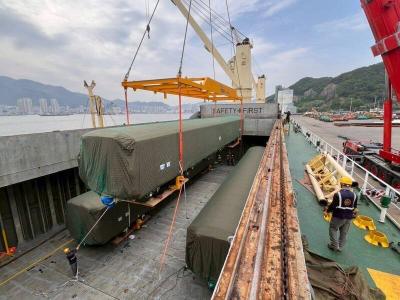
The first of 10 new high-capacity trains purchased from South Korea’s Hyundai Rotem arrived at the Port of Taipei yesterday to meet the demands of an expanding metro network, Taipei Rapid Transit Corp (TRTC) said yesterday. The train completed a three-day, 1,200km voyage from the Port of Masan in South Korea, the company said. Costing NT$590 million (US$18.79 million) each, the new six-carriage trains feature a redesigned interior based on "human-centric" transportation concepts, TRTC said. The design utilizes continuous longitudinal seating to widen the aisles and optimize passenger flow, while also upgrading passenger information displays and driving control systems for a more comfortable
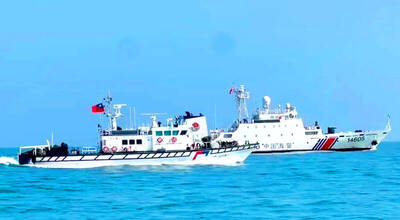
Instead of focusing solely on the threat of a full-scale military invasion, the US and its allies must prepare for a potential Chinese “quarantine” of Taiwan enforced through customs inspections, Stanford University Hoover fellow Eyck Freymann said in a Foreign Affairs article published on Wednesday. China could use various “gray zone” tactics in “reconfiguring the regional and ultimately the global economic order without a war,” said Freymann, who is also a nonresident research fellow at the US Naval War College. China might seize control of Taiwan’s links to the outside world by requiring all flights and ships entering or leaving Taiwan
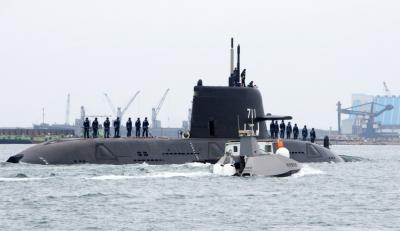
Taiwan's first indigenous defense submarine, the SS-711 Hai Kun (海鯤, or Narwhal), departed for its 13th sea trial at 7am today, marking its seventh submerged test, with delivery to the navy scheduled for July. The outing also marked its first sea deployment since President William Lai (賴清德) boarded the submarine for an inspection on March 19, drawing a crowd of military enthusiasts who gathered to show support. The submarine this morning departed port accompanied by CSBC Corp’s Endeavor Manta (奮進魔鬼魚號) uncrewed surface vessel and a navy M109 assault boat. Amid public interest in key milestones such as torpedo-launching operations and overnight submerged trials,
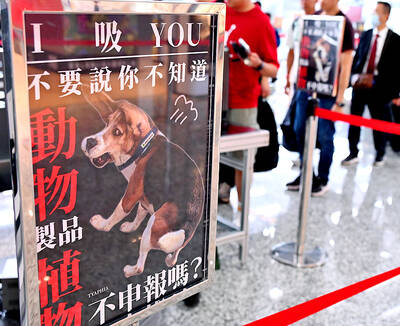
Quarantine awareness posters at Taiwan Taoyuan International Airport have gone viral for their use of wordplay. Issued by the airport branch of the Animal and Plant Health Inspection Agency, the posters feature sniffer dogs making a range of facial expressions, paired with advisory messages built around homophones. “We update the messages for holidays and campaign needs, periodically refreshing materials to attract people’s attention,” quarantine officials said. “The aim is to use the dogs’ appeal to draw focus to quarantine regulations.” A Japanese traveler visiting Taiwan has posted a photo on X of a poster showing a quarantine dog with a


 RSS
RSS