


The Cabinet yesterday approved a bill regulating research involving human embryos and stem cells while banning human cloning.
The draft bill, which will be sent to the legislature, stipulates a prison sentence of one to seven years and fines of NT$2 million (US$65,000) for researchers found guilty of violating the ban.
The Cabinet’s proposal marked the first time the executive branch has referred regulations on the research field to the legislature.
The draft says the regulation is intended to ensure freedom of scientific research while preventing unethical reproduction of human embryos and stem cells out of respect for human dignity.
“The potential for health treatment from research into human embryos and stem cells is exciting, but the controversy surrounding the experiments concerning ethics, life and culture should also be addressed,” Premier Liu Chao-shiuan (劉兆玄) told the Cabinet meeting.
In related news, the Cabinet yesterday held a two-day conference for senior Cabinet officials to intensify coordination among various agencies on key policies.
President Ma Ying-jeou (馬英九), top officials from the Presidential Office and Cabinet officials spent the night at an employee training center owned by the Bank of Taiwan last night and were to go on a mountain hike this morning.
Ma praised the premier and his Cabinet for their performance over the past two months, saying they had accomplished a lot that had been left unfinished over the past 10 years and that will benefit the public and influence the country’s long-term development.
Cabinet officials were classified into five groups on the basis of the type of work of their agencies and would discuss major issues facing the country and draw up a list of projects the government should complete in the next year-and-a-half, Liu said.
Liu said he would make the blueprint public at a press conference today.

LOUD AND PROUD Taiwan might have taken a drubbing against Australia and Japan, but you might not know it from the enthusiasm and numbers of the fans Taiwan might not be expected to win the World Baseball Classic (WBC) but their fans are making their presence felt in Tokyo, with tens of thousands decked out in the team’s blue, blowing horns and singing songs. Taiwanese fans have packed out the Tokyo Dome for all three of their games so far and even threatened to drown out home team supporters when their team played Japan on Friday. They blew trumpets, chanted for their favorite players and had their own cheerleading squad who dance on a stage during the game. The team struggled to match that exuberance on the field, with
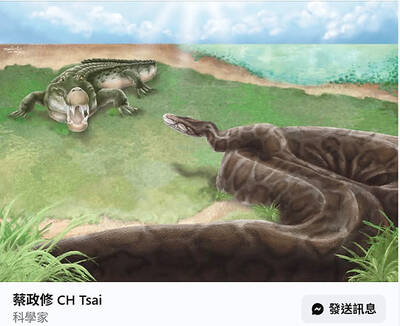
Taiwanese paleontologists have discovered fossil evidence that pythons up to 4m long inhabited Taiwan during the Pleistocene epoch, reporting their findings in the international scientific journal Historical Biology. National Taiwan University (NTU) Institute of Ecology and Evolutionary Biology associate professor Tsai Cheng-hsiu (蔡政修) led the team that discovered the largest snake fossil ever found in Taiwan. The single trunk vertebra was discovered in Tainan at the Chiting Formation, dated to between 400,000 and 800,000 years ago in the Middle Pleistocene, the paper said. The area also produced Taiwan’s first avian fossil, as well as crocodile, mammoth, saber-toothed cat and rhinoceros fossils, it said. Discoveries

Taiwanese paleontologists have discovered fossil evidence that pythons up to 4m long inhabited Taiwan during the Pleistocene epoch, reporting their findings in the international scientific journal Historical Biology. National Taiwan University (NTU) Institute of Ecology and Evolutionary Biology associate professor Tsai Cheng-hsiu (蔡政修) led the team that discovered the largest snake fossil ever found in Taiwan. A single trunk vertebra was discovered in Tainan at the Chiting Formation, dated to between 800,000 to 400,000 years ago in the Middle Pleistocene, the paper said. The area also produced Taiwan’s first avian fossil, as well as crocodile, mammoth, sabre-toothed cat and rhinoceros fossils, it said. Discoveries
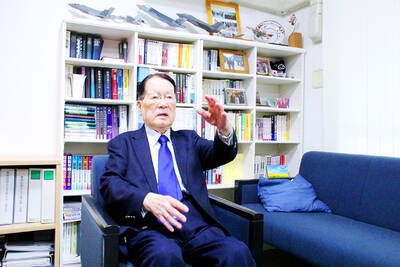
Whether Japan would help defend Taiwan in case of a cross-strait conflict would depend on the US and the extent to which Japan would be allowed to act under the US-Japan Security Treaty, former Japanese minister of defense Satoshi Morimoto said. As China has not given up on the idea of invading Taiwan by force, to what extent Japan could support US military action would hinge on Washington’s intention and its negotiation with Tokyo, Morimoto said in an interview with the Liberty Times (sister paper of the Taipei Times) yesterday. There has to be sufficient mutual recognition of how Japan could provide


 RSS
RSS