


One of the country’s four largest newspapers, the Chinese-language China Times, barely avoided catastrophe yesterday when union members came within five votes of launching a comprehensive strike that would have started today.
The 243-member union needed at least 122 votes in support of the strike. After discussions that lasted all day, 117 members voted in favor of the plan.
The strike would have included workers at the paper’s three printing presses and would have brought production to a standstill starting today, with the goal of seeking better job security and severance pay for laid-off employees.
A China Times reporter who declined to be named said that some of the union members had been bought off by the company ahead of the vote.
“We don’t have any bargaining chips left now that the strike has been voted down. I wouldn’t be surprised if the China Times shuts down in a few years if this is the way it treats its employees. Who in their right mind would want to stay when your job security is always in jeopardy?” he said.
“This is extremely bad news because it means that the company has leverage over the workers,” said another China Times reporter, who also declined to be named.
The reporter said that most of his colleagues had lost their work motivation since the paper decided last month to cut its workforce by 575 employees.
Most of the lay-offs affected reporters on the local news desk who have been with the paper less than five years, he said.
The China Times Group said the lay-off of staff was necessary because demand for newspapers is shrinking.
The union proposed the strike to seek two demands: that all remaining staffers be guaranteed at least five years of employment and that the China Times Group compensate those affected by the cut with severance pay equivalent to four months’ salary.
At the meeting yesterday, publisher Chou Sheng-yuan (周盛淵) offered an olive branch to employees.
After consideration, Chou said, the paper will only lay off 430 employees instead of 575 and all those who are laid off will receive one month’s salary as compensation.
“We sincerely hope employees will empathize with the paper’s dilemma and not turn the paper into a laughing stock,” he said.
The China Times was founded in 1950 as Credit News and focused on price indices. In 2006, its sister paper, the China Times Express was forced to shut down, citing sales hit by readers turning to the Internet for news.

LOUD AND PROUD Taiwan might have taken a drubbing against Australia and Japan, but you might not know it from the enthusiasm and numbers of the fans Taiwan might not be expected to win the World Baseball Classic (WBC) but their fans are making their presence felt in Tokyo, with tens of thousands decked out in the team’s blue, blowing horns and singing songs. Taiwanese fans have packed out the Tokyo Dome for all three of their games so far and even threatened to drown out home team supporters when their team played Japan on Friday. They blew trumpets, chanted for their favorite players and had their own cheerleading squad who dance on a stage during the game. The team struggled to match that exuberance on the field, with
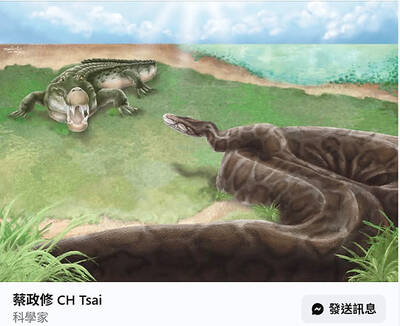
Taiwanese paleontologists have discovered fossil evidence that pythons up to 4m long inhabited Taiwan during the Pleistocene epoch, reporting their findings in the international scientific journal Historical Biology. National Taiwan University (NTU) Institute of Ecology and Evolutionary Biology associate professor Tsai Cheng-hsiu (蔡政修) led the team that discovered the largest snake fossil ever found in Taiwan. The single trunk vertebra was discovered in Tainan at the Chiting Formation, dated to between 400,000 and 800,000 years ago in the Middle Pleistocene, the paper said. The area also produced Taiwan’s first avian fossil, as well as crocodile, mammoth, saber-toothed cat and rhinoceros fossils, it said. Discoveries

Taiwanese paleontologists have discovered fossil evidence that pythons up to 4m long inhabited Taiwan during the Pleistocene epoch, reporting their findings in the international scientific journal Historical Biology. National Taiwan University (NTU) Institute of Ecology and Evolutionary Biology associate professor Tsai Cheng-hsiu (蔡政修) led the team that discovered the largest snake fossil ever found in Taiwan. A single trunk vertebra was discovered in Tainan at the Chiting Formation, dated to between 800,000 to 400,000 years ago in the Middle Pleistocene, the paper said. The area also produced Taiwan’s first avian fossil, as well as crocodile, mammoth, sabre-toothed cat and rhinoceros fossils, it said. Discoveries

Whether Japan would help defend Taiwan in case of a cross-strait conflict would depend on the US and the extent to which Japan would be allowed to act under the US-Japan Security Treaty, former Japanese minister of defense Satoshi Morimoto said. As China has not given up on the idea of invading Taiwan by force, to what extent Japan could support US military action would hinge on Washington’s intention and its negotiation with Tokyo, Morimoto said in an interview with the Liberty Times (sister paper of the Taipei Times) yesterday. There has to be sufficient mutual recognition of how Japan could provide


 RSS
RSS