


Fourteen recipients of this year’s Award for Contributions in Hakka Culture were honored at a ceremony in Taipei yesterday for their efforts.
“I’m very proud to receive this award,” said Huang Jui-chuan (黃瑞娟), a novelist who received the life-long contribution award.
Huang, who was born in 1934 during the Japanese colonial period, first began writing in 1961 and has published 20 books, including Yangmei Trio (楊梅三部曲), which tells the story of people in her hometown of Yangmei (楊梅) in Taoyuan County during the Japanese colonial period to the postwar era and the first transfer of power in 2000, based on her own experiences and observations.
In her other novels, she wrote mostly about the role of women in the Hakka society.
Despite her accomplishments in literature, she stressed that she didn’t feel proud for herself, but for all the Hakkas who strive to preserve Hakka culture.
“About 20 years ago, Hakkas in Taiwan went on the street for the first time to protest discrimination against the Hakka language,” she told the audience.
“At the time, Hakka could not be spoken anywhere in public places. Young Hakkas learned new languages at school and forgot about their native tongue — some even felt ashamed of it,” she said.
“Essentially, it’s the Hakkas’ own struggle that helped to save the culture from further decline,” she said, “and I’m honored to participate in the movement as a writer.”
While Huang recorded the Hakka life with words, the well-known cartoonist Liu Hsing-chin (劉興欽) did so with his artistic talent.
Liu is known for a series of comic books with Brother A-san (阿三哥) and Grand Auntie (大嬸婆) as the main characters.
“I created the image of Great Auntie based on my mother, who was a very typical Hakka woman,” Liu said.
His comic books, therefore, showcased the life of ordinary countryside Hakkas decades ago. Liu then used his fame to promote the Hakka culture.
“I founded a Grand Auntie Taiwanese School in the Silicon Valley in the US and offered free Hakka lessons,” he said.
“I hoped that not only Hakkas, but also people of different ethnic backgrounds and nationalities could enjoy the beauty of Hakka culture,” he said.
On the other hand, although Huang Jung-lo (黃榮洛), a former teacher, civil servant and a business owner, only realized how important it was to preserve his own culture when he was 59, he still made very important contributions at an earlier age.
“When I was 59, I realized all of a sudden how much people had forgotten about Hakka history, and wanted to pass it down [to future] generations,” he said after receiving the outstanding contribution award. “I started to research Hakka history, but then I realized it was very hard to find documentation on it.”
Huang Jung-lo traveled around Taiwan to gather first-hand information about his own people’s history on the island.
Among his collections are old Hakka mountain folk song lyrics, Hakka folklore and proverbs.
At the age of 82, Huang Jung-lo has already written six books on Hakka history and culture.
“It is for the award recipients’ hard work that we Hakkas can remember our glorious past, and create our bright future,” Council for Hakka Affairs Chairman Huang Yu-chen (黃玉振) said.
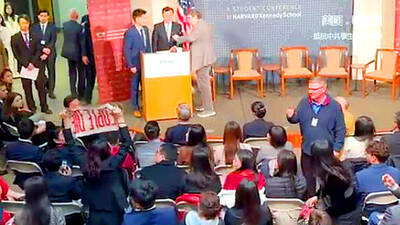
A group of Taiwanese-American and Tibetan-American students at Harvard University on Saturday disrupted Chinese Ambassador to the US Xie Feng’s (謝鋒) speech at the school, accusing him of being responsible for numerous human rights violations. Four students — two Taiwanese Americans and two from Tibet — held up banners inside a conference hall where Xie was delivering a speech at the opening ceremony of the Harvard Kennedy School China Conference 2024. In a video clip provided by the Coalition of Students Resisting the CCP (Chinese Communist Party), Taiwanese-American Cosette Wu (吳亭樺) and Tibetan-American Tsering Yangchen are seen holding banners that together read:

UNAWARE: Many people sit for long hours every day and eat unhealthy foods, putting them at greater risk of developing one of the ‘three highs,’ an expert said More than 30 percent of adults aged 40 or older who underwent a government-funded health exam were unaware they had at least one of the “three highs” — high blood pressure, high blood lipids or high blood sugar, the Health Promotion Administration (HPA) said yesterday. Among adults aged 40 or older who said they did not have any of the “three highs” before taking the health exam, more than 30 percent were found to have at least one of them, Adult Preventive Health Examination Service data from 2022 showed. People with long-term medical conditions such as hypertension or diabetes usually do not
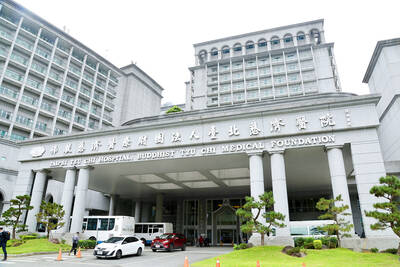
POLICE INVESTIGATING: A man said he quit his job as a nurse at Taipei Tzu Chi Hospital as he had been ‘disgusted’ by the behavior of his colleagues A man yesterday morning wrote online that he had witnessed nurses taking photographs and touching anesthetized patients inappropriately in Taipei Tzu Chi Hospital’s operating theaters. The man surnamed Huang (黃) wrote on the Professional Technology Temple bulletin board that during his six-month stint as a nurse at the hospital, he had seen nurses taking pictures of patients, including of their private parts, after they were anesthetized. Some nurses had also touched patients inappropriately and children were among those photographed, he said. Huang said this “disgusted” him “so much” that “he felt the need to reveal these unethical acts in the operating theater
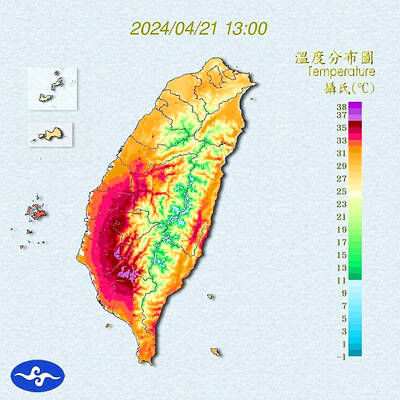
Heat advisories were in effect for nine administrative regions yesterday afternoon as warm southwesterly winds pushed temperatures above 38°C in parts of southern Taiwan, the Central Weather Administration (CWA) said. As of 3:30pm yesterday, Tainan’s Yujing District (玉井) had recorded the day’s highest temperature of 39.7°C, though the measurement will not be included in Taiwan’s official heat records since Yujing is an automatic rather than manually operated weather station, the CWA said. Highs recorded in other areas were 38.7°C in Kaohsiung’s Neimen District (內門), 38.2°C in Chiayi City and 38.1°C in Pingtung’s Sandimen Township (三地門), CWA data showed. The spell of scorching


 RSS
RSS