


Biofuel derived from cellulose could become a reality if a few kinks can be worked out, and with genetic engineering, those technical difficulties may be overcome within the next decade, Daniel I.C. Wang (王義翹), an institute professor at the Massachusetts Institute of Technology, said in an interview with the Taipei Times last week.
“Biomass ethanol is real — in the past there have been only small players in the field, however, lately big firms such as British Petroleum and Shell have entered,” Wang said.
Wang first worked with biofuel in the early 1980s, after the first oil crisis broke out. Although the US mostly uses corn as bioethanol (alcohol) feedstock, Wang proposes that cellulose should be used instead because it would be more sustainable than using edible materials.
“By using corn to produce bioethanol over the past few years, the US experienced a cascading phenomenon, during which many crop and meat prices have gone up,” he said.
The price increases came because farmers switched from growing their usual crops to corn because corn was subsidized and brought a more lucrative income, Wang said.
However, the large-scale switch caused shortages in other crops such as wheat, he said, adding that products from animal stock that feed on corn, such as chickens and cows, then also rose in price.
“If you consider that while the corn used [for biofuel] only produced 2 percent of the US’ total oil consumption, but comprised 17 percent of our corn harvest, then you will know that it’s not cost effective,” he said.
INCREASING DEMAND
With demand for biofuel in 2025 expected to be 132.5 billion liters, as proposed by US President George W. Bush, “bioalcohol needs to come from somewhere else — and I can only think of cellulose as a feasible option,” Wang said.
Plants that are not used for feed, trees such as poplar and aspen and grasses such as switchgrass would be good raw materials for biofuel, since some grow up to 9m a year, which is rapid enough to sustain their provision as fuel feedstock, Wang said.
In terms of the fossil fuel necessary to produce the biofuel, the energy efficiency for cellulose is much higher than corn, Wang said. Using 1 unit of fossil fuel will yield 1.3 units of alcohol from corn, but from cellulose 1 unit of fossil fuel will yield 10 units of alcohol. Also, producing fuel from corn can yield reductions of 12 percent to 26 percent in greenhouse gas emissions when compared to fossil fuels. But when using cellulose, that greenhouse gas emission reduction is 82 percent to 85 percent.
However, since technological development stalled in the late 1980s after oil prices deflated, “cellulosic bioethanol may take at least five years to be developed to a moderate production scale [and become economical],” Wang said.
The biggest challenge in mass producing cellulosic biofuel involves simplification and cost reductions in its production process, he said.
“The traditional process to produce biomass ethanol is to pretreat the feedstock before fermentation, which is a long and costly process that involves either high pressure steam, ammonium explosion or weak acid and high temperature. This is done so enzymes can attack the exposed sugars,” Wang said.
He said that deriving alcohol from cellulose is more complex than from corn, since cellulose is composed of polymers that include hexoses [six-carbon sugar], pentoses [five-carbon sugars] and lignins [the “glue” to hold them together], whereas cornstarch is composed of monomers of sugars.
NEW IDEA
Seeing that the tedious pretreatment process is hindering the development of cellulosic bioethanol, Wang’s team came up with the idea of sidestepping it.
“With metabolic pathway manipulation, we can genetically engineer a new enzyme that can produce cellulase and perform direct fermentation on the cellulose after a simple physical pretreatment [to break the raw materials into 1mm particles],” Wang said.
The complicated distillation process to recover ethanol in the fermented product should also be replaced with new technologies such as nanoparticle adsorption, he said.
Another challenge in using tall grasses and trees as fuel, Wang said, was collection and storage work.
“For example, because many crops are harvested once a year, their residues are not there year-round, whereas oil needs are. How to store the materials would be an issue,” he said.
Though Wang’s research has been in biofuel, he said that it was not the only solution to combat the fuel crisis.
“Biofuel, solar energy, nuclear energy, hydropower and wind turbines all have their unique advantages and shortcomings; the key to successfully compete against oil is the combination of different types of alternative energy,” Wang said.
The competitive edge biofuel has in the alternative energy market has been that “it can burn in the car,” Wang said. “It is much easier to keep the car the same, and change the fuel — you have a whole level of different engineering to do if you want cars powered by the sun or something else … Without any modifications in cars, the US offers E10 fuel, which is 10 percent bioethanol and 90 percent fossil fuel.”

A group of Taiwanese-American and Tibetan-American students at Harvard University on Saturday disrupted Chinese Ambassador to the US Xie Feng’s (謝鋒) speech at the school, accusing him of being responsible for numerous human rights violations. Four students — two Taiwanese Americans and two from Tibet — held up banners inside a conference hall where Xie was delivering a speech at the opening ceremony of the Harvard Kennedy School China Conference 2024. In a video clip provided by the Coalition of Students Resisting the CCP (Chinese Communist Party), Taiwanese-American Cosette Wu (吳亭樺) and Tibetan-American Tsering Yangchen are seen holding banners that together read:

UNAWARE: Many people sit for long hours every day and eat unhealthy foods, putting them at greater risk of developing one of the ‘three highs,’ an expert said More than 30 percent of adults aged 40 or older who underwent a government-funded health exam were unaware they had at least one of the “three highs” — high blood pressure, high blood lipids or high blood sugar, the Health Promotion Administration (HPA) said yesterday. Among adults aged 40 or older who said they did not have any of the “three highs” before taking the health exam, more than 30 percent were found to have at least one of them, Adult Preventive Health Examination Service data from 2022 showed. People with long-term medical conditions such as hypertension or diabetes usually do not

POLICE INVESTIGATING: A man said he quit his job as a nurse at Taipei Tzu Chi Hospital as he had been ‘disgusted’ by the behavior of his colleagues A man yesterday morning wrote online that he had witnessed nurses taking photographs and touching anesthetized patients inappropriately in Taipei Tzu Chi Hospital’s operating theaters. The man surnamed Huang (黃) wrote on the Professional Technology Temple bulletin board that during his six-month stint as a nurse at the hospital, he had seen nurses taking pictures of patients, including of their private parts, after they were anesthetized. Some nurses had also touched patients inappropriately and children were among those photographed, he said. Huang said this “disgusted” him “so much” that “he felt the need to reveal these unethical acts in the operating theater
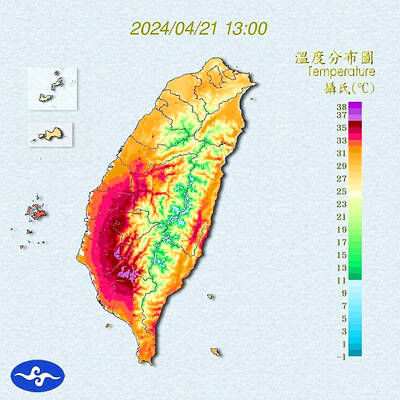
Heat advisories were in effect for nine administrative regions yesterday afternoon as warm southwesterly winds pushed temperatures above 38°C in parts of southern Taiwan, the Central Weather Administration (CWA) said. As of 3:30pm yesterday, Tainan’s Yujing District (玉井) had recorded the day’s highest temperature of 39.7°C, though the measurement will not be included in Taiwan’s official heat records since Yujing is an automatic rather than manually operated weather station, the CWA said. Highs recorded in other areas were 38.7°C in Kaohsiung’s Neimen District (內門), 38.2°C in Chiayi City and 38.1°C in Pingtung’s Sandimen Township (三地門), CWA data showed. The spell of scorching


 RSS
RSS