


As the mercury rises, an increasing number of people are hitting the beach for some rest and relaxation. To ensure the safety and health of beachgoers, the Environmental Protection Administration (EPA) yesterday released a list of the nation's top 10 beaches where revelers can enjoy the summer sun.
“In addition to minding one’s safety while in the water, people should also make sure that the water quality at the beaches they visit is good enough to swim in,” said Chu Yu-chi (朱雨其), director-general of the EPA’s department of environmental monitoring and information management.
In a water quality inspection conducted by the administration last Sunday and Monday at beaches around the nation, Taipei County’s New Jinshan Bathing Beach (新金山) was rated “superior” for water quality and the cleanest beach for swimming, Chu said.

PHOTO: KUO YEN-HUI, TAIPEI TIMES
“The water quality at beaches is rated by its E. coli concentration,” Chu said.
Class A beaches, such as at Jinshan, contain E. coli concentrations of less than 1,000 colony-forming units (CFU), Chu said, adding that to achieve the “superior” rating, the beach had to have a most probable number (MPN) below 10.
Beaches with good water quality — with MPNs of between 11 and 50 — included Fulong Beach (福隆) in Taipei County, Chiting (崎頂) and Tunghsiao beaches (通霄) in Miaoli County and Shanyuan Beach (杉原) in Taitung County, Chu said.
Tainan County’s Masago Beach (馬沙溝) was rated as having average water quality (51 to 200 MPN), while Kenting Tiaoshih Recreational Seashore (墾丁跳石) in Pingtung County was rated as fair (200 to 1,000 MPN), Chu said.
Three beaches — Ta-an Beach (大安) in Taichung County and Hsitzuwan (西子灣) and Chichin beaches (旗津) in Kaohsiung City — were rated as below par for Class A, containing over 1,000 CFU of E. coli concentration, making them unsuitable for swimming at this time, Chu said.
However, Chu also said that some of the beaches may have contained higher than normal germ concentrations because of the heavy rain in the past few weeks, which could have carried pollutants from the land into the seas.
“As a rule of thumb, it is best not to go swimming within three days of a typhoon or a heavy rain, as water is generally the dirtiest then,” Chu said.
The EPA will conduct biweekly inspections of water quality at top beaches around the nation until September, when the season ends, Chu said.
The latest inspection results can be found online at www.epa.gov.tw/wqm.
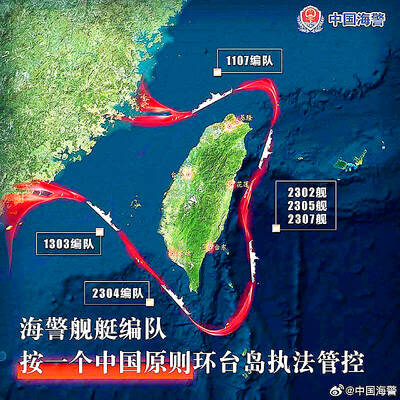
Taiwan would benefit from more integrated military strategies and deployments if the US and its allies treat the East China Sea, the Taiwan Strait and the South China Sea as a “single theater of operations,” a Taiwanese military expert said yesterday. Shen Ming-shih (沈明室), a researcher at the Institute for National Defense and Security Research, said he made the assessment after two Japanese military experts warned of emerging threats from China based on a drill conducted this month by the Chinese People’s Liberation Army’s (PLA) Eastern Theater Command. Japan Institute for National Fundamentals researcher Maki Nakagawa said the drill differed from the

‘WORSE THAN COMMUNISTS’: President William Lai has cracked down on his political enemies and has attempted to exterminate all opposition forces, the chairman said The legislature would motion for a presidential recall after May 20, Chinese Nationalist Party (KMT) Chairman Eric Chu (朱立倫) said yesterday at a protest themed “against green communists and dictatorship” in Taipei. Taiwan is supposed to be a peaceful homeland where people are united, but President William Lai (賴清德) has been polarizing and tearing apart society since his inauguration, Chu said. Lai must show his commitment to his job, otherwise a referendum could be initiated to recall him, he said. Democracy means the rule of the people, not the rule of the Democratic Progressive Party (DPP), but Lai has failed to fulfill his

A rally held by opposition parties yesterday demonstrates that Taiwan is a democratic country, President William Lai (賴清德) said yesterday, adding that if opposition parties really want to fight dictatorship, they should fight it on Tiananmen Square in Beijing. The Chinese Nationalist Party (KMT) held a protest with the theme “against green communists and dictatorship,” and was joined by the Taiwan People’s Party. Lai said the opposition parties are against what they called the “green communists,” but do not fight against the “Chinese communists,” adding that if they really want to fight dictatorship, they should go to the right place and face

A 79-year-old woman died today after being struck by a train at a level crossing in Taoyuan, police said. The woman, identified by her surname Wang (王), crossed the tracks even though the barriers were down in Jhongli District’s (中壢) Neili (內壢) area, the Taoyuan Branch of the Railway Police Bureau said. Surveillance footage showed that the railway barriers were lowered when Wang entered the crossing, but why she ventured onto the track remains under investigation, the police said. Police said they received a report of an incident at 6:41am involving local train No. 2133 that was heading from Keelung to Chiayi City. Investigators


 RSS
RSS