


The Democratic Progressive Party (DPP) yesterday said it was willing to engage in dialogue and cooperate with China as long as Beijing did not set preconditions, but questioned the timing of the meeting between Chinese Nationalist Party (KMT) Chairman Wu Poh-hsiung (吳伯雄) and Chinese President Hu Jintao (胡錦濤).
DPP Secretary-General Wang Tuoh (王拓) urged political parties to put aside their differences and engage in dialogue and cooperation on the nation’s China policy.
Wang said his party was glad to see the KMT attempt to stabilize cross-strait relations and that the DPP would be happy to see it promote Taiwan’s democracy and advance China’s democratization.
The DPP would also like to see the KMT protect Taiwan’s sovereignty, equality, national interest and security when dealing with the Chinese, he said.
But he expressed concern at the channel of communication established between the KMT and the Chinese Communist Party (CCP), urging the KMT to give official agencies a free hand so that the Straits Exchange Foundation (SEF) could negotiate with its Chinese counterpart, the Association for Relations Across the Taiwan Strait (ARATS).
DPP Chairwoman Tsai Ing-wen (蔡英文) also questioned the timing of the meeting between Wu and Hu.
“Wu is too hasty in visiting China,” she said.
Because it was important not to have a fixed agenda in cross-strait talks, Tsai said the necessity of the meeting could be called into question. She said she was baffled by the timing of the meeting because it seemed to coincide with the resumption of contact between the SEF and ARATS.
Contact between Wu and Hu was “political” rather than diplomatic and should be carefully scrutinized, she said, adding that the meeting might give the impression that the KMT organization wanted to usurp the executive.
Tsai said that Wu may have information about the meeting that he cannot divulge to the media, and that she would be very happy to exchange views with him when he returns from his trip.
Former DPP chairman Frank Hsieh (謝長廷) said that parties on both sides of the Taiwan Strait should be able to contact one another, but that interaction should not affect the functions of government.
He added that the KMT administration should be careful reaching compromises as the public is watching.

LOUD AND PROUD Taiwan might have taken a drubbing against Australia and Japan, but you might not know it from the enthusiasm and numbers of the fans Taiwan might not be expected to win the World Baseball Classic (WBC) but their fans are making their presence felt in Tokyo, with tens of thousands decked out in the team’s blue, blowing horns and singing songs. Taiwanese fans have packed out the Tokyo Dome for all three of their games so far and even threatened to drown out home team supporters when their team played Japan on Friday. They blew trumpets, chanted for their favorite players and had their own cheerleading squad who dance on a stage during the game. The team struggled to match that exuberance on the field, with
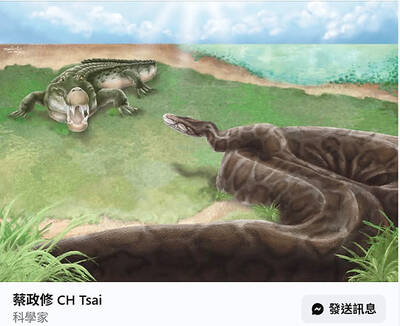
Taiwanese paleontologists have discovered fossil evidence that pythons up to 4m long inhabited Taiwan during the Pleistocene epoch, reporting their findings in the international scientific journal Historical Biology. National Taiwan University (NTU) Institute of Ecology and Evolutionary Biology associate professor Tsai Cheng-hsiu (蔡政修) led the team that discovered the largest snake fossil ever found in Taiwan. The single trunk vertebra was discovered in Tainan at the Chiting Formation, dated to between 400,000 and 800,000 years ago in the Middle Pleistocene, the paper said. The area also produced Taiwan’s first avian fossil, as well as crocodile, mammoth, saber-toothed cat and rhinoceros fossils, it said. Discoveries

Taiwanese paleontologists have discovered fossil evidence that pythons up to 4m long inhabited Taiwan during the Pleistocene epoch, reporting their findings in the international scientific journal Historical Biology. National Taiwan University (NTU) Institute of Ecology and Evolutionary Biology associate professor Tsai Cheng-hsiu (蔡政修) led the team that discovered the largest snake fossil ever found in Taiwan. A single trunk vertebra was discovered in Tainan at the Chiting Formation, dated to between 800,000 to 400,000 years ago in the Middle Pleistocene, the paper said. The area also produced Taiwan’s first avian fossil, as well as crocodile, mammoth, sabre-toothed cat and rhinoceros fossils, it said. Discoveries

Whether Japan would help defend Taiwan in case of a cross-strait conflict would depend on the US and the extent to which Japan would be allowed to act under the US-Japan Security Treaty, former Japanese minister of defense Satoshi Morimoto said. As China has not given up on the idea of invading Taiwan by force, to what extent Japan could support US military action would hinge on Washington’s intention and its negotiation with Tokyo, Morimoto said in an interview with the Liberty Times (sister paper of the Taipei Times) yesterday. There has to be sufficient mutual recognition of how Japan could provide


 RSS
RSS