


Parents of young children should remain vigilant in their efforts to prevent disease as the number of confirmed serious enterovirus cases has increased by 14 in the past three days, a Department of Health (DOH) official warned yesterday.
“The number of confirmed cases of severe enterovirus infection in Taiwan this year reached 107 as of 5pm Friday, and four of them have died, “ said Chou Chih-hao (周志浩), deputy director of the DOH’s Centers for Disease Control (CDC).
The figures showed that the number of confirmed serious enterovirus cases has risen swiftly since Tuesday, when the number was 93, with two fatalities in just three days.
Chou said one of the newly confirmed deaths involved a baby girl on the island of Lanyu (蘭嶼). The 15-month-old exhibited symptoms of suspected enterovirus and died last Sunday, Chou said.
“Laboratory tests have confirmed that the girl fell victim to a serious enterovirus infection,” Chou said.
The other new fatal case was a one-year-old boy residing in Tainan City, Chou said. The boy was checked into a clinic on May 14 after developing a fever. He was transferred to Chi Mei Medical Center on May 16 after his condition worsened and he died on Thursday.
“Investigations found that the boy’s two-year-old sister and two young cousins living under the same roof had been infected with enterovirus earlier this year, but all three had recovered,” Chou said.
Enterovirus infections are the most common cause of aseptic meningitis and can cause deadly diseases, especially in infants and those with compromised immune systems.
Chou said that all four of the patients who died fell victim to the same enterovirus strain — EV71. The first enterovirus death occurred in March in Yunlin County and the second occurred early this month in Kaohsiung County, CDC records showed.
Noting that the spread of enterovirus tends to peak in mid-June, Chou said that the recent developments could be a bad omen. He urged parents with young children to be on guard against the disease.
Meanwhile, Liu Ching-chuan (劉清泉), director of the infectious disease control department at Cheng Kung National University Hospital, said this year might see a major enterovirus outbreak, with the number of serious EV71 cases surging to as many as 300 by next month.
Liu said that Taiwan seems to see an enterovirus outbreak about once every 10 years and that this could just be part of the cycle. In 1998, Liu said, Taiwan recorded 405 serious EV71 cases with 78 fatalities, while in 2000, only a few cases were documented and there had been no serious enterovirus outbreak since 2005. Liu said parents need not panic over a possible outbreak.
“Given progress in Taiwan’s medical standards, the disease can be cured and a major outbreak could also be brought under control as long as parents keep vigilant and do not delay in having their children treated,” he said.


China has reserved offshore airspace in the Yellow Sea and East China Sea from March 27 to May 6, issuing alerts usually used to warn of military exercises, although no such exercises have been announced, the Wall Street Journal (WSJ) reported yesterday. Reserving such a large area for 40 days without explanation is an “unusual step,” as military exercises normally only last a few days, the paper said. These alerts, known as Notice to Air Missions (Notams), “are intended to inform pilots and aviation authorities of temporary airspace hazards or restrictions,” the article said. The airspace reserved in the alert is

South Korea is planning to revise its controversial electronic arrival card, a step Taiwanese officials said prompted them to hold off on planned retaliatory measures, a South Korean media report said yesterday. A Yonhap News Agency report said that the South Korean Ministry of Foreign Affairs is planning to remove the “previous departure place” and “next destination” fields from its e-arrival card system. The plan, reached after interagency consultations, is under review and aims to simplify entry procedures and align the electronic form with the paper version, a South Korean ministry official said. The fields — which appeared only on the electronic form
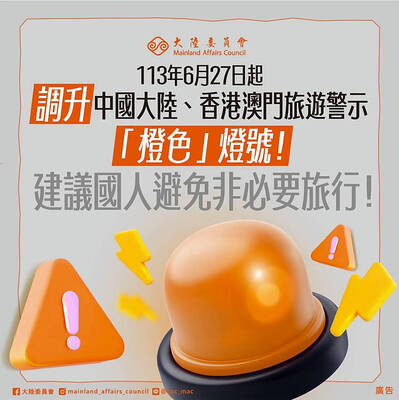
More than 6,000 Taiwanese students have participated in exchange programs in China over the past two years, despite the Mainland Affairs Council’s (MAC) “orange light” travel advisory, government records showed. The MAC’s publicly available registry showed that Taiwanese college and university students who went on exchange programs across the Strait numbered 3,592 and 2,966 people respectively. The National Immigration Agency data revealed that 2,296 and 2,551 Chinese students visited Taiwan for study in the same two years. A review of the Web sites of publicly-run universities and colleges showed that Taiwanese higher education institutions continued to recruit students for Chinese educational programs without

A bipartisan group of US senators has introduced a bill to enhance cooperation with Taiwan on drone development and to reduce reliance on supply chains linked to China. The proposed Blue Skies for Taiwan Act of 2026 was introduced by Republican US senators Ted Cruz and John Curtis, and Democratic US senators Jeff Merkley and Andy Kim. The legislation seeks to ease constraints on Taiwan-US cooperation in uncrewed aerial systems (UAS), including dependence on China-sourced components, limited access to capital and regulatory barriers under US export controls, a news release issued by Cruz on Wednesday said. The bill would establish a "Blue UAS


 RSS
RSS