


Former president Lee Teng-hui (李登輝) said at a book launch yesterday that president-elect Ma Ying-jeou (馬英九) had remained silent when he told him that there is no such thing as the so-called "1992 consensus."
The “1992 consensus” refers to an agreement that was ostensibly reached during cross-strait talks in October 1992. It postulates that both sides of the strait would adhere to the “one China” principle, but reserved the right to interpret the term “one China” differently.
Lee, who was president at the time, said he told Ma that people involved in the talks didn’t mention the “1992 consensus” and that the term was created by individuals who had nothing to do with the talks.
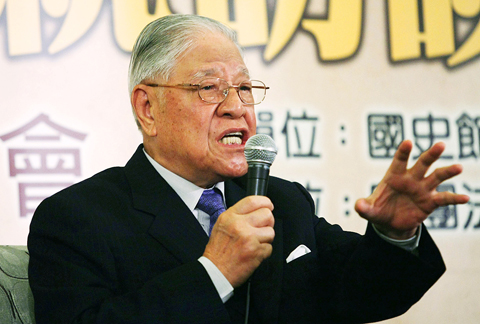
PHOTO: CNA
The conversation took place when Ma visited Lee after he was elected president in March.
Su Chi (蘇起), recently appointed secretary-general of the National Security Council for the incoming administration, admitted in February 2006 he had made up the term in 2000 as the Chinese Nationalist Party (KMT) was readying to hand over power to the Democratic Progressive Party (DPP).
Su, then chairman of the Mainland Affairs Council, said he invented the term to break the cross-strait deadlock and alleviate tensions.
Lee, on the other hand, said the term was invented to confuse the DPP administration.
He made the remarks while attending an event to mark the release of a four-volume oral history of his early life, beliefs and philosophy, political life and ideas about economics and industrial development.
Academia Historica began recording the material in June 2006.
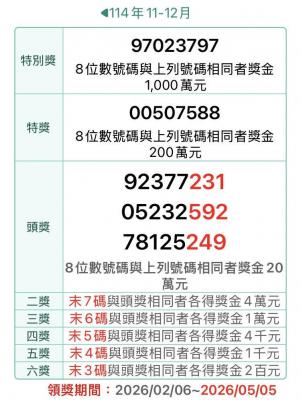
Seven of the 17 NT$10 million (US$311,604) winning receipts from the November-December uniform invoice lottery remain unclaimed as of today, the Ministry of Finance said, urging winners to redeem their prizes by May 5. The reminder comes ahead of the release of the winning numbers for the January-February lottery tomorrow. Among the unclaimed receipts was one for a NT$173 phone bill in Keelung, while others were for a NT$5,913 purchase at Costco in Taipei's Neihu District (內湖), a NT$49 purchase at a FamilyMart in New Taipei City's Tamsui District (淡水), and a NT$500 purchase at a tea shop in New Taipei City's
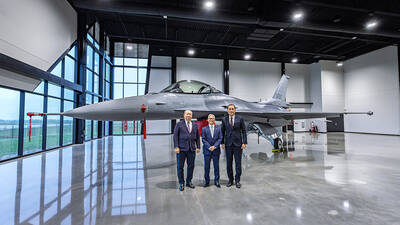
Taiwanese officials were shown the first of 66 F-16V fighter jets purchased by Taiwan from the United States, the Ministry of National Defense said yesterday, adding the aircraft has completed an initial flight test and is expected to be delivered later this year. A delegation led by Deputy Minister of National Defense Hsu Szu-chien (徐斯儉) visited Lockheed Martin’s F-16 C/D Block 70 (also known as F-16V) assembly line in South Carolina on March 16 to view the aircraft. The jet will undergo a final acceptance flight in the US before being delivered to Taiwan, the
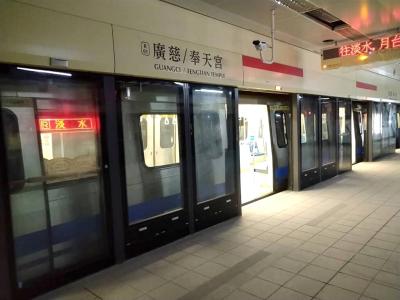
The New Taipei Metro's Sanyin Line and the eastern extension of the Taipei Metro's Tamsui-Xinyi Line (Red Line) are scheduled to begin operations in June, the National Development Council said today. The Red Line, which terminates at Xiangshan Station, would be connected by the 1.4km extension to a new eastern terminal, Guangci/Fengtian Temple Station, while the Sanyin Line would link New Taipei City's Tucheng and Yingge stations via Sanxia District (三峽). The council gave the updates at a council meeting reviewing progress on public construction projects for this year. Taiwan's annual public infrastructure budget would remain at NT$800 billion (US$25.08 billion), with NT$97.3
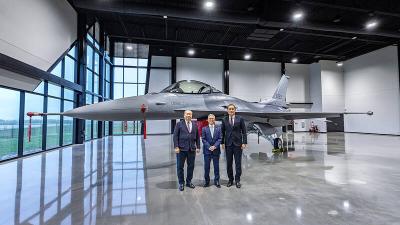
Deliveries of delayed F-16V jets are expected to begin in September, Minister of National Defense Wellington Koo (顧立雄) said today, after senior defense officials visited the US last week. The US in 2019 approved a US$8 billion sale of Lockheed Martin F-16 jets to Taiwan, a deal that would take the nation’s F-16 fleet to more than 200 jets, but the project has been hit by issues including software problems. Koo appeared today before a meeting of the legislature’s Foreign Affairs and National Defense Committee, which is discussing different versions of the special defense budget this week. The committee is questioning officials today,


 RSS
RSS