


President-elect Ma Ying-jeou (馬英九) expressed appreciation on Saturday for a “16-word maxim” that Chinese President Hu Jintao (胡錦濤) delivered recently concerning cross-strait relations.
Ma was referring to Hu’s statement during a meeting in Beijing with former Chinese Nationalist Party (KMT) chairman Lien Chan (連戰), when he said that China and Taiwan should “seek to build mutual trust, shelve disputes, seek common ground while reserving differences, and create ‘win-win’ development.”
“Hu’s remarks will serve as an important guide in turning a new page in the development of cross-strait relations,” Ma said during a conversation with a group of retired military commanders at an evening gathering, according to a news release issued by Ma’s campaign office around 1am yesterday.
Hu’s remarks were somewhat similar to a “16-word appeal” that vice president-elect Vincent Siew (蕭萬長) spelled out at the Boao Forum for Asia last month in Hainan, China, calling for the two sides of the strait to “face reality, create a new future, shelve disputes and seek ‘win-win’ approaches.”
Ma told the former defense ministers and chiefs of general staff — including Hau Pei-tsun (郝柏村), Chiang Chung-ling (蔣仲苓), Hsu Li-nung (�?A), Tang Yao-ming (湯曜明) and Lee Tien-yu (李天羽) — that Taiwan must take a path of reconciliation if the country wants long-term peace and stability, the news release said.
The “path” refers to reconciliation between the KMT-led pan-blue alliance and the Democratic Progressive Party-led pan-green camp, among people of different ethnic groups, between northern and southern Taiwan and between Taiwan and China, Ma said.
Noting that cross-strait reconciliation is a road that must be taken, Ma said as long as the two sides engage with each other more closely and try to better understand each other, cross-strait tensions will naturally diminish.
Ma told the veterans that he would try his utmost soon after his inauguration on May 20 to facilitate the opening of cross-strait charter flight services and to allow Chinese citizens to visit Taiwan for tourism purposes, the news release said.

FUKUOKA SITUATION: Japanese media reported that the pathogen is expected to be identified by the summer, while the CDC downplayed the idea that it was hMPV A “mysterious cold-like illness” reported in Japan’s Fukuoka Prefecture does not seem to be a new disease, but Japanese authorities have been asked about the situation, the Centers for Disease Control (CDC) said yesterday. The Fukuoka Prefectural Medical Association on Wednesday told a news conference that a “mystery cold” that has become a hot topic on social media is “highly likely to be caused by some kind of viral infection,” Japan’s KBC News reported. “Many people are experiencing symptoms starting with a sore throat, followed by a runny nose, phlegm and a severe cough,” KBC News reported, citing association officials. Health authorities are

Nvidia Corp CEO Jensen Huang (黃仁勳) arrived in Taiwan yesterday ahead of upcoming AI and technology events, saying he plans to meet with clients and Taiwan Semiconductor Manufacturing Co Chairman C.C. Wei (魏哲家) during his visit. After landing at Taipei Songshan Airport, Huang posed for photos with fans and handed out Yakult drinks to reporters and supporters waiting at the scene, saying he has “a lot to do” during the trip. Asked about reports that Nvidia’s planned headquarters site in Taipei’s Beitou Shilin Technology Park could break ground on May 27, Huang said that if the company holds an event, he would

Carrefour Taiwan is to begin using a new name from the start of July, but it cannot divulge the name until then, the chairman of the supermarket chain's parent company said today. President Chain Store Co chairman Lo Chih-hsien (羅智先) was asked by reporters after a shareholders' meeting to confirm whether the company has settled on a new name for the supermarket brand. In March, the government-registered name of two Carrefour Taiwan branches was quietly changed to "Le Chia Kang" (樂家康) in Chinese, raising speculation that has been selected as the name. Lo said that because of local regulations and contractual obligations, the
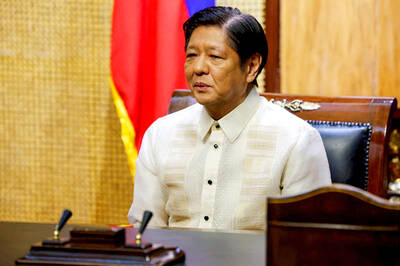
The Philippines would likely be involved in any conflict over Taiwan due to its proximity to the democracy claimed by China, President Ferdinand Marcos Jr said, reiterating a stance that risks angering Beijing. “In the Philippines, we do not have a choice because Taiwan is so close to the Philippines and we have almost 200,000 Filipino nationals living and working in Taiwan,” Marcos said in an interview with Japanese media in Manila on Monday. The Philippine leader’s comments come ahead of a state visit to Japan next week, where he is to meet with Japanese Prime Minister Sanae Takaichi to discuss security


 RSS
RSS