


The Ocean Goddess Matsu’s (媽祖) annual tour around the nation this year, which commenced yesterday, was modernized with a twist of environmental protection.
One of the most famous Matsu temples in Taiwan is the Jhenlan Temple (鎮瀾宮) in Taichung county’s Dajia Township (大甲) which has the greatest number of worshippers.
Each year around Matsu’s birthday, which falls in March on the Lunar calendar, the statue of the goddess — who looks over the safety of fishermen — tours through Matsu temples nationwide to greet her worshippers.
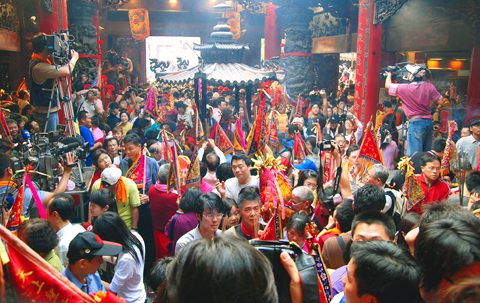
PHOTO: CNA
The tradition has historically attracted close to a million worshippers who follow the goddess’ journey by foot.
Though the followers may attain peace of mind for the rest of the year, hundreds of tons of garbage are produced, secretary-general of the Environmental Protection Agency’s (EPA) Recycling Fund Management Board Lin Chien-huei (林建輝) said.
From past experience, the administration found that most of the trash that remained after the parade was food packaging such as empty drink bottles and lunch boxes, he said, adding that in view of this, “This year’s Matsu parade will be a green one — for the first time ever an environmental protection team will head the procession, and along the route we have placed 6,000 garbage and recycling bins made of 100 percent recycled paper.”
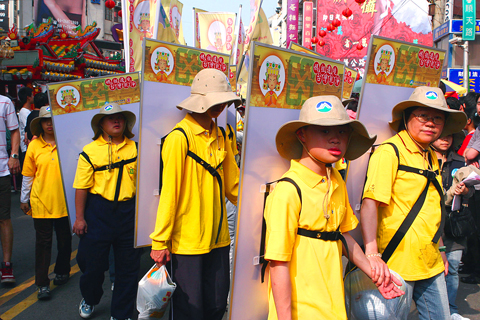
PHOTO: CNA
The environmental protection team consists of businesses and people who volunteered to promote the concept of resource conservation and garbage sorting to the townships they would be visiting, Lin said.
The cost of the reusable boxes — NT$800,000 — was donated by a collection of 16 businesses, he said, adding that the team has set a goal of returning the areas they visit back to normal within one hour of the parade leaving the premises.
The marathon walking event this year has had tens of thousands signed up to join Matsu in her 280km, eight-day stroll, set to travel from Dajia to townships including Chingshui (清水), Shalu (沙鹿), Lungjing (龍井), and Tuku (土庫) in Changhua, Yunlin and Chiayi counties, he said.
“In addition to mental purification, the tour will be a cleansing experience for our communities as well,” he said. “The Matsu tour on foot is a very local tradition, and by combining rituals like this with modern trends and needs like environmental protection efforts, we hope to instill in people more updated concepts of what is good for people and the next generation.”
Meanwhile, in related news, followers of Matsu from both sides of the Taiwan Strait are planning to seek UN approval to have the Matsu culture declared an intangible world cultural heritage.
The idea was proposed on Friday at a Taiwan Matsu cultural forum at the Jhenlan Temple. The event was part of this year’s Taichung County Matsu International Festival, which began on Feb. 21 and is scheduled to end on April 28.
During the forum, Matsu followers from Japan, South Korea, Australia and Singapore shared their views on various ways of worshipping the goddess.
For over 200 years, the Jhenlan Temple has been a religious mecca for Matsu worshipers in dozens of local villages, and has also drawn huge numbers of followers from all over the country.
The Dajia Matsu pilgrimage in spring is an internationally renowned event that draws hundreds of thousands of pilgrims every year to worship and honor the goddess of the sea.
The complex and creative Matsu-worshipping ceremonies and activities have been listed by the Discovery Channel as one of three major religious festivals in the world, the 18th-century Jhenlan Temple said.
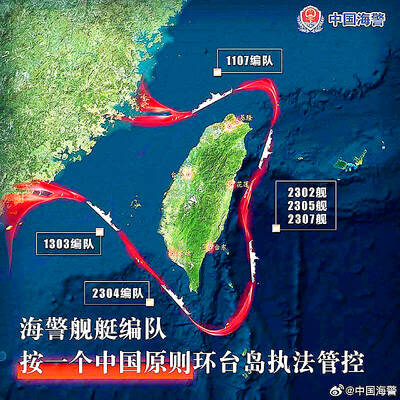
Taiwan would benefit from more integrated military strategies and deployments if the US and its allies treat the East China Sea, the Taiwan Strait and the South China Sea as a “single theater of operations,” a Taiwanese military expert said yesterday. Shen Ming-shih (沈明室), a researcher at the Institute for National Defense and Security Research, said he made the assessment after two Japanese military experts warned of emerging threats from China based on a drill conducted this month by the Chinese People’s Liberation Army’s (PLA) Eastern Theater Command. Japan Institute for National Fundamentals researcher Maki Nakagawa said the drill differed from the

‘WORSE THAN COMMUNISTS’: President William Lai has cracked down on his political enemies and has attempted to exterminate all opposition forces, the chairman said The legislature would motion for a presidential recall after May 20, Chinese Nationalist Party (KMT) Chairman Eric Chu (朱立倫) said yesterday at a protest themed “against green communists and dictatorship” in Taipei. Taiwan is supposed to be a peaceful homeland where people are united, but President William Lai (賴清德) has been polarizing and tearing apart society since his inauguration, Chu said. Lai must show his commitment to his job, otherwise a referendum could be initiated to recall him, he said. Democracy means the rule of the people, not the rule of the Democratic Progressive Party (DPP), but Lai has failed to fulfill his

A rally held by opposition parties yesterday demonstrates that Taiwan is a democratic country, President William Lai (賴清德) said yesterday, adding that if opposition parties really want to fight dictatorship, they should fight it on Tiananmen Square in Beijing. The Chinese Nationalist Party (KMT) held a protest with the theme “against green communists and dictatorship,” and was joined by the Taiwan People’s Party. Lai said the opposition parties are against what they called the “green communists,” but do not fight against the “Chinese communists,” adding that if they really want to fight dictatorship, they should go to the right place and face

A 79-year-old woman died today after being struck by a train at a level crossing in Taoyuan, police said. The woman, identified by her surname Wang (王), crossed the tracks even though the barriers were down in Jhongli District’s (中壢) Neili (內壢) area, the Taoyuan Branch of the Railway Police Bureau said. Surveillance footage showed that the railway barriers were lowered when Wang entered the crossing, but why she ventured onto the track remains under investigation, the police said. Police said they received a report of an incident at 6:41am involving local train No. 2133 that was heading from Keelung to Chiayi City. Investigators


 RSS
RSS