


President-elect Ma Ying-jeou’s (馬英九) choice of name the nation should use in its WHA observership this year has led some political analysts to wonder about his relationship with Beijing rather than the likelihood that this would allow Taiwan to join the world health body, which has shut down its bids for 11 consecutive years since 1997.
In an interview with Central News Agency yesterday, Ma expressed his unhappiness with the Democratic Progressive Party (DPP) government’s plan to apply for full WHO membership under the name Taiwan at next month’s World Health Assembly (WHA) in Geneva.
The Chinese Nationalist Party’s (KMT) Ma has said he favored a bid for WHA observer status under the name “Chinese Taipei.”
Minister of Foreign Affairs James Huang (黃志芳) yesterday restated that the DPP government would broach the subject with Ma’s office, but Ma claimed that the “full WHO membership proposal” was set in stone.
Ma urged the DPP to drop the plan, which he said brought “total embarrassment” to Taiwan in last year’s WHA meeting and “is doomed to fail” again this year.
The WHA will open on May 19, one day before Ma’s inauguration. It is seen as the first crucial test of the relationship between China and Ma’s administration.
The Taiwan Medical Professionals Alliance’s Wu Shuh-min (吳樹民), a long-term advocate of Taiwan’s WHO campaign, said he doubted Ma’s proposal would meet with acceptance among WHA members “unless Ma had already made an under-the-table deal sacrificing Taiwan’s national interests at the Chinese altar.”
“No matter which name we use for WHA observer status, China will oppose Taiwan’s bid. This is because China regards Taiwan’s requirement of WHA observership as a step toward full WHO membership, which requires statehood,” Wu said.
Wu said the possibility that the KMT may have made a demand by China that “Taiwan will no longer pursue full WHO membership” in exchange for Beijing’s nod on WHA observer status was cause for worry.
Taiwan, with its official name Republic of China (ROC), was one of the founding members of the global health organization, but was forced to forfeit its seat in 1972 after the ROC’s seat at the UN was replaced by the People’s Republic of China.
Since coming to power in 2000, President Chen Shui-bian (陳水扁) adopted the strategy used by the former KMT government to apply for observer status at the WHA, using the name ROC, made a bid for full WHO membership last year using the name “Taiwan.”
“Last year’s bid aimed at mitigating the influence of the ‘one China’ principle, which was the main reason the ROC bid was repeatedly rejected. The KMT and president-elect Ma should know that as well,” Government Information Office Minister Shieh Jhy-wey (謝志偉) said.
Some analysts have said that last year’s failed bid was a much bigger setback for the nation, as all major countries, including the US, Japan, EU member states and Canada refused to back Taiwan because of their “one China” policies.
To Taipei’s chagrin, Costa Rica, then a diplomatic ally, cast a negative vote, while four other allies — Panama, Nicaragua, the Marshall Islands and Saint Lucia — were absent from the session. Haiti, also an ally, abstained from voting.
Lin Chong-pin (林中斌), former deputy defense minister and president of the Foundation on International and Cross-Strait Studies, saw Ma’s proposal as “practical.”
The “Chinese Taipei” proposal might not be as efficient as previous bids when it comes to the issue of the country’s dignity, but Taiwan might be able to “inch forward” toward its goal, Lin said.
Lin said that before the March 22 presidential election, he had been informed by US specialists visiting Taipei on their way back from Beijing that China would allow Taiwan’s attendance in international organizations that do not require statehood.
It was inappropriate for Ma to reveal the “Chinese Taipei” proposal if he didn’t get China to agree to it in advance, as it might result in a degrading of the nation’s status, Lin said.
Ruan Ming (阮銘), a consultant at the Taiwan Research Institute, questioned the likelihood that Beijing would compromise its “one China” principle for the sake of the Ma administration.
“Whether Taiwan uses ‘Chinese Taipei’ or ‘China Taipei,’ to Beijing’s ears they both sound like ‘two Chinas,’ which goes against its ‘one China’ principle,” Ruan said.
Taiwan would have been accepted by the WHA under the previous KMT government or in 2005 and 2006 when Taiwan made its bid to gain observer status as a “health entity” in the WHA, Ruan said.
“When the ‘Chinese Taipei’ bid is officially formulated by the Ma administration, or when it fails again at the WHA, it will do great damage to Taiwan’s national identity,” Ruan said.
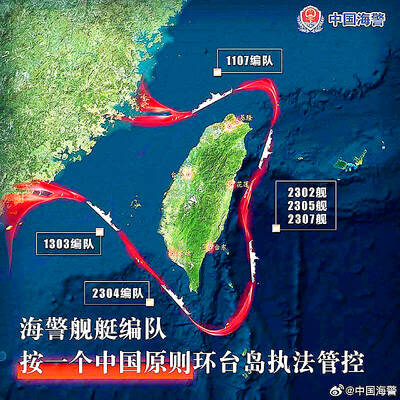
Taiwan would benefit from more integrated military strategies and deployments if the US and its allies treat the East China Sea, the Taiwan Strait and the South China Sea as a “single theater of operations,” a Taiwanese military expert said yesterday. Shen Ming-shih (沈明室), a researcher at the Institute for National Defense and Security Research, said he made the assessment after two Japanese military experts warned of emerging threats from China based on a drill conducted this month by the Chinese People’s Liberation Army’s (PLA) Eastern Theater Command. Japan Institute for National Fundamentals researcher Maki Nakagawa said the drill differed from the
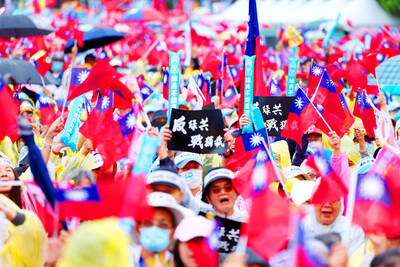
‘WORSE THAN COMMUNISTS’: President William Lai has cracked down on his political enemies and has attempted to exterminate all opposition forces, the chairman said The legislature would motion for a presidential recall after May 20, Chinese Nationalist Party (KMT) Chairman Eric Chu (朱立倫) said yesterday at a protest themed “against green communists and dictatorship” in Taipei. Taiwan is supposed to be a peaceful homeland where people are united, but President William Lai (賴清德) has been polarizing and tearing apart society since his inauguration, Chu said. Lai must show his commitment to his job, otherwise a referendum could be initiated to recall him, he said. Democracy means the rule of the people, not the rule of the Democratic Progressive Party (DPP), but Lai has failed to fulfill his
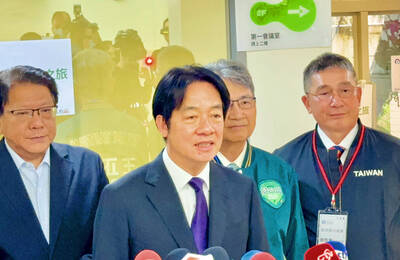
A rally held by opposition parties yesterday demonstrates that Taiwan is a democratic country, President William Lai (賴清德) said yesterday, adding that if opposition parties really want to fight dictatorship, they should fight it on Tiananmen Square in Beijing. The Chinese Nationalist Party (KMT) held a protest with the theme “against green communists and dictatorship,” and was joined by the Taiwan People’s Party. Lai said the opposition parties are against what they called the “green communists,” but do not fight against the “Chinese communists,” adding that if they really want to fight dictatorship, they should go to the right place and face
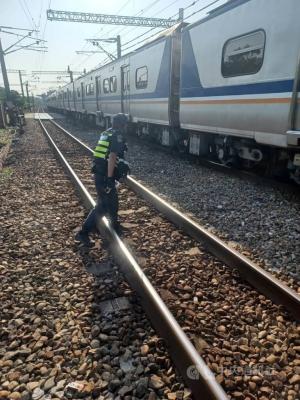
A 79-year-old woman died today after being struck by a train at a level crossing in Taoyuan, police said. The woman, identified by her surname Wang (王), crossed the tracks even though the barriers were down in Jhongli District’s (中壢) Neili (內壢) area, the Taoyuan Branch of the Railway Police Bureau said. Surveillance footage showed that the railway barriers were lowered when Wang entered the crossing, but why she ventured onto the track remains under investigation, the police said. Police said they received a report of an incident at 6:41am involving local train No. 2133 that was heading from Keelung to Chiayi City. Investigators


 RSS
RSS