


The Ministry of Foreign Affairs (MOFA) yesterday rebutted former Australian foreign minister Alexander Downer's "checkbook diplomacy" accusation, saying that all the nation's aid programs were carried out on the basis of cooperation and contributed to the international community.
"Cooperation and development programs are an obligation and the responsibility of every advanced nation in the international community. They should not be described as `checkbook diplomacy,'" said Victor Yu (于德勝), deputy director-general of the ministry's Department of East Asian and Pacific Affairs, at a regular press briefing.
Downer, who was in Taipei last week as part of an international parliamentary delegation to observe the presidential election, was quoted by the Australian Broadcasting Corp on Wednesday as saying that president-elect Ma Ying-jeou (馬英九) had given him a personal assurance that the new government would stop paying political bribes and improve its behavior in its dealings with South Pacific nations.
Downer claimed that under President Chen Shui-bian's (陳水扁) administration there had been a lot of "checkbook diplomacy," specifically with the Solomon Islands.
"There are clearly bribes that are being paid to members of parliament ... That has been undermining the work that we have been doing in RAMSI, the Regional Assistance Mission in Solomon Islands, in particular," Downer was quoted as saying in the report.
Both Taiwan and China have been accused of checkbook diplomacy in the Pacific, of using financial aid to gain the support of politicians in targeted countries. Taiwan's aid and grant programs to the Solomon Islands, one of its diplomatic allies in the region, have come under strong criticism in Canberra.
Commenting on Downer's accusations, MOFA spokeswoman Phoebe Yeh (葉非比) said that the Australian government sometimes misunderstands the nation's aid programs in the South Pacific region and that the Australian media often misinterpreted such efforts as checkbook diplomacy in the competition between Taiwan and China.
Meanwhile, Yu said Downer had misrepresented Ma's statement on the issue.
"All the resources that the nation has contributed are project-oriented and have generated substantial positive effects on the local economy and on society," Yu said. "Downer distorted what Ma actually meant."
Ma said in an international press conference on Sunday that the new government would focus on areas of economic, scientific and technological cooperation with the nation's diplomatic allies and would make sure that aid money did not go into the pockets of politicians.
Yu said that all cooperation projects required financial investment and what Taiwan was doing was sharing its know-how and technology to help its diplomatic allies.
He said that medical services were one of the nation's most important contributions in the region. From 2006 to last year, Taiwan sent as many as 24 "mobile medical groups" to the South Pacific to provide medical services to 15,000 people, he said.

FUKUOKA SITUATION: Japanese media reported that the pathogen is expected to be identified by the summer, while the CDC downplayed the idea that it was hMPV A “mysterious cold-like illness” reported in Japan’s Fukuoka Prefecture does not seem to be a new disease, but Japanese authorities have been asked about the situation, the Centers for Disease Control (CDC) said yesterday. The Fukuoka Prefectural Medical Association on Wednesday told a news conference that a “mystery cold” that has become a hot topic on social media is “highly likely to be caused by some kind of viral infection,” Japan’s KBC News reported. “Many people are experiencing symptoms starting with a sore throat, followed by a runny nose, phlegm and a severe cough,” KBC News reported, citing association officials. Health authorities are

Nvidia Corp CEO Jensen Huang (黃仁勳) arrived in Taiwan yesterday ahead of upcoming AI and technology events, saying he plans to meet with clients and Taiwan Semiconductor Manufacturing Co Chairman C.C. Wei (魏哲家) during his visit. After landing at Taipei Songshan Airport, Huang posed for photos with fans and handed out Yakult drinks to reporters and supporters waiting at the scene, saying he has “a lot to do” during the trip. Asked about reports that Nvidia’s planned headquarters site in Taipei’s Beitou Shilin Technology Park could break ground on May 27, Huang said that if the company holds an event, he would

The Ministry of Finance this afternoon announced the winning numbers for the March-April uniform invoice lottery. The winning number for the NT$10 million (US$318,060) special prize is 19531471, and the winning number for the NT$2 million grand prize is 85941329. Three numbers were drawn for the NT$200,000 first prize: 07225810, 20231230 and 83518781. Those with receipts matching the last seven digits of any of the first-prize numbers will win the NT$40,000 second prize, while those matching the last six digits will win the NT$10,000 third prize. Those whose receipts match the last five digits of the first-prize numbers can claim the NT$4,000 fourth prize,
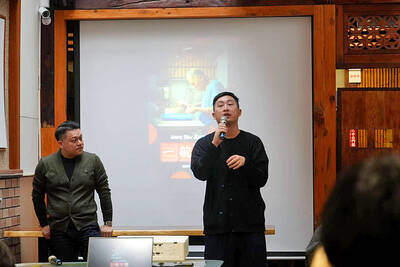
Taiwan Travelogue (臺灣漫遊錄), which earlier this week became the first Taiwanese novel to win the International Booker Prize, is to be adapted into a television series through a Taiwan-Japan coproduction, producer Chang Chen-yu (張辰漁) said yesterday. Chang, a producer at World Softest Production Film Co, wrote on Facebook that the company had been searching for projects with international appeal that retain a strong Taiwanese identity after colleagues and Japanese partners strongly recommended the novel. After reading the book, Chang said he immediately decided to pursue the screen rights. “A great story has the power to transcend time and borders, and connect countless people,”


 RSS
RSS