


Japan on Saturday renewed its call for dialogue between China and Taiwan following Chinese Nationalist Party (KMT) presidential candidate Ma Ying-jeou's (
In a statement after the result was confirmed, Japanese Foreign Minister Masahiko Komura said: "Japan hopes that the issue surrounding Taiwan will be resolved peacefully by direct dialogue between the parties concerned on the Taiwan Straits [sic] and that dialogue will resume soon for that purpose."
The foreign minister insisted that Japan's diplomatic relations with China remained unchanged, saying: "It intends to maintain Japan-Taiwan relations as a working relationship on a non-governmental basis."
Singapore had similar views.
"We welcome the successful conclusion of Taiwan's presidential election ... and congratulate Dr Ma Ying-jeou on his election," a foreign ministry spokesman said late on Saturday.
"We look forward to better cross-strait relations," the spokesman said in a statement.
"We urge all parties to take advantage of this new opportunity to resume dialogue and work towards greater peace and prosperity in the region," he said.
Meanwhile, Beijing welcomed the failure of the Democratic Progressive Party-sponsored referendum, which asked whether Taiwan should apply to enter the UN under the name "Taiwan."
"[President] Chen Shui-bian's [陳水扁] administration put forth a referendum to join the United Nations under the name `Taiwan,' but that referendum has failed, which goes to show that the people are not in favor of those who advocate Taiwan independence," Li Weiyi (李維一), spokesman for China's Taiwan Affairs Office, told Taiwanese reporters in Beijing.
Beijing's major newspapers yesterday gave accounts of the referendums, putting them ahead of the election results, indicating the Chinese Communist Party views the failed vote favorably.
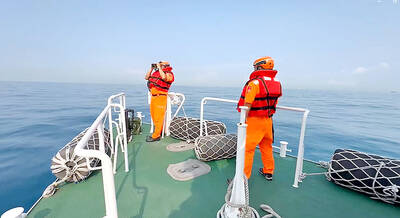
An increase in Taiwanese boats using China-made automatic identification systems (AIS) could confuse coast guards patrolling waters off Taiwan’s southwest coast and become a loophole in the national security system, sources familiar with the matter said yesterday. Taiwan ADIZ, a Facebook page created by enthusiasts who monitor Chinese military activities in airspace and waters off Taiwan’s southwest coast, on Saturday identified what seemed to be a Chinese cargo container ship near Penghu County. The Coast Guard Administration went to the location after receiving the tip and found that it was a Taiwanese yacht, which had a Chinese AIS installed. Similar instances had also

GOOD DIPLOMACY: The KMT has maintained close contact with representative offices in Taiwan and had extended an invitation to Russia as well, the KMT said The Chinese Nationalist Party (KMT) would “appropriately handle” the fallout from an invitation it had extended to Russia’s representative to Taipei to attend its international banquet last month, KMT Chairman Eric Chu (朱立倫) said yesterday. US and EU representatives in Taiwan boycotted the event, and only later agreed to attend after the KMT rescinded its invitation to the Russian representative. The KMT has maintained long-term close contact with all representative offices and embassies in Taiwan, and had extended the invitation as a practice of good diplomacy, Chu said. “Some EU countries have expressed their opinions of Russia, and the KMT respects that,” he

AMENDMENT: Contact with certain individuals in China, Hong Kong and Macau must be reported, and failure to comply could result in a prison sentence, the proposal stated The Chinese Nationalist Party (KMT) and the Taiwan People’s Party (TPP) yesterday voted against a proposed bill by Democratic Progressive Party (DPP) lawmakers that would require elected officials to seek approval before visiting China. DPP Legislator Puma Shen’s (沈伯洋) proposed amendments to the Act Governing Relations Between the People of the Taiwan Area and the Mainland Area (臺灣地區與大陸地區人民關係條例), stipulate that contact with certain individuals in China, Hong Kong and Macau should be reported, while failure to comply would be punishable by prison sentences of up to three years, alongside a fine of NT$10 million (US$309,041). Fifty-six voted with the TPP in opposition
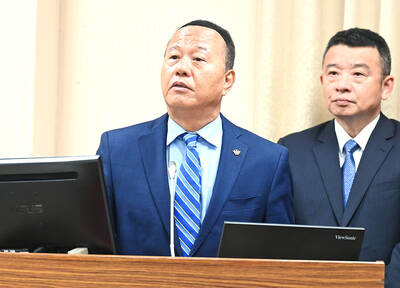
VIGILANCE: The military is paying close attention to actions that might damage peace and stability in the region, the deputy minister of national defense said The People’s Republic of China (PRC) might consider initiating a hack on Taiwanese networks on May 20, the day of the inauguration ceremony of president-elect William Lai (賴清德), sources familiar with cross-strait issues said. While US Secretary of State Anthony Blinken’s statement of the US expectation “that all sides will conduct themselves with restraint and prudence in the period ahead” would prevent military actions by China, Beijing could still try to sabotage Taiwan’s inauguration ceremony, the source said. China might gain access to the video screens outside of the Presidential Office Building and display embarrassing messages from Beijing, such as congratulating Lai


 RSS
RSS