


Beijing was likely to be pleased with Chinese Nationalist Party (KMT) presidential candidate Ma Ying-jeou's (
Beijing will now expect Ma to move swiftly toward renewing talks on building closer transportation and economic links, which have been frozen by Beijing for more than a decade, Peking University professor Niu Jun (牛軍) said.
"It seems to reflect the desire of Taiwanese voters to get cross-strait relations back on an even keel, which is something the mainland wants too," Niu said after it was announced that Ma was to replace President Chen Shui-bian (
There was no direct, immediate comment from the Chinese government or Chinese Communist Party on the election result. Niu said he did not expect any new initiatives from Beijing, saying the sides had already reached partial agreements when KMT politicians visited China.
"It's not a question of adjusting policy, but rather of consolidating the consensus already reached," Niu said.
Beijing suspended talks in part because of Taipei's refusal to recognize Beijing's "one China policy" under which Taiwan is considered a part of China.
China's official Xinhua news agency reported on Ma's victory in what it called Taiwan's "leadership election" -- reflecting Beijing's refusal to recognize the Taiwanese government.
Ma's win should be relatively palatable to Beijing because the KMT ostensibly favors unification between the two sides.
Beijing will also likely be happy at the failure of a pair of referendums on Taiwan's application to join the UN.
China has railed against the referendums, calling them a dangerous step toward independence and has rallied the US and other international powers in opposing it.
On Friday, Chinese Foreign Minister Yang Jiechi (
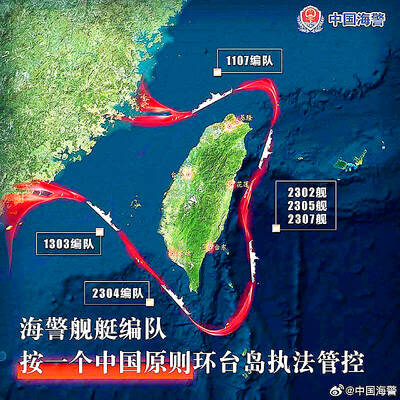
Taiwan would benefit from more integrated military strategies and deployments if the US and its allies treat the East China Sea, the Taiwan Strait and the South China Sea as a “single theater of operations,” a Taiwanese military expert said yesterday. Shen Ming-shih (沈明室), a researcher at the Institute for National Defense and Security Research, said he made the assessment after two Japanese military experts warned of emerging threats from China based on a drill conducted this month by the Chinese People’s Liberation Army’s (PLA) Eastern Theater Command. Japan Institute for National Fundamentals researcher Maki Nakagawa said the drill differed from the
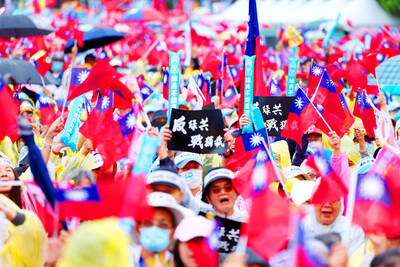
‘WORSE THAN COMMUNISTS’: President William Lai has cracked down on his political enemies and has attempted to exterminate all opposition forces, the chairman said The legislature would motion for a presidential recall after May 20, Chinese Nationalist Party (KMT) Chairman Eric Chu (朱立倫) said yesterday at a protest themed “against green communists and dictatorship” in Taipei. Taiwan is supposed to be a peaceful homeland where people are united, but President William Lai (賴清德) has been polarizing and tearing apart society since his inauguration, Chu said. Lai must show his commitment to his job, otherwise a referendum could be initiated to recall him, he said. Democracy means the rule of the people, not the rule of the Democratic Progressive Party (DPP), but Lai has failed to fulfill his

OFF-TARGET: More than 30,000 participants were expected to take part in the Games next month, but only 6,550 foreign and 19,400 Taiwanese athletes have registered Taipei city councilors yesterday blasted the organizers of next month’s World Masters Games over sudden timetable and venue changes, which they said have caused thousands of participants to back out of the international sporting event, among other organizational issues. They also cited visa delays and political interference by China as reasons many foreign athletes are requesting refunds for the event, to be held from May 17 to 30. Jointly organized by the Taipei and New Taipei City governments, the games have been rocked by numerous controversies since preparations began in 2020. Taipei City Councilor Lin Yen-feng (林延鳳) said yesterday that new measures by
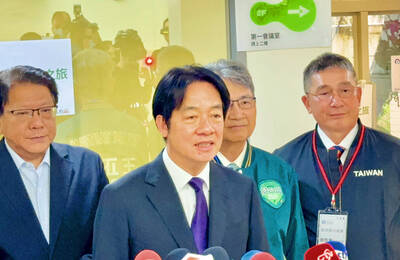
A rally held by opposition parties yesterday demonstrates that Taiwan is a democratic country, President William Lai (賴清德) said yesterday, adding that if opposition parties really want to fight dictatorship, they should fight it on Tiananmen Square in Beijing. The Chinese Nationalist Party (KMT) held a protest with the theme “against green communists and dictatorship,” and was joined by the Taiwan People’s Party. Lai said the opposition parties are against what they called the “green communists,” but do not fight against the “Chinese communists,” adding that if they really want to fight dictatorship, they should go to the right place and face


 RSS
RSS