


Democratic Progressive Party (DPP) presidential candidate Frank Hsieh (
There are many ways to support Tibet, Hsieh said, adding that one was for him and Ma to sacrifice their personal interests and protest against China's bloody crackdown.
"It would definitely send a shockwave around the world," he told reporters at his campaign office.
While Ma has not ruled out boycotting the Beijing Olympics if the Chinese government continues its suppression of Tibetans, Hsieh said it was hard to gauge whether the situation had worsened.
"Ma's position is unclear," he said.
Hsieh said a Taiwanese Olympic boycott might not be effective because China did not care whether or not Taiwan took part in the Games.
"Beijing has never believed that Taiwan is qualified to participate in the Olympics," Hsieh said. "As the host country, they cannot reject us -- but they do not want us there."
Hsieh criticized Ma for making a hasty decision and vacillating on his position. Politicians must exercise caution when they talk about sports and religion, he said.
China has a track record of denigrating the sovereignty of Tibet and Taiwan, Hsieh said, adding that the Olympic torch relay was another example of this.
When Taiwan rejected Beijing's arrangements for the relay, Hsieh said Ma had accused the DPP of ignoring the interests of Taiwanese athletes.
"Now he proposes boycotting the Olympic games," he said. "It only proves that [Ma] frequently changes his position and sees the Tibet issue as a trifling matter. What would happen to this country if he were elected president?"
In response, Ma spokesman Su Jun-pin (蘇俊賓) criticized Hsieh's suggestion to postpone the presidential poll.
"Postponing the election would seriously damage Taiwan's democracy," Su said at Ma's campaign headquarters.
Su urged Hsieh not to distract voters with such suggestions.
Central Election Commission (CEC) Secretary-General Teng Tien-yu (鄧天佑) assured the KMT caucus that the CEC would not postpone the presidential election unless a candidate died or was near death, in accordance with the President and Vice President Election and Recall Law (總統副總統選舉罷免法).
The commission would hold a meeting to determine whether to stop the election if a candidate were seriously wounded, Teng said.
He also said that if either candidate held an election-eve news conference after 10pm, they would be fined.
By law, campaign activities must cease by 10pm the night before the election. Violators are subject to fines of up to NT$5 million (US$163,000).
However, Teng did not say whether broadcasters would be punished for giving airtime to a candidate after the election eve deadline.
Additional reporting by Mo Yan-chih and Flora Wang

LOUD AND PROUD Taiwan might have taken a drubbing against Australia and Japan, but you might not know it from the enthusiasm and numbers of the fans Taiwan might not be expected to win the World Baseball Classic (WBC) but their fans are making their presence felt in Tokyo, with tens of thousands decked out in the team’s blue, blowing horns and singing songs. Taiwanese fans have packed out the Tokyo Dome for all three of their games so far and even threatened to drown out home team supporters when their team played Japan on Friday. They blew trumpets, chanted for their favorite players and had their own cheerleading squad who dance on a stage during the game. The team struggled to match that exuberance on the field, with
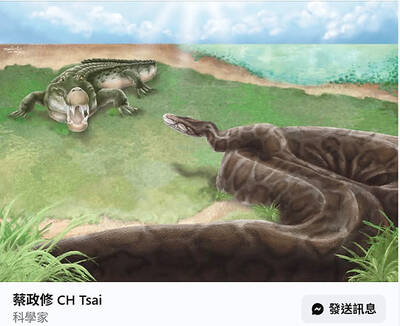
Taiwanese paleontologists have discovered fossil evidence that pythons up to 4m long inhabited Taiwan during the Pleistocene epoch, reporting their findings in the international scientific journal Historical Biology. National Taiwan University (NTU) Institute of Ecology and Evolutionary Biology associate professor Tsai Cheng-hsiu (蔡政修) led the team that discovered the largest snake fossil ever found in Taiwan. The single trunk vertebra was discovered in Tainan at the Chiting Formation, dated to between 400,000 and 800,000 years ago in the Middle Pleistocene, the paper said. The area also produced Taiwan’s first avian fossil, as well as crocodile, mammoth, saber-toothed cat and rhinoceros fossils, it said. Discoveries

Taiwanese paleontologists have discovered fossil evidence that pythons up to 4m long inhabited Taiwan during the Pleistocene epoch, reporting their findings in the international scientific journal Historical Biology. National Taiwan University (NTU) Institute of Ecology and Evolutionary Biology associate professor Tsai Cheng-hsiu (蔡政修) led the team that discovered the largest snake fossil ever found in Taiwan. A single trunk vertebra was discovered in Tainan at the Chiting Formation, dated to between 800,000 to 400,000 years ago in the Middle Pleistocene, the paper said. The area also produced Taiwan’s first avian fossil, as well as crocodile, mammoth, sabre-toothed cat and rhinoceros fossils, it said. Discoveries

Whether Japan would help defend Taiwan in case of a cross-strait conflict would depend on the US and the extent to which Japan would be allowed to act under the US-Japan Security Treaty, former Japanese minister of defense Satoshi Morimoto said. As China has not given up on the idea of invading Taiwan by force, to what extent Japan could support US military action would hinge on Washington’s intention and its negotiation with Tokyo, Morimoto said in an interview with the Liberty Times (sister paper of the Taipei Times) yesterday. There has to be sufficient mutual recognition of how Japan could provide


 RSS
RSS