


There are 13 members of the Military Police force that are entirely devoted to the nation and willing to make the ultimate sacrifice, and all they ask in return is a total monthly budget of NT$1,300 for food and medication.
They are the force's 13 German Shepherds.
"Know your dogs and love them with your all your heart. If you do, they will pay you back by sacrificing themselves and keeping you alive on the battlefield," Military Police dog squad chief Lieutenant Yeh Yu-ming (
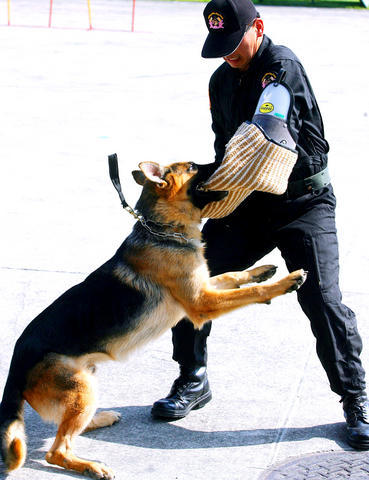
PHOTO: WANG YI-SUNG, TAIPEI TIMES
Yeh said the squad's top priority is to keep the dogs healthy and fit so they can be commissioned for any assignment at short notice.
"They give everything, including their lives, to help human beings. The least we can do for them in return is to make sure that they are in good shape," Yeh said.
Communication
He said that, while a regular soldier's top priority is to make sure that his weapons are in good condition so that nothing goes wrong when he needs them, the handlers of the military dog squad's priorities include making sure that communication with the dogs is adequate and that the dogs receive the necessary care and attention.
"It is not as easy as cleaning your rifle," Yeh said. "For us, the dogs are our `weapons,' but they are more than `weapons'; they are alive and need our attention all the time."
Yeh said the most important thing for his fellow dog squad members was to establish good relationships with their dogs.
He said that a well-trained dog would follow only the commands of his handler.
"If the dog does not recognize you as the `boss,' everything will be in vain," he said.
To do that, Yeh said, the squad members do their best to get to know their dogs.
"Like human beings, every dog has its own character and emotional behavior. You have to be his `friend' before he will accept you, recognize you as the `boss' and follow your orders. It takes a lot of time and patience," Yeh said.
Securing Taipei
The Military Police first established a "Military Dog Team" in 1964. In 1999, the team was downsized and merged with the Military Police's 202 Command Headquarters, which is responsible for securing the capital city.
Yeh said the German Shepherds' main mission is to help the National Security Bureau (NSB) and the regular police carry out anti-drug crackdowns or special escort missions. As puppies the dogs are also trained to sniff out explosives, and they help out the bomb squad every now and then.
"They have good noses," Yeh said. "With well-organized training courses, every one of them helps make law enforcement a lot easier. That is what they do."
Yeh said that the dogs' training courses include compliance training, barrier training and explosives and drug search training.
Compliance training is a daily routine in which squad members spend most of their day with assigned military dogs. The end goal is to help dogs develop a relationship with their handlers so that orders can be carried out efficiently.
Barrier training helps the dogs overcome their fear of strange environments to enable them to carry out orders under pressure.
This training also includes socialization training, which is designed to help the dogs socialize so they will not panic when they encounter a new situation or unfamiliar place.
The explosives and drug search training regime is the most important, Yeh said, as it enables the dogs to take advantage of their nasal prowess to help law enforcement officers crack down on drugs or discover explosives.
"Our puppies are able to find even a minute amount of drugs or explosives when a detecting machine cannot," Yeh said. "As a result, our puppies often help NSB agents secure a location before the visit of the president, vice president or foreign VIPs."
3km run
Private Lee Ming-han (
"When you are always there for your dogs whenever they need you, they will always be there for you when you need them," Lee said.

A group of Taiwanese-American and Tibetan-American students at Harvard University on Saturday disrupted Chinese Ambassador to the US Xie Feng’s (謝鋒) speech at the school, accusing him of being responsible for numerous human rights violations. Four students — two Taiwanese Americans and two from Tibet — held up banners inside a conference hall where Xie was delivering a speech at the opening ceremony of the Harvard Kennedy School China Conference 2024. In a video clip provided by the Coalition of Students Resisting the CCP (Chinese Communist Party), Taiwanese-American Cosette Wu (吳亭樺) and Tibetan-American Tsering Yangchen are seen holding banners that together read:

UNAWARE: Many people sit for long hours every day and eat unhealthy foods, putting them at greater risk of developing one of the ‘three highs,’ an expert said More than 30 percent of adults aged 40 or older who underwent a government-funded health exam were unaware they had at least one of the “three highs” — high blood pressure, high blood lipids or high blood sugar, the Health Promotion Administration (HPA) said yesterday. Among adults aged 40 or older who said they did not have any of the “three highs” before taking the health exam, more than 30 percent were found to have at least one of them, Adult Preventive Health Examination Service data from 2022 showed. People with long-term medical conditions such as hypertension or diabetes usually do not
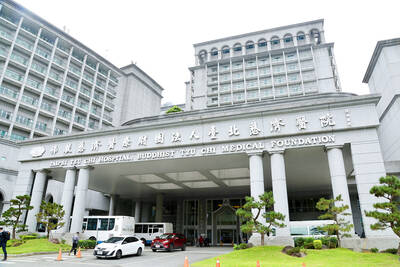
POLICE INVESTIGATING: A man said he quit his job as a nurse at Taipei Tzu Chi Hospital as he had been ‘disgusted’ by the behavior of his colleagues A man yesterday morning wrote online that he had witnessed nurses taking photographs and touching anesthetized patients inappropriately in Taipei Tzu Chi Hospital’s operating theaters. The man surnamed Huang (黃) wrote on the Professional Technology Temple bulletin board that during his six-month stint as a nurse at the hospital, he had seen nurses taking pictures of patients, including of their private parts, after they were anesthetized. Some nurses had also touched patients inappropriately and children were among those photographed, he said. Huang said this “disgusted” him “so much” that “he felt the need to reveal these unethical acts in the operating theater
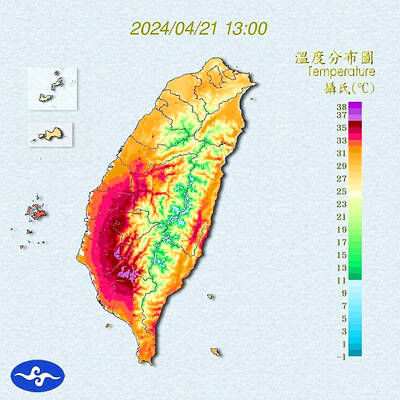
Heat advisories were in effect for nine administrative regions yesterday afternoon as warm southwesterly winds pushed temperatures above 38°C in parts of southern Taiwan, the Central Weather Administration (CWA) said. As of 3:30pm yesterday, Tainan’s Yujing District (玉井) had recorded the day’s highest temperature of 39.7°C, though the measurement will not be included in Taiwan’s official heat records since Yujing is an automatic rather than manually operated weather station, the CWA said. Highs recorded in other areas were 38.7°C in Kaohsiung’s Neimen District (內門), 38.2°C in Chiayi City and 38.1°C in Pingtung’s Sandimen Township (三地門), CWA data showed. The spell of scorching


 RSS
RSS