


On a Tuesday night, about 47 students sat in a classroom at the Taipei City Library learning how to speak a simple sentence like "The weather is hot" with their hands, lips, faces and bodies.
The sign language course is offered by the Organizing Committee of the Deaflympics.
An estimated 6,000 deaf athletes from more than 90 countries are expected to attend the event, which will take place in September next year.
To welcome the special guests, the committee has recruited approximately 2,200 volunteers. About two-thirds have received training in sign language.
Some of the volunteers were born deaf, while others became deaf because of illnesses they contracted in childhood. Some are people with normal hearing and the reasons that motivated them to take the course vary.
Lin Shiu-duan (林秀端) and her daughter, Hsieh Wan-cheng (謝宛錚), are attending an intermediate-level sign language class.
Lin said her daughter was diagnosed as being deaf when she was about one-and-a-half years old.
"I cried for two days after I heard [the news]," Lin said.
Lin's sadness abated when she heard that her daughter could still connect with the world through devices such as hearing aids. In the meantime, she started some research and discovered that swimming could be the best exercise to help stimulate her daughter's language skills as well as other abilities. Eventually, Lin quit her job at the National Museum of History and became a full-time special-education teacher.
Her daughter, Hsieh, is attending regular school and has been on the swimming team ever since elementary school.
The training, however, was never easy.
"The coach could tell the other children straight away what they were doing wrong so they could change it immediately," Lin said. "But he couldn't do that with her because she couldn't hear the instructions. He could only show her what she was doing wrong after she finished her laps, so it would take her more time to get it right."
Misunderstandings would also occur when Hsieh's teammates tried to relay the coach's instructions to her, Lin said.
Lin said she was not aware that there were international games dedicated to the deaf until four years ago, when the last Deaflympics were held in Sydney, Australia.
Lin said she and her daughter were excited by the fact that the event is going to be in Taipei next year. As a veteran volunteer in the deaf community, she said she is just as willing to allocate her time to help greet our friends from overseas.
Chen Liao-ching (
Because of his work as a ground service agent at the Taiwan Taoyuan International Airport, Chen has to commute between Taoyuan and Taipei daily and has to be on night shift from time to time.
Also taking a sign language class at night was very tiring, but Chen considers it a labor of love.
"I don't know how to describe it, but it is such a charming language," he said.
Chen said he is aiming to practice what he has learned at the Deaflympics, for which he will take a leave of absence from work for 11 days.
Chen hopes the games will help Taiwan gain publicity around the world and help persuade the government to care more for the needs of the physically-challenged when constructing public facilities.
Committee deputy executive director Chiu Chin-chi (邱金治) said the city aims to have at least 3,000 volunteers for the event.
A deaf person herself, Chiu is in charge of designing the sign language courses for the Deaflympics volunteers.
She said the committee provided courses in the Taiwanese version of sign language and its international counterpart. Those taking the international sign language class needed to be adept in Taiwanese sign language first, she said.
Chiu said that about 280 volunteers, who are either proficient in international sign language or have the ability to lip read English, would be assigned to translate discussions at the games, such as those between referees and athletes.
As for the majority of the general public who probably will not know how to communicate with the athletes in sign language, Chiu offered a simple solution.
"They can always do a mime," she said.

GOOD DIPLOMACY: The KMT has maintained close contact with representative offices in Taiwan and had extended an invitation to Russia as well, the KMT said The Chinese Nationalist Party (KMT) would “appropriately handle” the fallout from an invitation it had extended to Russia’s representative to Taipei to attend its international banquet last month, KMT Chairman Eric Chu (朱立倫) said yesterday. US and EU representatives in Taiwan boycotted the event, and only later agreed to attend after the KMT rescinded its invitation to the Russian representative. The KMT has maintained long-term close contact with all representative offices and embassies in Taiwan, and had extended the invitation as a practice of good diplomacy, Chu said. “Some EU countries have expressed their opinions of Russia, and the KMT respects that,” he
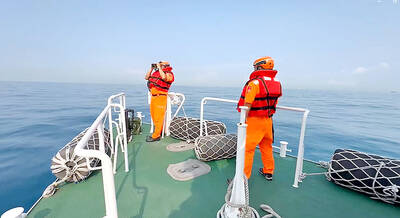
An increase in Taiwanese boats using China-made automatic identification systems (AIS) could confuse coast guards patrolling waters off Taiwan’s southwest coast and become a loophole in the national security system, sources familiar with the matter said yesterday. Taiwan ADIZ, a Facebook page created by enthusiasts who monitor Chinese military activities in airspace and waters off Taiwan’s southwest coast, on Saturday identified what seemed to be a Chinese cargo container ship near Penghu County. The Coast Guard Administration went to the location after receiving the tip and found that it was a Taiwanese yacht, which had a Chinese AIS installed. Similar instances had also

CHANGES: After-school tutoring periods, extracurricular activities during vacations or after-school study periods must not be used to teach new material, the ministry said The Ministry of Education yesterday announced new rules that would ban giving tests to most elementary and junior-high school students during morning study and afternoon rest periods. The amendments to regulations governing public education at elementary schools and junior high schools are to be implemented on Aug. 1. The revised rules stipulate that schools are forbidden to use after-school tutoring periods, extracurricular activities during summer or winter vacation or after-school study periods to teach new course material. In addition, schools would be prohibited from giving tests or exams to students in grades one to eight during morning study and afternoon break periods, the

AMENDMENT: Contact with certain individuals in China, Hong Kong and Macau must be reported, and failure to comply could result in a prison sentence, the proposal stated The Chinese Nationalist Party (KMT) and the Taiwan People’s Party (TPP) yesterday voted against a proposed bill by Democratic Progressive Party (DPP) lawmakers that would require elected officials to seek approval before visiting China. DPP Legislator Puma Shen’s (沈伯洋) proposed amendments to the Act Governing Relations Between the People of the Taiwan Area and the Mainland Area (臺灣地區與大陸地區人民關係條例), stipulate that contact with certain individuals in China, Hong Kong and Macau should be reported, while failure to comply would be punishable by prison sentences of up to three years, alongside a fine of NT$10 million (US$309,041). Fifty-six voted with the TPP in opposition


 RSS
RSS