


The commander of the US forces in the Pacific said on Tuesday he has seen no indication of unusual Chinese military movements in the Taiwan Strait ahead of Taiwan's presidential election, but his forces will monitor the situation "very carefully" in the period between March 22 poll and the presidential inauguration in May.
Testifying before the Senate Armed Services Committee on the posture of US forces in the region, Admiral Timothy Keating said it was "very unlikely that anything will happen across the Strait" in coming months.
He said he was "cautiously optimistic" about the situation in the Strait.
After the hearing, in answer to a question by the Taipei Times during a brief press conference, Keating said that his comment was "optimism fueled by hope."
"I have no indication today," he said, "that there is reason for increased concern with respect to the likelihood of military hostilities in the Strait of Taiwan. We watch very carefully both sides in all areas close to and further from the Strait."
"We have spent considerable efforts with parties from both sides to ask them to take a long, measured view of the situation in the Strait. So, writ large, I see no reason for concern," he said.
Noting that the Chinese military "continues to move their forces around," he said, "there is no direct movement of forces that would indicate to me any increased reason for concern over the Strait."
Nevertheless, Keating urged both President Chen Shui-bian (
"President Chen has made statements that we at the Pacific Command ... think are not helpful to peace and stability in the region," he said.
"And so, in the period between the election and the inauguration, were hopeful that the new elected president, whoever he might be, and the outgoing president continue to demonstrate responsible behavior in the form of something other than potentially inflammatory rhetoric," he said.
During the hearing, Keating said he had cautioned both sides against "untoward military activity," in the upcoming period.
"The two leading candidates [in the elections] both advocate a more modest, less bellicose approach to Taiwan's dealings with the People's Republic of China [PRC]. So, we're certainly optimistic that a little bit of the steam will leave the kettle after the 22nd of March," he said.
Between the election and the swearing-in of a new president, "there will be a period of months where we'll continue to watch very carefully cross-strait tensions. I think it very unlikely that any hostilities will break out," Keating said.
He expressed disappointment in the hearing over the progress in trying to improve Sino-American military-to-military relations.
In his written opening statement, Keating said that the relationship was "not at the level we desire. Progress was decidedly uneven."
He also complained about the "perplexing cancelation of some routine activities. Nevertheless, improving the interactions between USPACOM [the US Pacific Command] and the PLA [People's Liberation Army] is critically important, in terms of maintaining stability across the Taiwan Strait and in assuring regional nations."
Turning to what Taiwan can do, Keating said, "I remain concerned about Chinese double-digit growth in annual defense spending and investment in systems which threaten Taiwan and our own capabilities ... USPACOM is encouraging Taiwan to improve its self-defense capabilities and thereby deter potential PRC aggression."
Also See: China wants to manage US policy
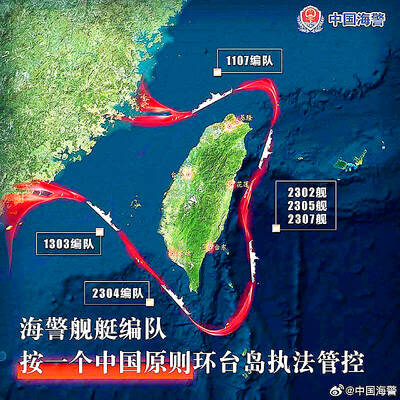
Taiwan would benefit from more integrated military strategies and deployments if the US and its allies treat the East China Sea, the Taiwan Strait and the South China Sea as a “single theater of operations,” a Taiwanese military expert said yesterday. Shen Ming-shih (沈明室), a researcher at the Institute for National Defense and Security Research, said he made the assessment after two Japanese military experts warned of emerging threats from China based on a drill conducted this month by the Chinese People’s Liberation Army’s (PLA) Eastern Theater Command. Japan Institute for National Fundamentals researcher Maki Nakagawa said the drill differed from the
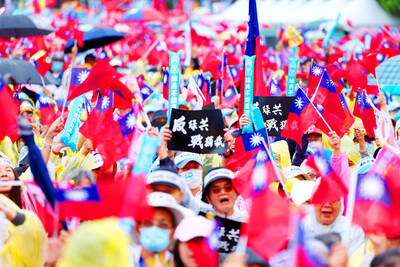
‘WORSE THAN COMMUNISTS’: President William Lai has cracked down on his political enemies and has attempted to exterminate all opposition forces, the chairman said The legislature would motion for a presidential recall after May 20, Chinese Nationalist Party (KMT) Chairman Eric Chu (朱立倫) said yesterday at a protest themed “against green communists and dictatorship” in Taipei. Taiwan is supposed to be a peaceful homeland where people are united, but President William Lai (賴清德) has been polarizing and tearing apart society since his inauguration, Chu said. Lai must show his commitment to his job, otherwise a referendum could be initiated to recall him, he said. Democracy means the rule of the people, not the rule of the Democratic Progressive Party (DPP), but Lai has failed to fulfill his
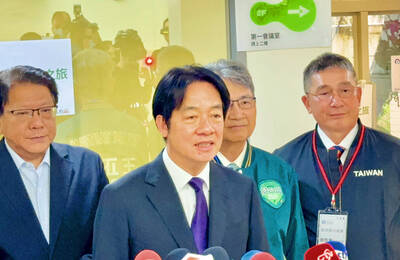
A rally held by opposition parties yesterday demonstrates that Taiwan is a democratic country, President William Lai (賴清德) said yesterday, adding that if opposition parties really want to fight dictatorship, they should fight it on Tiananmen Square in Beijing. The Chinese Nationalist Party (KMT) held a protest with the theme “against green communists and dictatorship,” and was joined by the Taiwan People’s Party. Lai said the opposition parties are against what they called the “green communists,” but do not fight against the “Chinese communists,” adding that if they really want to fight dictatorship, they should go to the right place and face
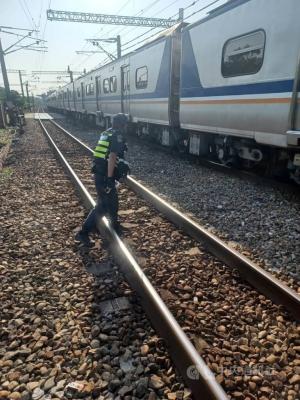
A 79-year-old woman died today after being struck by a train at a level crossing in Taoyuan, police said. The woman, identified by her surname Wang (王), crossed the tracks even though the barriers were down in Jhongli District’s (中壢) Neili (內壢) area, the Taoyuan Branch of the Railway Police Bureau said. Surveillance footage showed that the railway barriers were lowered when Wang entered the crossing, but why she ventured onto the track remains under investigation, the police said. Police said they received a report of an incident at 6:41am involving local train No. 2133 that was heading from Keelung to Chiayi City. Investigators


 RSS
RSS