


Since registering for the presidential election with the Central Election Commission (CEC) on Jan. 27, Chinese Nationalist Party (KMT) presidential candidate Ma Ying-jeou's (馬英九) US green card status has been a subject of controversy and attacks by his Democratic Progressive Party (DPP) rival Frank Hsieh (謝長廷).
When Hsieh first raised the green card issue, Ma initially responded that he did not have a green card, but later conceded that he possessed one in 1977 to get student loans and employment after graduation. However, it was automatically invalidated in 1985 when he applied for a visa to travel to the US, Ma said.
Hsieh alleged that Ma has not provided evidence to back his claims and still holds a valid US green card because he never completed an I-407 form to relinquish his permanent residency in the US nor has a US immigration court invalidated his card.
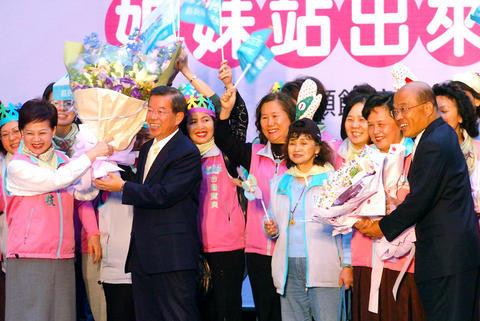
PHOTO: CHIEN JUNG-FONG, TAIPEI TIMES
The issue carried over to the first televised presidential debate on Feb. 24, when Hsieh asked Ma to apologize if evidence proves that his US permanent residency was still valid before Jan. 27.
The two camps threatened to sue each other after Hsieh spokesman Chao Tien-lin (
The latest allegation surfaced when Kaohsiung County Commissioner Yang Chiu-hsing (
Analysts said that had Ma come clean on his US green card sooner, the controversy would not have dragged on for so long.
Hwang Shiow-duan (
"His crisis management has always been poor," she said. "If I were him, I would have gone to the [AIT] to fill out the I-407 form and publicly renounce the US permanent residency to minimize the damage that could have been done."
She said she did not know why the AIT or the US government did not come forward and help clarify the matter, but she suspected they either did not want to get involved or wanted to wait until they received a formal request from the CEC.
CEC ROLE
The CEC has since stepped in to resolve the controversy. Hsieh and his running mate, Su Tseng-chang (
The AIT has said it would consider providing information to the CEC on the citizenship or permanent legal resident status of presidential candidates. AIT officials, however, said the CEC had not yet contacted them.
Former senior presidential adviser Wu Li-pei (
Wu, who relinquished his green card in 2004, said he understood the US government might want to protect Ma's personal information, but said it would only be to the advantage of Ma and Taiwan's democracy if the US government clarified the matter.
Political analyst Antonio Chiang (江春男) said he did not think the US government would want to get involved because it would be considered an overt endorsement of a particular candidate if it came out and said Ma does not have a valid green card. It would likely cause even more trouble if it confirmed that Ma's green card is valid, he said.
POLL RESULTS
The results of a poll released by Taiwan Thinktank yesterday showed that more than 43 percent of respondents said they did not think AIT's reticence was an indication that the US favored any candidate, while aprroximately 37 percent said that it did.
More than 47 percent said they were not worried that the US government would meddle in Taiwan's presidential election, while nearly 41 percent said they were worried.
While the public might have grown weary of the ongoing controversy, Hwang said the issue was important because a US green card is a document that grants lawful permanent residency in the US, a prerequisite to immigrating to that country.
That Ma applied for and received a green card could indicate that Ma had attempted to immigrate to the US in the 1970s when Taiwan was in a difficult situation, she said.
The Nationality Law (
It could also lead to a constitutional crisis if Ma won the presidential election only to be found later on to have foreign nationality. In that case, the election results could face a challenge.
"If that were the case, it would be a problem not only for the KMT, but also for the entire nation," Chiang said. "It would be both a legal problem and a serious political problem."
Chiang said Ma's wishy-washy attitude may have damaged his image and given the public the impression that he is dishonest and poor at crisis management. But he did not think Hsieh would continue to push the issue because it has been dragging on for so long that its impact has diminished as the issue becomes more trivial and complicated.
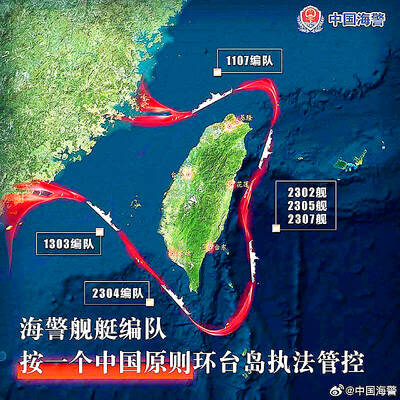
Taiwan would benefit from more integrated military strategies and deployments if the US and its allies treat the East China Sea, the Taiwan Strait and the South China Sea as a “single theater of operations,” a Taiwanese military expert said yesterday. Shen Ming-shih (沈明室), a researcher at the Institute for National Defense and Security Research, said he made the assessment after two Japanese military experts warned of emerging threats from China based on a drill conducted this month by the Chinese People’s Liberation Army’s (PLA) Eastern Theater Command. Japan Institute for National Fundamentals researcher Maki Nakagawa said the drill differed from the
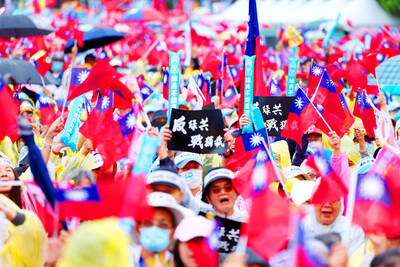
‘WORSE THAN COMMUNISTS’: President William Lai has cracked down on his political enemies and has attempted to exterminate all opposition forces, the chairman said The legislature would motion for a presidential recall after May 20, Chinese Nationalist Party (KMT) Chairman Eric Chu (朱立倫) said yesterday at a protest themed “against green communists and dictatorship” in Taipei. Taiwan is supposed to be a peaceful homeland where people are united, but President William Lai (賴清德) has been polarizing and tearing apart society since his inauguration, Chu said. Lai must show his commitment to his job, otherwise a referendum could be initiated to recall him, he said. Democracy means the rule of the people, not the rule of the Democratic Progressive Party (DPP), but Lai has failed to fulfill his
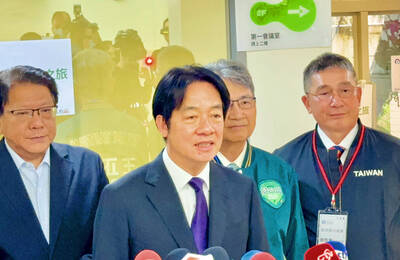
A rally held by opposition parties yesterday demonstrates that Taiwan is a democratic country, President William Lai (賴清德) said yesterday, adding that if opposition parties really want to fight dictatorship, they should fight it on Tiananmen Square in Beijing. The Chinese Nationalist Party (KMT) held a protest with the theme “against green communists and dictatorship,” and was joined by the Taiwan People’s Party. Lai said the opposition parties are against what they called the “green communists,” but do not fight against the “Chinese communists,” adding that if they really want to fight dictatorship, they should go to the right place and face
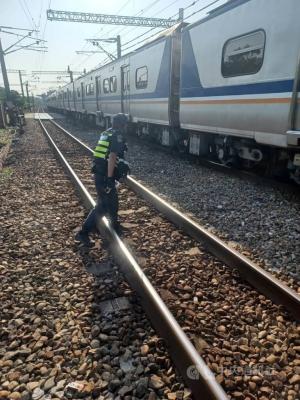
A 79-year-old woman died today after being struck by a train at a level crossing in Taoyuan, police said. The woman, identified by her surname Wang (王), crossed the tracks even though the barriers were down in Jhongli District’s (中壢) Neili (內壢) area, the Taoyuan Branch of the Railway Police Bureau said. Surveillance footage showed that the railway barriers were lowered when Wang entered the crossing, but why she ventured onto the track remains under investigation, the police said. Police said they received a report of an incident at 6:41am involving local train No. 2133 that was heading from Keelung to Chiayi City. Investigators


 RSS
RSS