


Democratic Progressive Party (DPP) presidential candidate Frank Hsieh (謝長廷) yesterday said he was willing to compromise if the legal threshold for a valid referendum is lowered to a simple majority.
For the sake of seeking a consensus and Taiwan's international profile, Hsieh said he was willing to separate the two referendums from the presidential election if the legal threshold is reduced to a simple majority.
The DPP has proposed holding a referendum on seeking UN membership using the name "Taiwan," while the Chinese Nationalist Party (KMT) has initiated a referendum on rejoining the body using the name "Republic of China" or any other "practical" name.
Half of all eligible voters must vote in favor of a referendum for it to succeed, according to the Referendum Law (
In addition to the voter turnout threshold, the law stipulates that the signatures of 0.5 percent of eligible voters -- approximately 80,000 -- be collected to apply to hold a referendum.
In the second application stage, 5 percent of eligible voters -- approximately 800,000 -- must sign the petition before it can be screened by the Referendum Review Committee.
President Chen Shui-bian (陳水扁) said on Wednesday that he would hold cross-party negotiations on separating the referendums on UN membership from the presidential election if the KMT is willing to amend the Referendum Law to lower the voting threshold for referendum results to be considered valid.
As the legislature is set to go into a recess in two weeks, Hsieh yesterday said he hoped the legislature would come to an agreement on the matter. With the KMT's three-quarters majority, Hsieh said it would be easy to amend the law if a consensus were reached.
But the DPP "would be left with little option" if the KMT is trying to stall the process and foil the two referendums, he said.
Meanwhile, Hsieh's campaign yesterday continued to lambaste the "cross-strait common market" proposed by KMT rival Ma Ying-jeou's (
Hsieh Hsin-ni (
"With the government ban in place, over NT$109 billion of technology and capital has gone to China. I cannot imagine how much investment would go to China if Ma is elected president," she said.
A poll released by the Taiwan Thinktank yesterday showed that a majority of the respondents said they were against the free flow of people and products under the framework of a "cross-strait common market."
Over 67 percent of the poll respondents said that they were worried about the deterioration of social security and quality of life if a vast number of Chinese were allowed to come and go freely.
Of the people polled, 64 percent said that they were worried that poor quality food products from China would enter the local market if both sides became a common market.
In other developments, Hsieh yesterday criticized Ma for being selfish and disrespectful as Ma was coughing when Hsieh was speaking during a televised presentation of the candidates' platforms on Friday night.
"While he should have apologized for disturbing me, he said he was taking advantage of the time when I was speaking to cough," Hsieh said. "Apparently he was thinking only of himself."
At a separate setting yesterday, Ma said he was willing to offer an apology. Ma said he has been suffering from respiratory allergies recently.
"My throat was not very comfortable, and I was not trying to disturb Hsieh on purpose. I will apologize to him if he felt my coughing interfered too much with his presentation," he said.
Ma said that hopefully his respiratory symptoms would get better so there would be less disruption during the second presidential debate this afternoon.
ADDITIONAL REPORTING BY MO YAN-CHIH
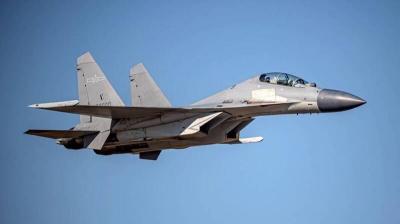
Eight Chinese naval vessels and 24 military aircraft were detected crossing the median line of the Taiwan Strait between 6am yesterday and 6am today, the Ministry of National Defense said this morning. The aircraft entered Taiwan’s northern, central, southwestern and eastern air defense identification zones, the ministry said. The armed forces responded with mission aircraft, naval vessels and shore-based missile systems to closely monitor the situation, it added. Eight naval vessels, one official ship and 36 aircraft sorties were spotted in total, the ministry said.
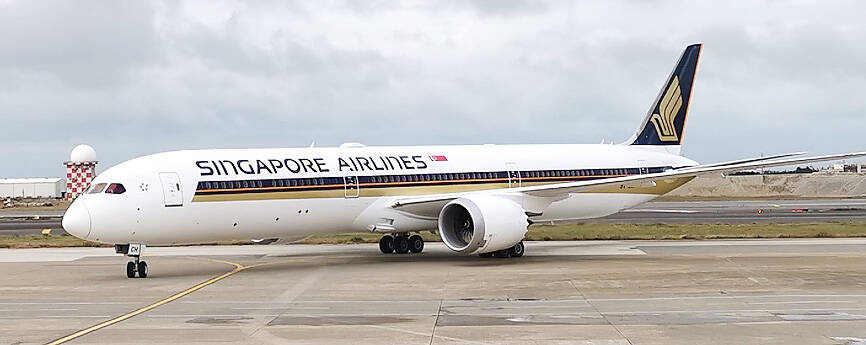
INCREASED CAPACITY: The flights on Mondays, Wednesdays, Fridays and Sundays would leave Singapore in the morning and Taipei in the afternoon Singapore Airlines is adding four supplementary flights to Taipei per week until May to meet increased tourist and business travel demand, the carrier said on Friday. The addition would raise the number of weekly flights it operates to Taipei to 18, Singapore Airlines Taiwan general manager Timothy Ouyang (歐陽漢源) said. The airline has recorded a steady rise in tourist and business travel to and from Taipei, and aims to provide more flexible travel arrangements for passengers, said Ouyang, who assumed the post in July last year. From now until Saturday next week, four additional flights would depart from Singapore on Monday, Wednesday, Friday
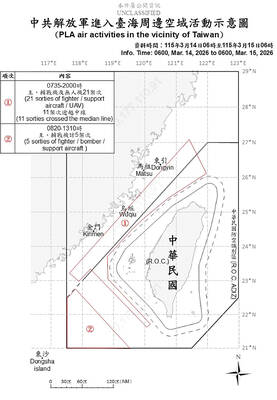
The Ministry of National Defense yesterday reported the return of large-scale Chinese air force activities after their unexplained absence for more than two weeks, which had prompted speculation regarding Beijing’s motives. China usually sends fighter jets, drones and other military aircraft around the nation on a daily basis. Interruptions to such routine are generally caused by bad weather. The Ministry of National Defense said it had detected 26 Chinese military aircraft in the Taiwan Strait over the previous 24 hours. It last reported that many aircraft on Feb. 25, when it spotted 30 aircraft, saying Beijing was carrying out another “joint combat
The Ministry of Foreign Affairs (MOFA) today said that if South Korea does not reply appropriately to its request to correct Taiwan’s name on its e-Arrival card system before March 31, it would take corresponding measures to alter how South Korea is labeled on the online Taiwan Arrival Card system. South Korea’s e-Arrival card system lists Taiwan as “China (Taiwan)” in the “point of departure” and “next destination” fields. The ministry said that it changed the nationality for South Koreans on Taiwan’s Alien Resident Certificates from “Korea” to “South Korea” on March 1, in a gesture of goodwill and based on the


 RSS
RSS