


Wearing traditional Aboriginal clothing and bands bearing the word "dignity," hundreds of Aborigines from across the country yesterday staged a demonstration in front of National Taiwan Democracy Memorial Hall and marched to the Presidential Office, demanding greater protection of their rights.
"We are humble and peaceful people, but if anyone insults our dignity, we will not hesitate to voice our discontent," Gui Giling, chairman of the Medical Association for Indigenous People of Taiwan and a member of the Rukai and Paiwan tribes, told the crowd, referring to an incident during a hunting festival in Taitung County last year.
On Dec. 31, several Puyuma hunters participating in the Grand Hunters' Festival -- an event that the county government had been informed of and had approved -- were chased down and body-searched by the police during the night.
The action drew protests from members of the Puyuma tribe, but the police said the search was justified as the hunters had wandered outside of their traditional hunting grounds.
In response, Aboriginal groups from across the country, began to coordinate a protest, saying the police search violated Aboriginal rights.
On Feb. 28, the groups launched a "sacred item relay" walk, starting in Katatipul community, Zhiben Township (知本), in Taitung County. Members of the community walked to Pingtung carrying a traditional Puyuma warrior's spear and a bamboo tube with soil from the community's lands.
Once in Pingtung, members of the Paiwan tribe took over the spear, added soil from their lands to the tube and walked on.
After Pingtung, the relay made similar stops in a Tsou village in Chiayi County, a Thao community in Nantou County, a Saisiat village in Miaoli County and the Atayal town of Smangus in Hsinchu County before reaching their final stop at Sijhou Aboriginal Community in Sindian (
Leaders carried the two items during yesterday's march.
"The injustice suffered by the people of the Katatipol community wasn't an isolated incident. Similar incidents happen in all Aboriginal communities across the country. I'm glad to see representatives from all the tribes here today," a Puyuma priest from Taitung said. "The government should restore to us our dignity and the right to manage our traditional domains and should apologize."
After each tribe performed their own blessing rituals, the protesters danced and sang in unison at Liberty Square. The group marched to the Presidential Office on Ketagalan Boulevard, where representatives met Vice President Annette Lu (
Eight representatives were escorted by two files of Paiwan and Puyuma guards dressed in full warrior regalia and holding spears and wooden shields with carved totems.
At the entrance to the Presidential Office, the eight representatives took off their hunting knives and entered, while their guards waited outside.
Sakinu Tepiq, one of the representatives, explained the significance of the formalities, which he said were traditionally employed when leaders of one village held talks with another community.
"The government promised us a quasi-nation-to-nation status, so we're treating the government as our equals," he said.
After an hour's talk, the negotiators returned with a statement from Lu, saying that President Chen Shui-bian (
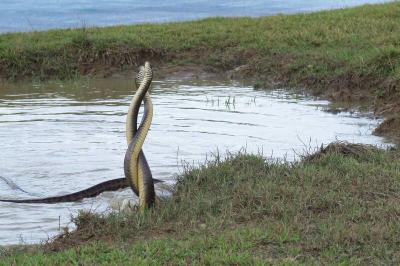
Kenting National Park service technician Yang Jien-fon (楊政峰) won a silver award in World Grand Prix Photography Awards Spring Season for his photograph of two male rat snakes intertwined in combat. Yang’s colleagues at Kenting National Park said he is a master of nature photography who has been held back by his job in civil service. The awards accept entries in all four seasons across six categories: architectural and urban photography, black-and-white and fine art photography, commercial and fashion photography, documentary and people photography, nature and experimental photography, and mobile photography. Awards are ranked according to scores and divided into platinum, gold and

More than half of the bamboo vipers captured in Tainan in the past few years were found in the city’s Sinhua District (新化), while other districts had smaller catches or none at all. Every year, Tainan captures about 6,000 snakes which have made their way into people’s homes. Of the six major venomous snakes in Taiwan, the cobra, the many-banded krait, the brown-spotted pit viper and the bamboo viper are the most frequently captured. The high concentration of bamboo vipers captured in Sinhua District is puzzling. Tainan Agriculture Bureau Forestry and Nature Conservation Division head Chu Chien-ming (朱健明) earlier this week said that the

The Chinese Nationalist Party (KMT) caucus yesterday said it opposes the introduction of migrant workers from India until a mechanism is in place to prevent workers from absconding. Minister of Labor Hung Sun-han (洪申翰) on Thursday told the Legislative Yuan that the first group of migrant workers from India could be introduced as early as this year, as part of a government program. The caucus’ opposition to the policy is based on the assessment that “the risk is too high,” KMT caucus secretary-general Lin Pei-hsiang (林沛祥) said. Taiwan has a serious and long-standing problem of migrant workers absconding from their contracts, indicating that

SPACE VETERAN: Kjell N. Lindgren, who helps lead NASA’s human spaceflight missions, has been on two expeditions on the ISS and has spent 311 days in space Taiwan-born US astronaut Kjell N. Lindgren is to visit Taiwan to promote technological partnerships through one of the programs organized by the US for its 250th national anniversary. Lindgren would be in Taiwan from Tuesday to Saturday next week as part of the US Bureau of Educational and Cultural Affairs’ US Speaker Program, organized to celebrate the 250th anniversary of the signing of the Declaration of Independence, the American Institute in Taiwan (AIT) said in a statement yesterday. Lindgren plans to engage with key leaders across the nation “to advance cutting-edge technological partnerships and inspire the next generation of scientists and engineers,”


 RSS
RSS