


Democratic Progressive Party (DPP) presidential candidate Frank Hsieh (謝長廷) criticized Chinese Nationalist Party (KMT) rival Ma Ying-jeou (馬英九) for inconsistency after Ma denied ever proposing a "cross-strait common market" and then saying that he would recognize Chinese educational credentials.
Election platforms are a serious matter and should be well thought out, Hsieh told a press conference at his campaign headquarters yesterday morning. Ma should not dodge or deny platform planks that he proposed under pressure, Hsieh said.
"Instead of defending his own platforms or debating them with his challengers, he denies them," Hsieh said.
"This is irresponsible and careless. How does he expect the public to trust him? The public will be the judge of his behavior," Hsieh said.
Hsieh said the "cross-strait common market" is more than just a platform, it was "contract" endorsed by Ma. When Ma became KMT chairman on July 17, 2005, he wrote a letter to Chinese President Hu Jintao (
Lien and Hu had agreed in April 2005 to prioritize discussion of a "cross-strait common market"after Taiwan and China resumed bilateral negotiations.
In his letter, Ma expressed the hope of seeing the KMT and the Chinese Communist Party aggressively push exchanges between the two parties and work for the implementation of the Lien-Hu agreement, Hsieh said.
He also slammed Ma's plan to recognize Chinese educational credentials.
Ma denied during their televised debate that he would recognize degrees offered by Chinese educational institutions, but later said that he would "conditionally" support recognition although he would be against letting those with Chinese credentials take national examinations for professional licenses, Hsieh said.
However, Ma was quoted by the Liberty Times (the Taipei Times' sister paper) on Aug. 21, 2004, as saying that "to recognize Chinese educational credentials is to truly love Taiwan," Hsieh said, showing a copy of the newspaper article.
Hsieh said he would like to know exactly what Ma meant by recognizing Chinese educational credentials.
Campaigning at Taipei's Longshan Temple, Hsieh said that if he was elected, he could act as a check on the power of the KMT.
He also said that he could appoint a KMT member as premier.
Hsieh continued to attack what he said was Ma's inconsistency, saying a presidential candidate's platforms are like a restaurant menu and a fancy-looking menu does not necessarily guarantee delicious food on the table.
He also said Ma had sabotaged the police department's promotion system when he was Taipei mayor by keeping the incumbent city police chief in that job for eight to nine years.
Hsieh said Ma had broken the law by preventing law enforcement officers at the central and local governments from exchanging positions.
Meanwhile, KMT vice presidential candidate Vincent Siew (
During a campaign event at KMT headquarters, Siew said Hsieh's labelling the "cross-strait common market" a "one China" market was part of the DPP's smear tactics.
He said economic issues should not be "politicized."
Siew also said he would hold a major press conference tomorrow to elaborate on his proposal so that the public will understand that a "cross-strait common market" would "invigorate" the nation's economy.
Additional reporting by Flora Wang

GOOD DIPLOMACY: The KMT has maintained close contact with representative offices in Taiwan and had extended an invitation to Russia as well, the KMT said The Chinese Nationalist Party (KMT) would “appropriately handle” the fallout from an invitation it had extended to Russia’s representative to Taipei to attend its international banquet last month, KMT Chairman Eric Chu (朱立倫) said yesterday. US and EU representatives in Taiwan boycotted the event, and only later agreed to attend after the KMT rescinded its invitation to the Russian representative. The KMT has maintained long-term close contact with all representative offices and embassies in Taiwan, and had extended the invitation as a practice of good diplomacy, Chu said. “Some EU countries have expressed their opinions of Russia, and the KMT respects that,” he
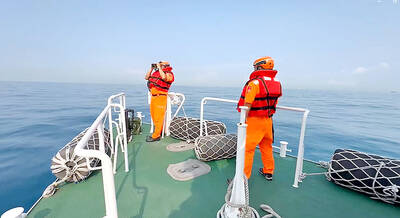
An increase in Taiwanese boats using China-made automatic identification systems (AIS) could confuse coast guards patrolling waters off Taiwan’s southwest coast and become a loophole in the national security system, sources familiar with the matter said yesterday. Taiwan ADIZ, a Facebook page created by enthusiasts who monitor Chinese military activities in airspace and waters off Taiwan’s southwest coast, on Saturday identified what seemed to be a Chinese cargo container ship near Penghu County. The Coast Guard Administration went to the location after receiving the tip and found that it was a Taiwanese yacht, which had a Chinese AIS installed. Similar instances had also

CHANGES: After-school tutoring periods, extracurricular activities during vacations or after-school study periods must not be used to teach new material, the ministry said The Ministry of Education yesterday announced new rules that would ban giving tests to most elementary and junior-high school students during morning study and afternoon rest periods. The amendments to regulations governing public education at elementary schools and junior high schools are to be implemented on Aug. 1. The revised rules stipulate that schools are forbidden to use after-school tutoring periods, extracurricular activities during summer or winter vacation or after-school study periods to teach new course material. In addition, schools would be prohibited from giving tests or exams to students in grades one to eight during morning study and afternoon break periods, the
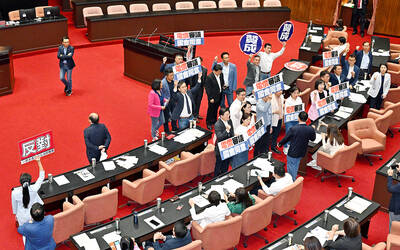
AMENDMENT: Contact with certain individuals in China, Hong Kong and Macau must be reported, and failure to comply could result in a prison sentence, the proposal stated The Chinese Nationalist Party (KMT) and the Taiwan People’s Party (TPP) yesterday voted against a proposed bill by Democratic Progressive Party (DPP) lawmakers that would require elected officials to seek approval before visiting China. DPP Legislator Puma Shen’s (沈伯洋) proposed amendments to the Act Governing Relations Between the People of the Taiwan Area and the Mainland Area (臺灣地區與大陸地區人民關係條例), stipulate that contact with certain individuals in China, Hong Kong and Macau should be reported, while failure to comply would be punishable by prison sentences of up to three years, alongside a fine of NT$10 million (US$309,041). Fifty-six voted with the TPP in opposition


 RSS
RSS