


Officials from the Council for Cultural Affairs urged the public yesterday to help protect 2,000-year-old stone carvings and sculptures located in the Central Mountain Range that have been damaged recently.
Officials, who visited the site with members of the Kaohsiung County Government last week to determine if it should be designated a national historic site, confirmed that the stone carvings had been damaged by fire and an industrial adhesive, which they said may have been used in the process of making stone rubbings.
The officials believe the fires were lit to burn away a 3.3cm-thick layer of moss covering the carvings, located in a remote area of Maolin Township (
Tsao Chia-wen (曹家文), head of a preparatory committee for the council's planned Cultural Assets Management Department, said he and his colleagues could not be certain if the damage was caused by members of an academic organization as reported by a media outlet a day earlier.
Tsao said that instructions and warning signs would be posted at the entrance of the Wanshan mountain area to remind people of the archeological and cultural value of the stone carvings and the importance of protecting them.
The series of carvings were first discovered by mountain climbers in 1972, and are believed to be the work of the Rukai, one of the nation's 12 indigenous groups, up to 2,000 years ago.
The 14 groups of carvings include images of human faces, geometric patterns composed of circles and hundred-pacer snakes, a totem of the Rukai people. They are seen as treasures of Aboriginal culture and history.
The Kaohsiung County government designated the area as a historic site in 2006, but Tsao was unsure yesterday if the site would be upgraded to a national historic site.
He said a committee established to consider the matter would meet again soon to discuss the site's archeological, ethnic, artistic and architectural significance.
A resolution on the site's status is expected to be made late next month, Tsao said.
The council's Cultural Assets Management Department preparatory office said organizations or individuals who are interested in viewing or taking impressions of the Wanshan Aboriginal stone carvings should first apply with the Kaohsiung County Government to obtain a permit.
The site can only be reached by crossing mountains and rivers on foot.
Those who damage artifacts face fines up to NT$1 million (US$33,000) or jail terms of up to five years, the officials said.

A group of Taiwanese-American and Tibetan-American students at Harvard University on Saturday disrupted Chinese Ambassador to the US Xie Feng’s (謝鋒) speech at the school, accusing him of being responsible for numerous human rights violations. Four students — two Taiwanese Americans and two from Tibet — held up banners inside a conference hall where Xie was delivering a speech at the opening ceremony of the Harvard Kennedy School China Conference 2024. In a video clip provided by the Coalition of Students Resisting the CCP (Chinese Communist Party), Taiwanese-American Cosette Wu (吳亭樺) and Tibetan-American Tsering Yangchen are seen holding banners that together read:

UNAWARE: Many people sit for long hours every day and eat unhealthy foods, putting them at greater risk of developing one of the ‘three highs,’ an expert said More than 30 percent of adults aged 40 or older who underwent a government-funded health exam were unaware they had at least one of the “three highs” — high blood pressure, high blood lipids or high blood sugar, the Health Promotion Administration (HPA) said yesterday. Among adults aged 40 or older who said they did not have any of the “three highs” before taking the health exam, more than 30 percent were found to have at least one of them, Adult Preventive Health Examination Service data from 2022 showed. People with long-term medical conditions such as hypertension or diabetes usually do not
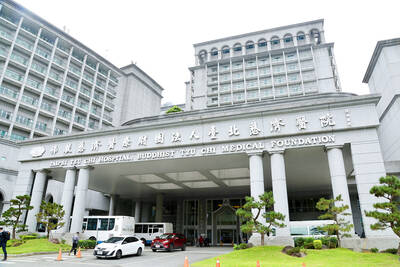
POLICE INVESTIGATING: A man said he quit his job as a nurse at Taipei Tzu Chi Hospital as he had been ‘disgusted’ by the behavior of his colleagues A man yesterday morning wrote online that he had witnessed nurses taking photographs and touching anesthetized patients inappropriately in Taipei Tzu Chi Hospital’s operating theaters. The man surnamed Huang (黃) wrote on the Professional Technology Temple bulletin board that during his six-month stint as a nurse at the hospital, he had seen nurses taking pictures of patients, including of their private parts, after they were anesthetized. Some nurses had also touched patients inappropriately and children were among those photographed, he said. Huang said this “disgusted” him “so much” that “he felt the need to reveal these unethical acts in the operating theater
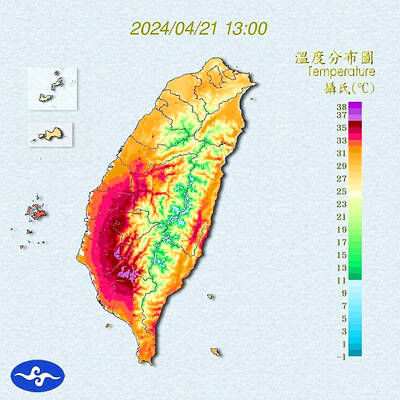
Heat advisories were in effect for nine administrative regions yesterday afternoon as warm southwesterly winds pushed temperatures above 38°C in parts of southern Taiwan, the Central Weather Administration (CWA) said. As of 3:30pm yesterday, Tainan’s Yujing District (玉井) had recorded the day’s highest temperature of 39.7°C, though the measurement will not be included in Taiwan’s official heat records since Yujing is an automatic rather than manually operated weather station, the CWA said. Highs recorded in other areas were 38.7°C in Kaohsiung’s Neimen District (內門), 38.2°C in Chiayi City and 38.1°C in Pingtung’s Sandimen Township (三地門), CWA data showed. The spell of scorching


 RSS
RSS