


The independence advocate Koo Kwan-ming (
In a briefing with several members of the Taiwan Washington press corps, Yang said that of the US$95,000 that several Taiwanese-American organizations, including FAPA, had raised for those ads and others, Koo provided US$40,000, allowing the organizations to exceed their fundraising objectives for the ad campaign.
The ads urged the Bush administration to support Taiwan's entry in the UN and other international organizations such as the WHO and to "trust the people of Taiwan to choose a future of freedom and peace" by supporting Taiwan's upcoming democratic referendum on joining the UN under the name of Taiwan.
Yang said the funding effort well exceeded the groups' expectation of raising between US$70,000 and US$80,000, allowing the groups to abandon earlier plans to advertise in the Washington Times and the Liberty Times (the Taipei Times' sister publication) and use the money instead to place the ad in the more expensive New York Times.
The Post ad cost US$24,000 while that in the New York Times cost US$30,000, he said.
With the extra money, the group intends to place ads, at some time in the near future, in the Washington Times and the Liberty Times, Yang said.
Koo was "very willing and generous" to give the money, but expressed the wish that his name not be used in the ads. He also had "no input" on the content of the ads, Yang said.
Aside from Koo, each organization contributed to the campaign and was named in the ads. A number of individuals whose names did not appear also contributed, he said. Depending on their size, the organizations contributed between US$300 and US$2,000.
Despite the critical tone of the ads vis-a-vis the Bush administration, FAPA gave officials at the US Department of State and the American Institute in Taiwan (AIT) a preview of the ads, Yang told the Taipei Times.
"The officials were very polite and receptive and did not try to discourage us from proceeding with the ads," he said.
In other matters, Yang said FAPA was pondering how its mission in the US capital would have to change should Chinese Nationalist Party (KMT) candidate Ma Ying-jeou (馬英九) be elected president next month, Yang said.
The Washington-based organization, which has intimate ties with the Democratic Progressive Party (DPP) and President Chen Shui-bian (陳水扁), is the leading and most effective Taiwanese organization lobbying US Congress to pass legislation that is favorable to Taiwan and enlisting members of Congress to be sympathetic to the Taiwanese cause.
It was also instrumental in the creation of the House-based Congressional Taiwan Caucus and its Senate Taiwan Caucus counterpart.
"We feel that FAPA's strategy may have to be adjusted depending on the outcome of the election. However, we will not waver from FAPA's principal goal, which is to seek international support for the right of the people of Taiwan to establish an independent and democratic country," Yang said.
If, for instance, the next president advocated unification with or annexation by China, FAPA's "collaboration with the Taiwan government on certain things like this particular issue would have to be adjusted. But we will not stop advocating Taiwan as a full equal member in the international community," he said.
During a meeting of the group's standing committee last month, the association came to no firm conclusions, but decided "it would be important to continue to emphasize that the protection of Taiwan is in the US national interest" and that "it is important for the US that it does not `lose' Taiwan," Yang said.
In legislative matters, Yang said that this year FAPA had two main priorities regarding the passage of bills by Congress.
The first, which will be taken up by the House Foreign Affairs Committee today, reaffirms US support for Taiwan's democracy and urges the US and other countries to send observers to Taiwan's presidential election as a show of support.
The other, introduced in the House in March last year, but which has yet to be considered by the Foreign Affairs Committee, would require that future AIT representatives receive full Senate vetting and approval to ensure that the representatives are fully qualified and to subject the nomination to the full scrutiny of congressional debate on Taiwan policy.
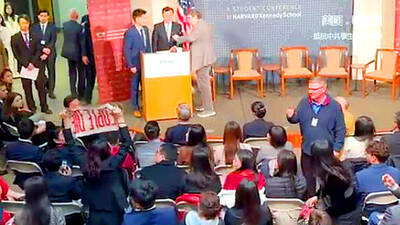
A group of Taiwanese-American and Tibetan-American students at Harvard University on Saturday disrupted Chinese Ambassador to the US Xie Feng’s (謝鋒) speech at the school, accusing him of being responsible for numerous human rights violations. Four students — two Taiwanese Americans and two from Tibet — held up banners inside a conference hall where Xie was delivering a speech at the opening ceremony of the Harvard Kennedy School China Conference 2024. In a video clip provided by the Coalition of Students Resisting the CCP (Chinese Communist Party), Taiwanese-American Cosette Wu (吳亭樺) and Tibetan-American Tsering Yangchen are seen holding banners that together read:

UNAWARE: Many people sit for long hours every day and eat unhealthy foods, putting them at greater risk of developing one of the ‘three highs,’ an expert said More than 30 percent of adults aged 40 or older who underwent a government-funded health exam were unaware they had at least one of the “three highs” — high blood pressure, high blood lipids or high blood sugar, the Health Promotion Administration (HPA) said yesterday. Among adults aged 40 or older who said they did not have any of the “three highs” before taking the health exam, more than 30 percent were found to have at least one of them, Adult Preventive Health Examination Service data from 2022 showed. People with long-term medical conditions such as hypertension or diabetes usually do not
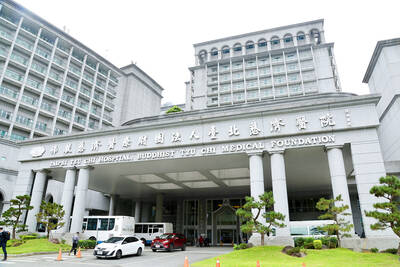
POLICE INVESTIGATING: A man said he quit his job as a nurse at Taipei Tzu Chi Hospital as he had been ‘disgusted’ by the behavior of his colleagues A man yesterday morning wrote online that he had witnessed nurses taking photographs and touching anesthetized patients inappropriately in Taipei Tzu Chi Hospital’s operating theaters. The man surnamed Huang (黃) wrote on the Professional Technology Temple bulletin board that during his six-month stint as a nurse at the hospital, he had seen nurses taking pictures of patients, including of their private parts, after they were anesthetized. Some nurses had also touched patients inappropriately and children were among those photographed, he said. Huang said this “disgusted” him “so much” that “he felt the need to reveal these unethical acts in the operating theater
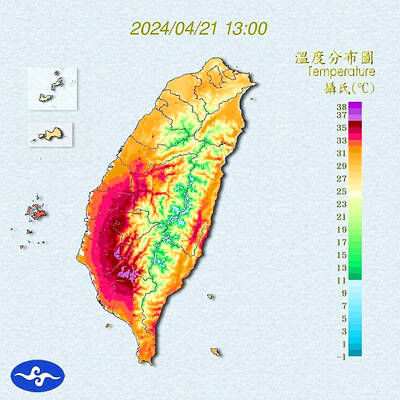
Heat advisories were in effect for nine administrative regions yesterday afternoon as warm southwesterly winds pushed temperatures above 38°C in parts of southern Taiwan, the Central Weather Administration (CWA) said. As of 3:30pm yesterday, Tainan’s Yujing District (玉井) had recorded the day’s highest temperature of 39.7°C, though the measurement will not be included in Taiwan’s official heat records since Yujing is an automatic rather than manually operated weather station, the CWA said. Highs recorded in other areas were 38.7°C in Kaohsiung’s Neimen District (內門), 38.2°C in Chiayi City and 38.1°C in Pingtung’s Sandimen Township (三地門), CWA data showed. The spell of scorching


 RSS
RSS